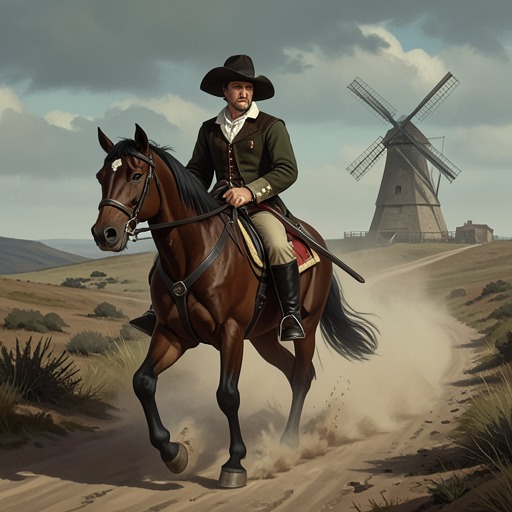
The Battle with the Windmills
Don QuixoteThe Battle with the Windmills is an early, defining episode in which Don Quixote’s determination to perform knightly deeds transforms ordinary windmills into monstrous opponents. Sancho Panza sees what is actually before them and tries to stop the charge, but his master attacks regardless. The windmills’ turning sails break Don Quixote’s lance and cast horse and rider onto the plain; even after the fall, Don Quixote preserves his heroic interpretation by blaming enchantment. The episode makes the distance between his chivalric vision and Sancho’s practical judgment visible in action, while showing how little defeat alters his resolve.
The Encounter and Its Misreading
The pair come within sight of thirty or forty windmills on a plain. Don Quixote immediately recasts them as more than thirty giants, announces that he intends to fight and kill them, and imagines their spoils as the beginning of his fortune. His language gives the encounter a moral as well as a material purpose: he calls it righteous warfare and presents the destruction of the supposed giants as a service to God. Before any blow is struck, he has made the windmills into enemies and the attack into a mission.
Sancho Panza answers with a practical explanation. The apparent arms are sails, he points out, and their movement in the wind turns the millstone. Don Quixote rejects this correction as evidence that Sancho lacks experience of adventures, then offers him the choice of leaving or praying while he fights. The contrast is not simply between two descriptions of the same scene: Don Quixote treats his own interpretation as a test of courage, whereas Sancho tries to make the visible evidence count. The more plainly Sancho names the windmills, the more confidently Don Quixote insists upon giants.
The Charge and the Fall
Ignoring Sancho’s cries, Don Quixote spurs Rocinante toward the first windmill. He challenges the supposed giants to flee, then sees their sails begin to turn in a slight breeze and compares their many arms to those of Briareus. He commends himself to Dulcinea of Toboso, asks for her support in the peril, and lowers his lance behind his buckler. The gestures belong to the ritual of a knight going into combat; their solemnity intensifies the mismatch between the imagined danger and the actual machinery.
Don Quixote drives his lance-point into a sail. The wind catches it and turns it with such force that the lance shatters; horse and rider are swept along and roll across the plain. The intended victory becomes an immediate physical defeat. Sancho hastens to help and finds Don Quixote unable to move from the shock of the fall with Rocinante. The damage extends beyond the broken weapon: when Sancho helps his master rise, Rocinante’s shoulder is half out, and Don Quixote appears crooked from the shaking of the fall.
Explanation and Aftermath
Sancho recalls that he had warned Don Quixote the objects were only windmills, and says that only someone with something of the same kind in his head could have mistaken them. Don Quixote does not accept the correction. He answers that the fortunes of war are liable to frequent changes, then attributes the transformation to Sage Friston, the enchanter he already regards as his enemy for carrying off his study and books. In this account, the windmills were giants until magic changed them into mills to rob him of the glory of defeating them. The explanation absorbs the contradiction without requiring him to abandon the adventure’s original premise.
Sancho helps Don Quixote back onto Rocinante. Don Quixote is grieved by the loss of his lance, but turns at once to a precedent from chivalric history: Diego Perez de Vargas, he recalls, broke his sword in battle, tore a heavy branch from an oak, and used it so effectively against the Moors that he acquired the name Machuca. Don Quixote resolves to find a similar branch and perform deeds that Sancho will be fortunate to witness. The broken lance therefore does not end his imagined campaign; it prompts a new plan for continuing it.
Narrative Significance
The episode’s action is driven by the gap between what Don Quixote expects and what happens. His charge begins as a promised triumph, but the turning sail reverses that expectation in an instant, leaving him injured, disarmed, and dependent on Sancho’s help. Yet the reversal changes his explanation rather than his purpose. By invoking Sage Friston, he converts physical evidence against his belief into further evidence of an enemy’s interference, preserving the possibility of future glory.
Sancho’s role likewise combines correction with care. He warns Don Quixote before the attack, states what the windmills are, and afterward helps him rise and remount despite the master’s refusal to accept his judgment. Their competing readings persist as they resume the road to Puerto Lapice, which Don Quixote chooses because he expects a busy thoroughfare to provide abundant adventures. The episode thus establishes a recurring pattern: Sancho registers immediate circumstances and consequences, while Don Quixote interprets them through chivalric expectation; when events defeat his expectation, he finds another way to continue.