The Duke and Duchess’s Staged Adventures
Don QuixoteThe Duke and Duchess’s Staged Adventures are a sequence of aristocratic practical jokes designed to look like chivalric adventures to Don Quixote and Sancho Panza. The hosts draw on their knowledge of the First Part, their fondness for books of chivalry, and Sancho’s own fabricated account of Dulcinea del Toboso’s enchantment. Their entertainment depends on making performance feel like proof: servants, costumes, a hunting party, and a night-time spectacle are arranged to fit the knight’s expectations, while the people staging the marvels are themselves caught up in their force.
The Hosts and Their Plan
The scheme begins with the arrival of Don Quixote and Sancho at the estate. Sancho reports The Duchess’s welcome, praising her beauty, gaiety, and courtesy in his rustic manner. The Duke and The Duchess have both read the First Part and know of Don Quixote’s delusion. They await him eagerly, intending to humor him, agree with what he says, and receive him with the ceremonies of knight-errantry. Their fondness for the same books that shape his imagined world gives them a ready-made theatrical language for the jokes they plan.
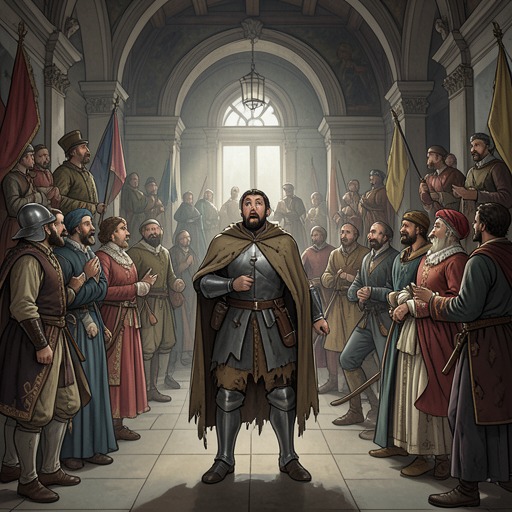
The welcome is not entirely under anyone’s control. As Don Quixote approaches, Sancho tries to hold his stirrup but catches his foot in a rope of Dapple’s pack-saddle and is left hanging, face and breast toward the ground. Expecting his squire to assist him, Don Quixote dismounts without the stirrup being held; his poorly girthed saddle comes down with him. The Duke sends huntsmen to help the fallen knight and squire. Shaken and limping, Don Quixote advances to kneel before the noble pair, but The Duke dismounts and embraces him instead. The comic mishap briefly interrupts the formal welcome, while also establishing the physical awkwardness beneath the visitors’ ceremonious roles.
The hosts’ amusement grows through conversation. The Duchess delights in Sancho’s proverbs, even when Don Quixote rebukes him for using them incoherently. Sancho also jokes that he has seen asses become governors and would have no difficulty taking his own along to a governorship. After dismissing him to sleep, The Duchess recounts their conversation to The Duke; together they plot a joke in the style of knight-errantry and prepare several of their servants to carry it out. The prank is collaborative theatre, not a solitary deception: its success depends on coordination between the noble hosts and their household.
The Hunt as a Chivalric Stage
For their principal scheme, The Duke and The Duchess use Don Quixote’s account of the Cave of Montesinos as the basis for a new apparent adventure. The Duchess is especially astonished that Sancho believes Dulcinea has truly been enchanted, although Sancho himself had invented the trick that produced this belief. The hosts turn that contradiction into an opportunity: their performance will treat the supposed enchantment as a real problem requiring a chivalric solution.
Six days after preparing their servants, they take Don Quixote and Sancho hunting with a retinue of huntsmen and beaters. They offer both men hunting clothes of fine green cloth. Don Quixote declines his outfit, saying he must soon return to the hard pursuit of arms and cannot carry wardrobes or stores; Sancho accepts his and plans to sell it at the first opportunity. He refuses an offered horse and rides Dapple among the huntsmen. Don Quixote, by contrast, courteously holds the rein of The Duchess’s palfrey. These small differences preserve the pair’s familiar priorities even as the estate supplies them with a carefully arranged pageant.
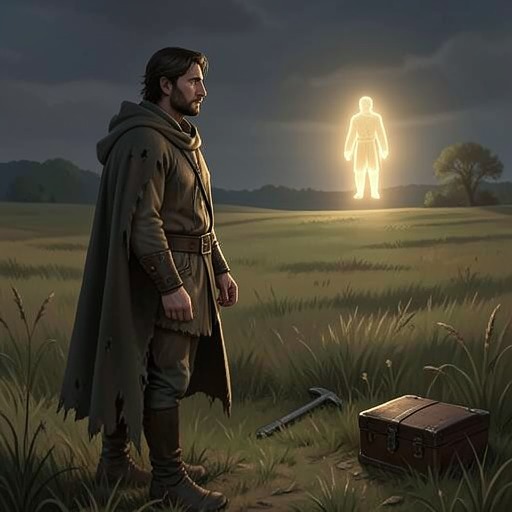
The hunt proceeds in a wood between two high mountains. The party spreads out among posts, ambushes, and paths, while the noise of hounds and horns fills the wood. The Duchess takes a sharp boar-spear and stations herself where wild boars are accustomed to pass. As day gives way to night, midsummer haze helps conceal the hosts’ design. The wood then appears to burn on every side, and military instruments sound as though bodies of cavalry are moving through it. The performance shifts from a hunting excursion to a spectacle of apparent supernatural danger.
The Apparition and Its Meaning
The noise intensifies: horns, clarions, drums, and fifes mingle with repeated battle cries described as Moorish. A postillion dressed as a demon passes before the company, blowing a large hollow horn in place of a bugle. The Duke asks who he is and what troops are passing through the wood. The courier claims to be the devil, says he has come in search of Don Quixote of La Mancha, and announces six troops of enchanters bearing Dulcinea del Toboso on a triumphal car. He further claims that Montesinos accompanies her and that she has come under enchantment to explain how she can be disenchanted.
The supposed revelation is tailored to the story Don Quixote already believes: the Cave of Montesinos supplies a precedent, and Sancho’s false enchantment of Dulcinea becomes the premise for an elaborate public spectacle. Yet the staging does not produce simple, effortless control. The Duke is astonished, The Duchess amazed, Don Quixote wonders, and Sancho trembles; even those who know the cause are frightened by the fire and din. The courier’s claim that he failed to notice Don Quixote standing before him adds comic dissonance to the menacing announcement. In this opening episode, the hosts’ privilege lets them manufacture the forms of marvel, but the confusion and fear those forms provoke show how readily their play exceeds a merely private joke.