The Knight of the White Moon’s Duel with Don Quixote
Don QuixoteThe Knight of the White Moon’s duel with Don Quixote is the decisive defeat that compels Don Quixote to leave the road and return to his village. Staged by Bachelor Samson Carrasco under a new disguise, the encounter turns a challenge about the beauty of Dulcinea del Toboso into a binding condition: Don Quixote must lay aside his arms and adventures for a year. He loses the contest, but not his commitment to Dulcinea or his promise to honor the terms; the victory instead becomes the instrument by which another person tries to end his wandering.
Challenge and Conditions
The encounter begins during one of Don Quixote’s walks along the beach at Barcelona. He is in full armor, as he habitually is, when a knight approaches with a shining moon painted on his shield. Calling himself the Knight of the White Moon, the stranger challenges Don Quixote to acknowledge that his own lady is more beautiful than Dulcinea del Toboso. He presents the challenge as a choice between concession and combat, and attaches a specific consequence to defeat: Don Quixote must put aside his arms, stop seeking adventures, and return to his village for a year, or for whatever longer period the victor may require.
Don Quixote disputes the stranger’s claim without conceding that it is a lie. He reasons that anyone who had seen Dulcinea could not doubt her beauty, and accepts the challenge so that the appointed day’s business will not be delayed. He accepts the stipulated terms but refuses one proposed reward: the transfer to him of the victor’s renown. Don Quixote says that he is content with his own achievements, whatever their worth. The exchange makes the contest about more than physical victory: the question is whether he will preserve his ideal of Dulcinea while submitting to the rules he has accepted.
The Beach Combat
The Viceroy of Barcelona learns that the knights are preparing to fight and hurries to the beach with Don Antonio Moreno and other gentlemen. At first, he suspects the encounter may be a joke arranged by Don Antonio or another local gentleman. The Knight of the White Moon explains that the dispute concerns precedence in beauty and that both combatants have accepted the conditions. The Viceroy cannot establish whether the challenge is a jest, but, seeing that Don Quixote will not be dissuaded and the other knight insists on proceeding, he allows the combat to go forward.
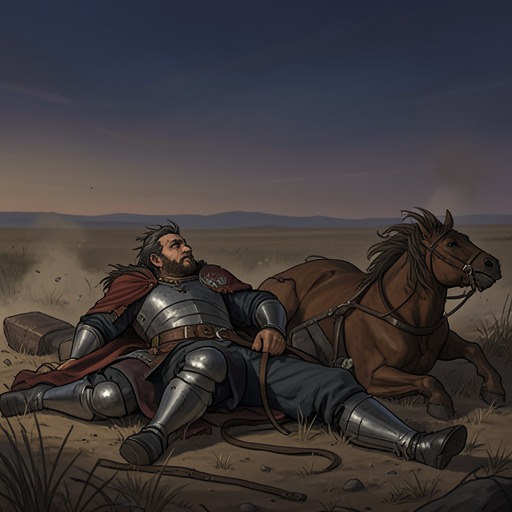
Before the charge, Don Quixote commends himself to heaven and Dulcinea, as he customarily does before a combat. The knights turn their horses at the same moment. The Knight of the White Moon is faster: he meets Don Quixote after covering about two-thirds of the course and strikes with such force that Don Quixote and Rocinante are thrown to the ground. His lance is held high rather than directed at Don Quixote; the contest is won by the impact that unhorses him, not by a wound. The victor places his lance over Don Quixote’s visor and demands that he accept the terms or face the consequence of refusing them.
Bruised and stunned, Don Quixote does not withdraw his claim for Dulcinea. He maintains that she is the fairest woman in the world and that his defeat cannot make that truth false. He offers his life rather than let the defeat be treated as proof against her beauty. The Knight of the White Moon refuses to kill him and clarifies the limit of his demand: Don Quixote must retire to his village for a year, but Dulcinea’s fame is to remain undiminished. Don Quixote agrees to observe the rest of the conditions so long as nothing prejudicial to Dulcinea is required of him. The distinction allows him to surrender his travels without surrendering the conviction that has organized them.
The Disguise Revealed
After the victor rides away, the Viceroy asks Don Antonio to discover his identity. Don Antonio follows him to a lodging in the city, where the knight eventually reveals that he is Bachelor Samson Carrasco, from Don Quixote’s own village. Carrasco explains that he had previously gone out against Don Quixote disguised as the Knight of the Mirrors. His purpose then, as now, was to defeat Don Quixote without harming him and use the victor’s right to send him home for a year, in the hope that quiet and staying in his own house would help him recover.
That earlier plan failed: Don Quixote unhorsed Carrasco, leaving Carrasco defeated, ashamed, and badly bruised. The failure did not end Carrasco’s effort to stop Don Quixote’s travels. He returned under the identity of the Knight of the White Moon, this time winning and securing a condition he believes Don Quixote will obey because Don Quixote takes the laws of knight-errantry seriously. Carrasco asks Don Antonio not to expose him to Don Quixote, so that the plan may succeed. The revelation changes the meaning of the duel: what appeared to be a stranger’s challenge to Don Quixote’s devotion was also a deliberate attempt by an acquaintance to bring him home.
Defeat and Its Consequences
Those present raise Don Quixote and carry him back into the city in a chair sent by the Viceroy. Sancho Panza is deeply dismayed. He fears that Don Quixote is badly hurt, that Rocinante may be permanently crippled, and that his master’s defeat has extinguished the prospects attached to the promises recently made to him. He even wonders whether the fall might end Don Quixote’s madness, but cannot take comfort in that possibility amid the immediate losses he imagines. The scene sets Sancho’s practical grief against the formal terms of the contest: the year of retirement affects not only Don Quixote’s identity as a knight-errant but also the hopes Sancho has placed in their shared journey.
As he later leaves Barcelona, Don Quixote looks back toward the place where he fell and understands the defeat as the end of his happiness and the dimming of his former achievements. He does not, however, treat the outcome as permission to break his word. He reflects that his own confidence and lack of prudence helped bring about the loss, including his failure to reckon with the disparity between Rocinante’s strength and the opposing horse. The duel therefore closes one phase of his life through both an external defeat and his recognition that he chose to risk it. Its central reversal is exact: the Knight of the White Moon can compel Don Quixote’s return, but he cannot make Don Quixote renounce Dulcinea.