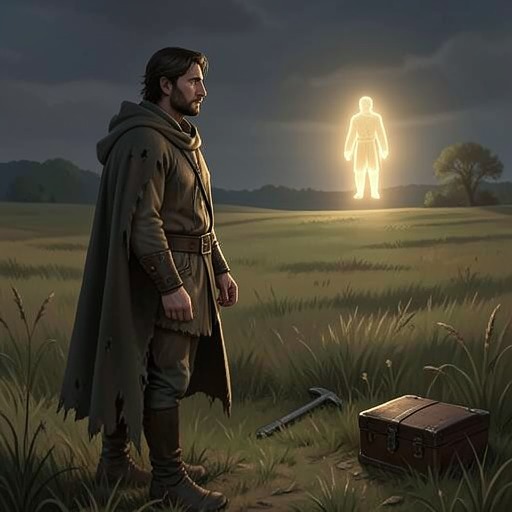
The Mock Disenchantment of Dulcinea
Don QuixoteThe Mock Disenchantment of Dulcinea is a theatrical deception devised by The Duke and The Duchess, but its joke creates a consequential bargain: Sancho Panza must undertake 3,300 lashes for Dulcinea del Toboso to be disenchanted. A nocturnal woodland pageant lends invented enchantment the appearance of solemn authority; Sancho’s resistance, and his eventual consent on his own terms, become the scene’s real action. The spectacle does not show the task completed or Dulcinea restored. Instead, it establishes a condition whose fulfillment is deferred.
The Pageant in the Wood
After a day spent visiting posts and hiding places in the wood, dusk brings a carefully staged disturbance. Fires appear on every side, military instruments sound through the trees, and a postillion dressed as a demon announces the arrival of enchanters bearing Dulcinea in a triumphal car. The Duke, The Duchess, Don Quixote of La Mancha, and Sancho Panza are caught within a spectacle designed to make a trick seem like a supernatural event; even those who know its cause are described as frightened.
The car’s display intensifies the contrast between ceremony and deception. Six grey mules draw it, white-clad figures carry candles, and a veiled woman sits on a raised throne. Beside her stands a figure who reveals a death-like appearance and identifies himself as Merlin. In this role, he claims to have learned of Dulcinea’s enchantment and to have come with its remedy. The elaborate procession supplies visible signs of importance, while the announcement converts those signs into a supposed magical rule.
The Price of Disenchantment
Merlin declares that Dulcinea can regain her former beauty only if Sancho gives himself 3,300 lashes on his bare buttocks. Don Quixote responds as though the decree were binding and threatens to inflict twice that number himself. Merlin immediately limits the threat: the lashes must be given voluntarily, at a time Sancho chooses, though another person may administer half the punishment. The distinction between consent and force is central to the scene’s mechanism. Don Quixote may command, but even within the pageant’s invented rules he cannot make the required offering count by compulsion.
Sancho rejects the proposed remedy and questions why his suffering should have anything to do with Dulcinea’s condition. He also objects to being asked without reward or courtesy, invoking his status as a governor as well as a squire. The Duke then makes the bargain sharper: unless Sancho agrees to be whipped, he will not receive the government. The demand for a supposedly charitable act is thus tied to an earthly reward, and the performance’s moral pressure comes not only from Merlin’s prophecy but from the Duke’s control over Sancho’s advancement.
Consent on Sancho’s Terms
Faced with the ultimatum, Sancho asks whether he can have two days to think. Merlin refuses any delay and presents the choice as immediate: Dulcinea will remain in her peasant form or be carried to the Elysian fields to wait until the required number of lashes is complete. The supposed deadline makes postponement seem to endanger Dulcinea, even though the penance itself has no fixed schedule. The scene therefore presses Sancho to consent now while leaving him latitude over when he will act.
Sancho finally accepts, but negotiates the conditions. He will give himself the 3,300 lashes whenever he chooses, without specified days or times; they need not draw blood, and lashes he considers ineffective are to count. He asks Merlin to keep the tally and agrees to try to discharge the debt as quickly as he can. Merlin promises that Dulcinea will be disenchanted the instant the full number is reached and will seek out and reward Sancho. The acceptance changes the scene’s outcome without bringing the promised transformation about: the penance is agreed to, not performed, and its timing remains in Sancho’s hands.
The Joke’s Consequences
When Sancho gives his consent, the trumpets sound again and muskets are fired. Don Quixote embraces and kisses him repeatedly on the forehead and cheeks, while The Duke and The Duchess show satisfaction; the car moves on, and the woman presented as Dulcinea bows to them and curtseys to Sancho. At dawn, the company returns to the castle. The Duke and The Duchess are pleased with the success of their plan and resolve to continue the joke, making clear that the pageant belongs to an ongoing campaign of staged adventures rather than to an independent supernatural intervention.
The scene makes a bodily price the test of loyalty and compassion, but keeps its comic force in the distance between solemn ritual and manipulated performance. Merlin’s pronouncement gives the prank a rule-bound shape; Sancho’s bargaining exposes how that rule can be negotiated, even as the Duke turns the governorship into leverage. Don Quixote treats the spectacle as real, while the narrative identifies the satisfaction of his hosts as satisfaction in a successful joke. The episode’s decisive result is therefore not Dulcinea’s disenchantment but Sancho’s agreement to a future ordeal, secured through a mixture of theatrical authority, emotional pressure, and promised reward.