The Staged Disenchantment of Dulcinea
Don QuixoteThe Staged Disenchantment of Dulcinea turns a supposed magical remedy into a prolonged courtly prank: the Duke and Duchess present Sancho Panza with a demand that links his voluntary penance to Dulcinea del Toboso’s return to her former appearance. The spectacle makes Sancho’s body the proposed instrument of a solution to someone else’s enchantment, while his resistance and bargaining give him a measure of control over the terms. The episode’s theatrical magic is exposed the next day as a contrivance devised by the household, but its consequences continue beyond the performance.
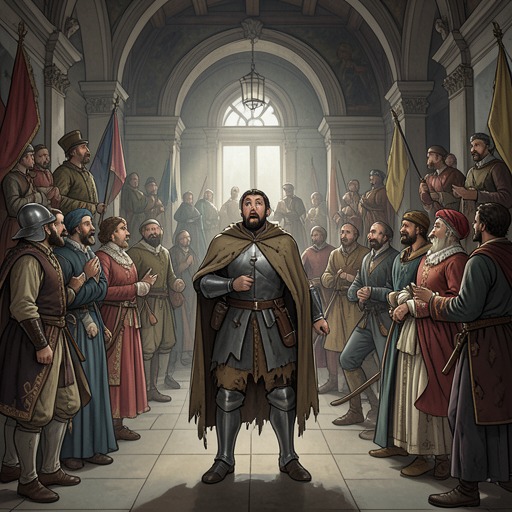
The nocturnal pageant
The scene begins during an outing through the wood. Though it is midsummer, a haze settles after twilight, helping the Duke and Duchess carry out their project. Fires appear around the wood, military instruments sound from several directions, and a courier dressed as a demon passes before the company with a large horn. The noise and sudden illumination unsettle even those who know the commotion has a human cause. The Duke asks the courier who he is and what troops are approaching, allowing the supposed supernatural messenger to deliver the explanation in public.
The courier claims to be seeking Don Quixote of La Mancha and describes six troops of enchanters bringing Dulcinea del Toboso on a triumphal car. He says that she and the Frenchman Montesinos are under enchantment and will explain how she can be released. The Duke points out that the knight is already present, but the courier answers that he had forgotten to recognize him. This comic failure of attention punctures the grand supernatural announcement even as the staged procession continues toward its audience.
The car is drawn by six grey mules with white coverings. Penitents carrying lit tapers accompany it, while a veiled nymph sits on a raised throne in silver fabric embroidered with gold. Beside her stands a figure in a state robe and black veil. When the music stops, the figure reveals a representation of Death and speaks as Merlin. The contrast between formal pageantry and the performer’s deliberately theatrical appearance makes the claim of ancient magical authority part of the entertainment rather than proof of an actual enchantment.
Merlin’s condition and Sancho’s resistance
In Merlin’s speech, the enchanter presents himself as compassionate toward Dulcinea and says he has learned of her transformation from high-born lady into peasant woman. He casts Don Quixote as the champion capable of addressing her plight, but makes the remedy depend on Sancho: the squire must give himself 3,300 lashes for Dulcinea to regain her former form and beauty. The elaborate setting lends ceremony to the demand, yet its practical burden falls not on the knight who loves Dulcinea but on his servant.
Sancho refuses at first. He questions why his body should answer for Dulcinea’s enchantment and says he would rather leave her enchanted than accept the proposed punishment. Don Quixote responds angrily and threatens to impose the task by force. Merlin intervenes to define the condition differently: the lashes must be given freely, Sancho may choose when to perform them, and he may have another person administer half the total. The distinction between willing acceptance and a forced order becomes central to the bargain, even though the performance is designed by people who are manipulating the circumstances around him.
Sancho rejects the suggestion that another person should do the work and disputes the premise that he ought to suffer for Dulcinea. He also redirects responsibility toward Don Quixote, whose devotion to her is the reason the proposed remedy matters to him. Merlin urges Sancho to accept, presenting the task as beneficial to both body and soul. Sancho finally agrees, but only after securing terms: he can choose the timing, need not deliberately draw blood, and wants even ineffective, light strokes counted. He also asks Merlin to keep track, so that he will not be made to exceed the stated total through a mistake in counting. Merlin assures him that Dulcinea will be released as soon as the number is reached and promises that Sancho will not be cheated.
Acceptance and the continuation of the trick
When Sancho consents, the instruments sound again and muskets are discharged. Don Quixote embraces and repeatedly kisses him, while the Duke and Duchess express satisfaction. As the car moves away, the veiled figure playing Dulcinea bows to the hosts and curtsies to Sancho. The pageant closes with apparent confirmation that his acceptance has advanced a genuine magical cure. Dawn follows, and the Duke and Duchess return to their castle pleased with the success of their plan and resolved to continue the joke.
That continuation becomes explicit the next day. The Duchess asks Sancho whether he has begun his penance; he says that he gave himself five lashes during the night, using his hand. She judges this too mild to satisfy Merlin and tells him he needs an implement that will make the task more effective. Sancho is willing to accept a proper scourge or cord only on the understanding that it will not hurt too much, explaining that he does not intend to destroy himself for another person’s benefit. His first attempt thus shows both compliance and resistance: he has begun, but in a form that preserves the flexibility he negotiated.
The revelation behind the magic
The account later identifies the people behind the supposed supernatural event. The Duke’s majordomo played Merlin, arranged the previous adventure, composed its verses, and obtained a page to represent Dulcinea. The revelation changes the meaning of the forest scene without erasing its effects. The prophecy, the enchanted procession, and Merlin’s authority were fabricated for the household’s amusement; nevertheless, Sancho has accepted an obligation that the performance makes him treat as real, and the Duchess immediately presses him to carry it out in earnest.
The episode therefore sets theatrical control against Sancho’s practical bargaining. The hosts devise the setting and assign roles, while Sancho responds to the announced condition by negotiating its timing, manner, and count. His agreement provides the spectacle with its desired conclusion, but it is not an unqualified surrender: the conditions he extracts shape what happens after the procession has departed. The next morning’s discussion also shows how the prank moves from a single night’s pageant into an ongoing demand, with the Duchess acting to ensure that Sancho’s self-imposed penance does not remain merely symbolic.