The inn where Don Quixote was knighted
Don QuixoteThe inn where Don Quixote was knighted is an unnamed roadside lodging whose importance comes from the transformation Don Quixote imposes on it. Arriving hungry and exhausted, he sees a castle; its yard becomes the place where he watches over his arms, and its landlord, account book, trough, and inhabitants are drawn into a ceremony that he believes will authorize his life as a knight-errant. The episode makes the inn a threshold between the ordinary conditions of travel and the chivalric adventures he intends to pursue, though the threshold exists chiefly in his interpretation.
Arrival and the Imagined Castle
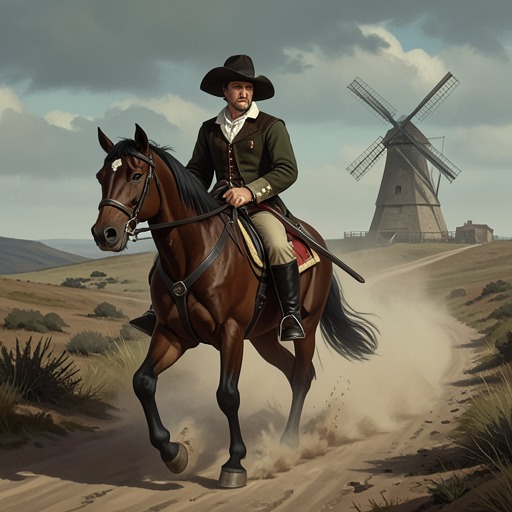
After a day on the road without the adventure he had hoped to encounter, Don Quixote and Rocinante are tired and hungry. Near nightfall he spots an inn and welcomes it as a place where his immediate needs might be relieved. Yet his reading of the building changes as soon as he approaches: to him it is a castle, complete with the towers, pinnacles, drawbridge, and moat associated with the romances that have shaped his expectations. He pauses, waiting for a dwarf to announce his arrival with a trumpet, but Rocinante is eager for the stable and no herald appears. Don Quixote proceeds to the entrance instead.
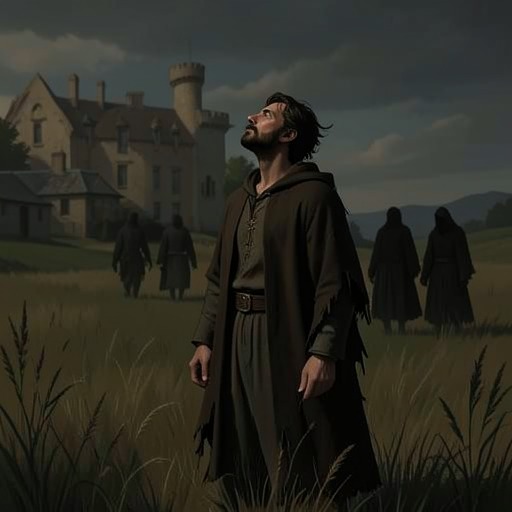
Two local young women stand by the door. Don Quixote imagines them as highborn ladies at a castle gate and addresses them with formal courtesy, while their alarm at the armed stranger gives way to laughter when he calls them maidens. Their response registers the gap between the roles he assigns and their actual circumstances. A swineherd’s horn, sounded as he gathers pigs, supplies the expected castle signal in Don Quixote’s mind. The inn’s everyday details continue to be translated into romance: the stockfish is imagined as trout, the bread as the whitest bread, the women as ladies, and the landlord as a castellan. A later burst of piping from a sowgelder further confirms, to Don Quixote, that he has arrived at a famous castle and that his expedition has begun successfully.
The Request for Knighthood
The inn’s role changes when Don Quixote realizes that he has not yet been dubbed a knight. As he understands the rules of chivalry, he cannot lawfully undertake adventures until he receives the order. After supper he takes the landlord aside in the stable, kneels, and asks for the favor that will allow him to roam the world in aid of people in distress. He describes the lodging as a castle and asks to keep watch over his arms in its chapel before being knighted the following morning.
The landlord does not share Don Quixote’s understanding of the scene. He responds to the request by offering practical counsel: knights and their squires need money and ordinary supplies, including lint and ointments for wounds, and should not travel without them. Don Quixote promises to follow this advice. The ceremony’s intended setting, however, is adjusted to the actual building. Since the inn has no chapel, the landlord arranges for the arms to be watched in a large yard beside a well. Don Quixote gathers them onto a trough, braces his buckler, takes up his lance, and paces before them as night falls.
An Interrupted Vigil and Improvised Ceremony
The landlord tells the other people at the inn about his guest’s plan, and they gather to watch from a distance. Don Quixote keeps his vigil with composure, sometimes pacing and sometimes standing with his lance while looking at his armor. The practical use of the yard soon disrupts the ritual: a carrier needs to water his animals, so he moves the arms from the trough. Don Quixote warns him not to touch them, but the carrier ignores the warning. Don Quixote then appeals to Dulcinea del Toboso for aid and attacks the carrier, who is left injured. When another carrier approaches the arms, Don Quixote strikes him as well.
The disturbance brings the carriers’ companions into the conflict. They throw stones at Don Quixote, who shields himself with his buckler and refuses to abandon the arms. The landlord calls for the attackers to leave him alone, explaining that his guest is mad and cannot be held accountable in the ordinary way. Once the carriers withdraw, Don Quixote calmly resumes the watch. Faced with the danger of further disorder, the landlord decides not to wait until morning. He tells Don Quixote that a chapel is unnecessary and that the essential parts of knighting are an accolade and a blow on the shoulder. He also declares the vigil complete, although Don Quixote has watched for more than four hours rather than the two the landlord says are required.
For the ceremony, the landlord brings out a book used to record straw and barley supplied to carriers. With a boy carrying a candle-end and the two women present, he tells Don Quixote to kneel. He reads from the account book as though reciting a prayer, strikes Don Quixote on the neck, and gives his shoulder a blow with the sword, muttering throughout. The women help complete the ceremony by girding on his sword and fastening his spur. The inn has thus supplied the objects and participants for a knighting, but its improvised rite rests on the landlord’s quick explanation and the equipment of an ordinary lodging.
The Inn as a Chivalric Threshold
During the ceremony, Don Quixote asks the women for their names so that he can remember those to whom he owes the favor and share with them any honor he wins. One identifies herself as La Tolosa, a cobbler’s daughter from Toledo; he asks her to adopt the title Dona Tolosa. The other is La Molinera, a miller’s daughter from Antequera, and he likewise asks her to take the title Dona Molinera. Their participation completes his imagined transformation of the inn’s company into the attendants of a castle, even as the details of their ordinary identities remain plainly present.
The episode gives the inn a concentrated narrative function: it is at once a place of food, shelter, animal care, and sudden conflict, and the setting where Don Quixote’s proposed vocation is formally recognized. Its yard cannot become a chapel, its trough is used to hold armor, and its ledger serves as a ceremonial book. The contrast does not prevent the knighting from mattering to Don Quixote; rather, it shows how his chivalric undertaking begins through an improvised encounter between his expectations and the everyday world he misreads.