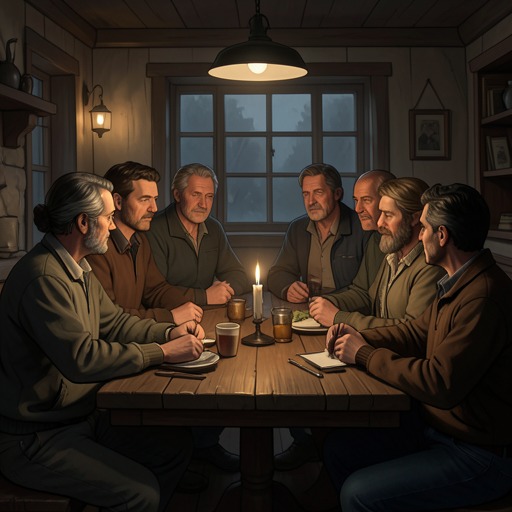
The reunion at the inn
Don QuixoteThe reunion at the inn brings Cardenio and Luscinda back together and forces Don Fernando to face Dorothea, the woman he had left behind. Recognition arrives through voices before faces: Cardenio hears Luscinda speak from beyond the door of Don Quixote’s room, and the identities concealed by veils become impossible to keep hidden. Their reunion might have ended in renewed conflict, but Dorothea’s appeal, followed by the counsel of those gathered around them, turns the encounter toward reconciliation.
Recognition at the inn
A woman who has remained silent does not answer Dorothea’s offers of help until a veiled gentleman warns that she is ungrateful and untruthful. The woman immediately denies the charge, saying her truthfulness has brought her into her present misery. Cardenio hears her reply from close by, separated from her only by the door of Don Quixote’s room. He recognizes the voice and cries out in astonishment. The woman turns toward it and tries to reach the room, but the gentleman holds her back. In the sudden movement, the silk covering her face falls away, revealing Luscinda.
As the gentleman is occupied with restraining Luscinda, his own veil slips off. Dorothea, who is supporting Luscinda, sees that the man is Don Fernando, her husband by the promise she says he made and the commitment she considers binding. At that sight she faints. Don Fernando recognizes her as she falls, while still holding Luscinda; Luscinda, in turn, has recognized Cardenio by his voice. Cardenio, hearing Dorothea’s cry and believing it came from Luscinda, rushes out and finds Don Fernando holding her. In an instant, all four recognize one another, but the shock leaves them speechless.
Competing claims and a choice
Luscinda first asks Don Fernando to release her. She declares her fidelity to Cardenio and identifies him as her true husband, insisting that threats, promises, and gifts have not changed her attachment. The encounter makes their separation visible as well as their reunion: Luscinda is in Don Fernando’s grasp, while Cardenio stands before her, and her appeal is for Don Fernando to acknowledge a bond she says cannot be displaced.
Dorothea recovers and kneels before Don Fernando. She recounts how she had lived in seclusion until he persuaded her to trust him, and argues that his promises and conduct made her his wife. She says she came not because shame drove her from home but because she grieved at being forgotten. Her appeal also invokes her parents, whose service to Don Fernando’s family, she argues, should not be answered with their daughter’s abandonment. She challenges the idea that her lower station excuses his withdrawal, maintaining that virtue, not birth alone, establishes worth. Her plea is both personal and public: she asks him to honor his word rather than expose her and her parents to the consequences of his desertion.
Don Fernando listens without answering. Dorothea’s distress moves those present, including the men who arrived with him, and Luscinda looks on with compassion and admiration. When Dorothea finishes, Don Fernando releases Luscinda and acknowledges that the force of the truths presented to him has overcome his resistance. The change is decisive: Luscinda is no longer held by the man who sought to claim her, and Dorothea’s appeal has made her own claim impossible to ignore.
Intervention and reconciliation
Once free, Luscinda nearly falls, and Cardenio comes forward to support her. They recognize one another fully and embrace, affirming their enduring attachment. Don Fernando puts his hand to his sword, and Dorothea, fearing that he may attack Cardenio, catches him by the knees and urges him not to let anger undo what has happened. She points out that the woman he sought as a wife is now with her husband, while his own wife is before him. Cardenio watches Don Fernando closely, prepared to defend himself if he moves against them.
Don Fernando’s companions, the curate, the barber, and Sancho Panza join Dorothea in asking him to accept the lovers’ union. The curate reminds him that Luscinda and Cardenio would rather die than be separated, and argues that, since the situation cannot be remedied by force, self-restraint is the honorable course. He also urges Don Fernando to honor his promise to Dorothea, whose modesty and affection, he says, give him ample reason to accept her. The assembled group thus turns the crisis from a private contest of claims into a judgment on fidelity, rank, and the obligations created by a promise.
Don Fernando finally stoops to embrace Dorothea and asks her not to reproach him for his wrongdoing. He presents his past conduct as a struggle against accepting the bond he had formed, but now declares that he has found in Dorothea what he wishes for and asks Heaven to grant them a long life together. He also accepts Cardenio and Luscinda’s happiness, praying that they may live together in peace. Cardenio and Luscinda kneel to thank him; he raises them and embraces them with affection. The reconciliation is marked by tears from the couple, Dorothea, Don Fernando, and many of the onlookers. Sancho Panza weeps too, though he later explains that he had expected Dorothea to be the queen Micomicona and had hoped for favors from her.
What the reunion reveals
Afterward, Don Fernando asks Dorothea how she reached the distant place where they met. She briefly retells the misadventures she had already recounted to Cardenio. Don Fernando then explains what happened after he found the paper in Luscinda’s bosom declaring that she was Cardenio’s wife and could never be his. He says that he had intended to kill her but was prevented by her parents, then left in anger and shame, resolved to seek vengeance later. He learned the next day that Luscinda had disappeared, and only months afterward discovered that she was living in a convent and meant to remain there unless she could share her life with Cardenio.
Don Fernando says he went to the convent with three companions, avoiding a direct approach because he feared that his presence would lead to tighter precautions. When the porter’s lodge was open, two companions guarded the gate while he and another entered. They found Luscinda in the cloisters speaking with a nun and took her away before she could resist. His account supplies the immediate background to the inn’s startling encounter: the reunion follows Luscinda’s removal from the convent and the concealed journey that brought her into Don Fernando’s company.
The scene resolves two intertwined separations through recognition, testimony, and restraint rather than combat. Luscinda’s voice identifies the beloved Cardenio has been seeking; Dorothea’s direct appeal turns Don Fernando toward the promise he had evaded; and the assembled witnesses help prevent the lovers’ reunion from provoking another act of force. The tears and embraces complete the reversal: those who first confront one another in confusion leave the encounter with their relationships publicly acknowledged and their claims newly settled.