the Duke who promises Sancho an island
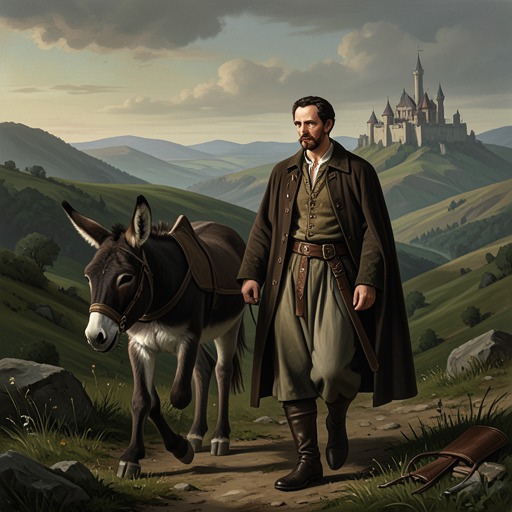
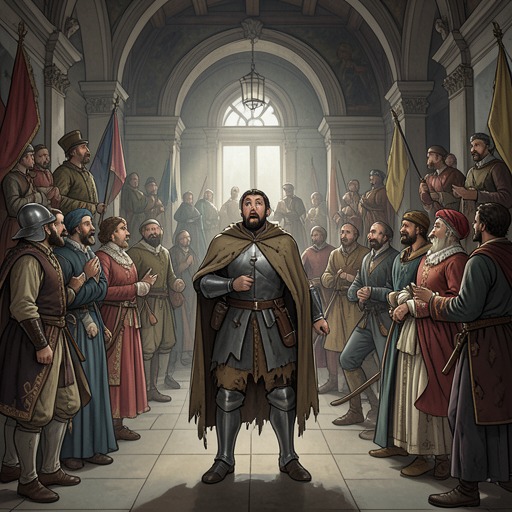
Don QuixoteThe Duke who promises Sancho an island is a wealthy nobleman who welcomes Don Quixote and Sancho Panza to his estate, then uses his knowledge of their exploits to stage elaborate entertainments around them. He offers Sancho the government he has long hoped for, but makes that reward part of a continuing joke: the duke and his household arrange the setting and appearances, while Sancho and his master are encouraged to treat the performance as real. His role is therefore both host and director, making the courtly welcome that Don Quixote receives inseparable from the tricks prepared for him.
Identity and welcome
The duke enters the story through the hospitality of his wife, the Duchess who plots Dulcinea’s disenchantment. After Sancho reports that the duchess has welcomed Don Quixote to her estate, the knight approaches to greet her. The duke is summoned and joins her in receiving him. Both have read the First Part of the history and know of Don Quixote’s delusion; they await him with delight and curiosity, intending to humor his understanding of himself as a knight-errant and to treat him with the ceremonies of chivalric books, which they enjoy reading.
The welcome is not entirely smooth. As Sancho dismounts from Dapple, his foot catches in the pack-saddle, leaving him unable to help his master down. Don Quixote, accustomed to having a stirrup held, dismounts without assistance and falls with Rocinante’s saddle. The duke sends his huntsmen to help knight and squire. Once Sancho has secured the saddle, the party sets out for the castle, with the duchess in the middle and Sancho beside her and the duke. The duke takes evident pleasure in receiving the pair, whose contrasting manners make them a source of amusement as well as honored guests.
Chivalric hospitality as performance
At their first meeting, the duke adopts the language of Don Quixote’s imagined world. When Sancho corrects the title the duke has begun to use, insisting that his master is now the Knight of the Lions, the duke accepts the correction and invites him to a nearby castle, promising the reception due to such a personage. The exchange shows how readily the duke adapts his welcome to the knight’s chosen identity. The ceremony is attentive, but its terms have been set by a host who knows that Don Quixote will understand the household through the conventions of romance.
The duke and duchess make that understanding the basis of further staged adventures. They are entertained by Don Quixote’s conversation and by Sancho’s simplicity, including his belief that Dulcinea has been enchanted, although Sancho himself had invented the deception behind that belief. To devise a new joke, they draw on Don Quixote’s account of the Cave of Montesinos, instruct their servants, and take the pair hunting six days later with a large retinue. They provide hunting clothes; Don Quixote declines his, saying that he must return to the pursuit of arms and cannot carry extra stores, while Sancho accepts his fine green suit intending to sell it at the first opportunity. The contrast places the knight’s commitment to his role beside the squire’s practical eye for the value of a gift.
The promised island
The duke turns Sancho’s expectation of an island into a formal promise. When an ecclesiastic asks whether Sancho is the squire to whom Don Quixote has promised one, Sancho confirms it and argues, through a string of proverbs, that service beside a good master may make him worthy of advancement. The duke answers that, in Don Quixote’s name, he grants Sancho the government of an island at his disposal. Don Quixote tells Sancho to kneel and thank the duke. The ecclesiastic, appalled that a sensible nobleman should endorse what he considers madness, leaves the table in anger; the duke’s amusement at the outburst makes clear that the promise is already part of the household’s entertainment.
Sancho later resists joining Don Quixote on Clavileño, worrying that the promised islanders may hear that their governor is traveling through the air and that the journey might leave him away for years. The duke reassures him that the island is fixed in place and will still be waiting when he returns. He also describes the governorship as the reward he expects Sancho to earn by accompanying Don Quixote and bringing the adventure to its conclusion. The assurance helps persuade Sancho to go forward, although he asks to be blindfolded and placed in God’s care. The promise thus functions not simply as a reward already given, but as an inducement that keeps the squire within the duke’s staged adventure.
Making the joke govern
After the Clavileño episode, the duke tells Sancho to prepare to govern: the islanders, he says, are already awaiting him. Sancho’s view of the reward has shifted. From the height of the supposed flight he had seen the earth as so small that the thought of governing it no longer seemed grand; he says he would prefer even a small piece of heaven. The duke replies that heavenly rewards belong to God, while he can offer a real, fertile island where Sancho may use his opportunities well. His answer brings Sancho’s imagined experience back to the practical promise of office without abandoning the fiction on which the household’s entertainment depends.
The duke then puts that fiction into operation. Don Quixote’s written counsels for Sancho fall into the duke’s hands, and he shows them to the duchess; both are again astonished by the combination of Don Quixote’s madness and wit. That evening they send Sancho off with a large following to the village assigned to serve as his island. The duke’s majordomo, who has been instructed by the duke and duchess, oversees the scheme. Sancho recognizes the majordomo’s face as resembling that of Countess Trifaldi, another role played by the same man, and wonders whether the apparent resemblance signals enchantment. The episode demonstrates how the duke’s servants sustain the staged world beyond the castle’s immediate welcome.
Household authority and narrative role
The duke’s influence reaches Sancho’s household as well as his adventures. During the governorship, Sancho asks that his letter and a bundle be sent to Teresa Panza through the duchess. Later, after the duchess has learned of Doña Rodríguez’s visit to Don Quixote, she and Altisidora interrupt the meeting and punish the duenna and Don Quixote. The duke is amused by what has happened. The duchess then sends the page who had impersonated Dulcinea in the disenchantment negotiations to Teresa with Sancho’s letter, a letter of her own, and a string of coral beads. Through the duke’s household, the joke acquires real effects: its servants carry messages and gifts to Sancho’s family even as they help maintain the staged adventures.
The duke’s defining tension is between the forms of generosity and the uses to which he puts them. He welcomes Don Quixote with the ceremonies the knight longs to receive, offers Sancho an office he genuinely desires, and arranges the means for the promised governorship to appear convincing. Yet the evidence also shows that these acts are coordinated with jokes, instructions to servants, and the couple’s pleasure in playing along with the travelers’ beliefs. He is not merely a spectator: his wealth and household authority allow him to turn the pair’s expectations into a sustained performance, one in which Sancho’s hope of advancement and Don Quixote’s chivalric self-image supply the roles.