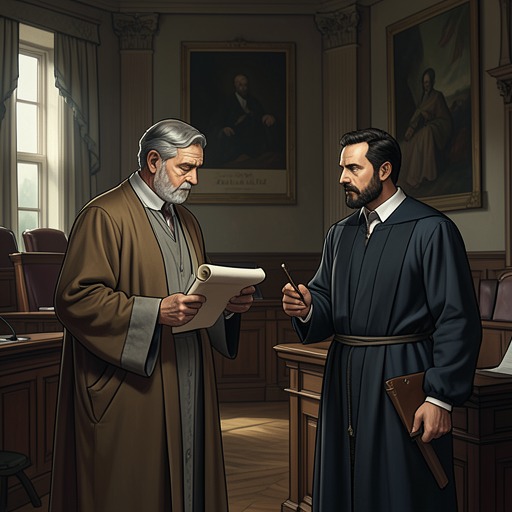
Abraham
Don't Leave God Alone: How to Get God's Attention, Remain in His Presence, and Even Change His Mind to Make a Difference in Your WorldAbraham is portrayed as a friend and servant of God who was given an unusual opportunity to plead for Sodom and Gomorrah. His decisive significance lies in the incompleteness of that intercession: he began by challenging the justice of destroying the righteous with the wicked, but he ultimately stopped counting at ten. In the book’s theology of persistent prayer, Abraham demonstrates both the power of intercession and the cost of leaving God alone too soon.
Identity and Introduction
Abraham appears in the discussion as a man to whom God disclosed an impending judgment. The disclosure itself is treated as meaningful. God is said to have considered whether to hide His intentions from Abraham, whom He regarded as a friend and servant. The book argues that God could have destroyed the cities without warning, so the conversation gave Abraham an opening to intervene on behalf of their inhabitants.
This presentation places Abraham within a personal relationship with God rather than depicting him as a distant observer of divine judgment. He is not merely informed about what will happen; he is invited into a conversation in which his response might matter. The narrative therefore makes his responsibility relational as well as moral: because he knows what is coming, he has the opportunity to plead for mercy.
Intercession for Sodom and Gomorrah
Abraham initially confronted God over the proposed destruction. He questioned whether the judge of all the earth would destroy good people along with bad ones and asked whether the cities would be spared for the sake of fifty righteous inhabitants. His appeal was not a passive prayer. He stood in God’s path, addressed the justice of the judgment, and tried to identify a number of righteous people whose presence could preserve the cities.
God agreed to spare Sodom and Gomorrah for each number Abraham proposed. The negotiation descended from fifty to forty-five, then through progressively smaller numbers, until Abraham asked whether the cities would be spared if ten righteous people could be found. The book treats each concession as evidence that God was willing to hear Abraham’s requests and alter the announced outcome in response to intercession.
Abraham’s method resembles Moses’s earlier plea for Israel, but the comparison exposes a crucial difference. Both men faced a judgment that could have ended in destruction, and both addressed God on behalf of people who were in danger. Moses, however, continued to press for mercy, whereas Abraham stopped when the number reached ten. The book’s interpretation is that Abraham did not reach the boundary of God’s willingness to listen; he reached the boundary of his own persistence.
The Failure to Continue
The defining failure in Abraham’s trajectory is that he gave up too early. The narrative cites the statement that the Lord went away after He had finished speaking with Abraham, and it interprets that departure as the moment when Abraham allowed God to be left alone. Abraham then returned to his own place, while the opportunity for further pleading ended.
The book imagines a further appeal that Abraham might have made, including a request for the sake of one righteous person, perhaps his nephew Lot. That possibility is presented not as a recorded event but as the unrealized continuation of the prayer. The argument is that Abraham could have continued asking whether the city might be spared for even one righteous man, just as Moses continued to stand between God’s judgment and Israel.
The consequence was catastrophic. God rained fire and brimstone upon Sodom and Gomorrah, destroying the cities, the plain, their inhabitants, and what grew from the ground. The book therefore treats Abraham’s stopping point as historically consequential within its interpretation: the destiny of two cities was connected to the moment when one intercessor ceased pleading. It suggests that the people might have been saved by the cry of one man, but Abraham did not continue to make that cry.
Relationships, Contrast, and Significance
Abraham’s relationship with God is marked by intimacy, confrontation, and unrealized possibility. God speaks with him as a friend, while Abraham responds by questioning the justice of the threatened judgment. This boldness is not condemned in itself; indeed, the book presents his initial challenge as the correct beginning of intercession. The failure lies in withdrawing before the appeal had been exhausted.
The contrast with Moses supplies Abraham’s primary narrative function. Moses did not leave God alone concerning Israel, and his persistence resulted in a whole nation being spared. Abraham began in the same posture but quit counting at ten, so the judgment proceeded. The two men thus embody opposite outcomes of the same principle: a righteous person can stand before God for others, but the effectiveness of that stand depends on refusing to surrender prematurely.
The book extends Abraham’s example beyond the ancient cities. Its larger claim is that God looks for people who will give Him a reason to intervene even when judgment appears deserved. Persistent prayer is presented as a form of moral participation in the fate of communities, churches, cities, and nations. Silence leaves destructive forces unchallenged, while determined intercession is said to confront violence, profanity, corrupt wisdom, defiled sanctuaries, iniquity, and terror.
For that reason, Abraham becomes both an example and a warning. His first appeals reveal that prayer can engage divine judgment, but his ending shows that beginning boldly is not the same as persevering. The book repeatedly urges readers to adopt the persistence Abraham displayed at first but abandoned at the decisive moment: they are to keep praying until circumstances change, rather than treating an apparent refusal as the final answer.