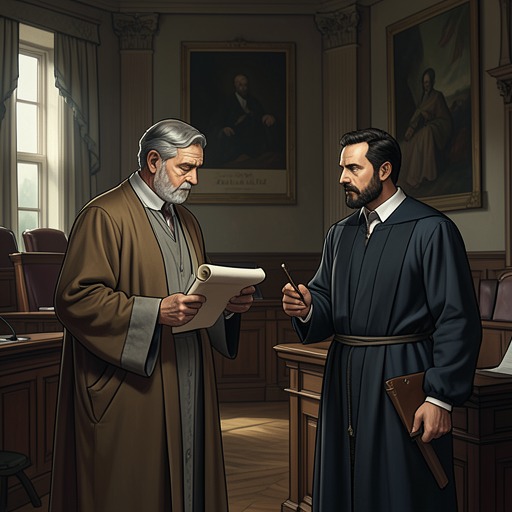
Abraham's intercession for Sodom
Don't Leave God Alone: How to Get God's Attention, Remain in His Presence, and Even Change His Mind to Make a Difference in Your WorldAbraham's intercession for Sodom is presented as a decisive but unfinished confrontation with impending judgment. Abraham recognizes that persistent prayer can affect the fate of cities, and he initially stands before God on behalf of Sodom and Gomorrah, asking whether the righteous should perish with the wicked. Yet he finally stops at ten righteous people. The book treats that stopping point as the tragedy of the episode: Abraham had begun to intercede, but he left God alone too soon, and the cities were destroyed.
Judgment and the Opening for Intercession
The episode begins with God disclosing the coming judgment rather than destroying Sodom and Gomorrah without warning. The book emphasizes that God asked whether He should hide from Abraham what He was about to do, identifying Abraham as a friend and servant whose response mattered. This disclosure is interpreted as an opening for intercession. If destruction had been irrevocably intended, the argument runs, God could have acted without first speaking to Abraham; the conversation placed the fate of the cities within a prayerful exchange.
The stakes were collective and severe. The threatened judgment concerned not only the cities themselves but also the entire plain, its inhabitants, and everything growing there. Against that scale of destruction, Abraham's appeal takes the form of a moral challenge to divine judgment. He questions whether the Judge of all the earth would treat good and bad alike, making the distinction between righteous and wicked people the basis on which mercy might be extended.
Abraham's Bargaining with God
Abraham begins by asking whether the cities would be spared for the sake of fifty righteous people. The book describes him as standing in God's path and confronting the justice of destroying the good together with the bad. God agrees to spare the cities for the requested number, and Abraham continues lowering the count. The bargaining therefore becomes a sequence of descending thresholds, with each answer confirming that the intercessor's appeal can alter the announced judgment.
The negotiation resembles the account of Moses, who also refused to leave God alone regarding Israel and, in the book's broader argument, saw a nation spared through persistent prayer. Abraham's first appeals show the same potential. He does not merely express grief about Sodom; he actively presses the question of how many righteous people would be enough to secure mercy. Each reduction demonstrates both the seriousness of judgment and the possibility that determined intercession can interrupt it.
When Abraham reaches ten, however, he stops counting. The book identifies this as the crucial failure. Abraham had originally begun to plead for the people, but he gave up too early instead of continuing toward the smallest possible number. The interpretation goes beyond the biblical scene's explicit outcome by proposing that Abraham could have asked God to spare the city for one righteous person, and that God was willing to hear such a cry. The decisive contrast is therefore not between prayer and no prayer, but between prayer that persists and prayer that ends before the answer is fully pursued.
The Cost of Leaving God Alone
After Abraham stops, the Lord goes His way, and Abraham returns to his own place. The book repeatedly treats that departure as a narrative sign: God was left alone because Abraham no longer continued the conversation. Brimstone and fire then fall on Sodom and Gomorrah, destroying the cities, the plain, their inhabitants, and the growth of the ground. The sequence makes Abraham's withdrawal consequential rather than merely incomplete.
The book frames the episode as a costly missed possibility. What happened through Moses might have happened through Abraham: the cry of one man could have resulted in the preservation of the people. The destruction of Sodom and Gomorrah is consequently interpreted as the outcome of an intercessor who quit counting at ten. Even the possibility of pleading for Lot is raised as an unrealized continuation of the appeal. Abraham could have pursued the matter after admitting that ten righteous people might not be found, but he did not do so.
This reading places responsibility on persistence. The text does not portray Abraham as indifferent; he did approach God and argue for mercy. His failure lies in abandoning the appeal before exhausting it. The event thus becomes an example of how an initially courageous prayer can still end in loss when the petitioner accepts an apparent limit and allows the divine conversation to close.
From Sodom to Cities and Nations
Abraham's intercession is used to establish a wider principle about prayer for public life. The book argues that the cry of the righteous must be louder than the cry of evil, because otherwise evil will prevail. Prayer is therefore extended beyond private needs to cities, churches, and nations. Silence concerning violence, crime, corruption, and fear is described as leaving God alone about the conditions that require intervention.
In this framework, Ezekiel's account of Lucifer's fall supplies a list of destructive influences that persistent prayer is said to confront: violence, profanity, corrupt wisdom, defiled sanctuaries, iniquities, and terror or fear. The application is practical and collective. Distress over a church's condition or a town's murder and crime rate is not meant to end in complaint; it should become continued prayer until change appears.
The book supports this appeal with an account of prayer concerning storms in Florida. In 2004, during a conference in Jacksonville, Florida, a prophecy warned of two back-to-back hurricanes and said that prayer could keep them away. People prayed, but the hurricanes still came, which the book presents as evidence that their prayers needed to rise to a higher level. The following year, a storm was named and expected shortly before another conference; this time hundreds prayed with fervency and determined that the storm would not enter as before, and it never hit them. The contrast is used to show the book's central lesson: prior disappointment must not become permission to accept no as the final answer.
The Model for Persistent Prayer
The account of Abraham is set beside Moses, the early church in Acts 12, and the book's direct teaching on importunity. The early church responded to Peter's imprisonment not by relying on ordinary political measures but by praying persistently, continuing the pattern of a community that refused to let go of God. In the book's summary of deliverance, believers are instructed to refuse to leave God alone, use the Word of God and the name of Jesus, believe that freedom is God's desire, stand their ground, refuse to give up, and remain connected to a church with an anointed pastor.
The same attitude is defined through Jesus' teaching about importunity in Luke 11 and the command to pray and not faint in Luke 18. Importunity is described as shameless, bold, determined, pressing, entreating, and persistent requesting. Abraham's intercession supplies the negative counterpart to that ideal: he possessed boldness at the beginning but did not sustain it to the end.
The episode also informs the book's closing invitation to personal faith. Readers who have run away from prayer because of failure, shame, or disappointment are urged to return rather than hide, as Adam and Eve hid after sin. The final appeal invites a new life of knowing Jesus Christ through daily prayer and asks readers to continue pursuing God until blessing comes. In that conclusion, Abraham's unfinished plea remains both warning and summons: intercession may begin with one question about justice, but its promised power depends on refusing to withdraw before mercy has been fully sought.