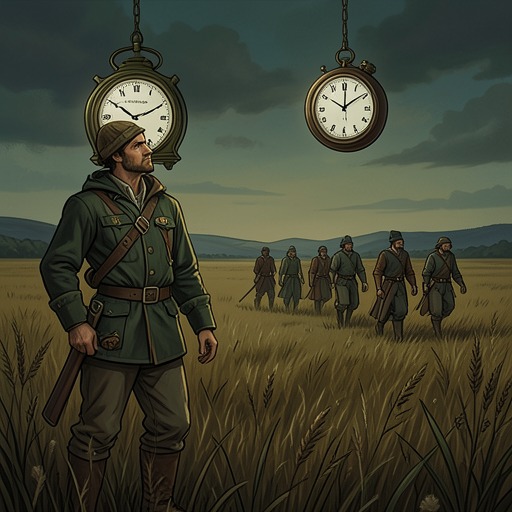
Daniel's Twenty-One-Day Prayer Delay
Don't Leave God Alone: How to Get God's Attention, Remain in His Presence, and Even Change His Mind to Make a Difference in Your WorldDaniel's Twenty-One-Day Prayer Delay is used as a decisive explanation for unanswered prayer: the delay does not necessarily mean that God has failed to hear or intends to deny the request. According to the account, Daniel's prayer was heard on the first day, but the answer was held back for twenty-one days by the prince of Persia. The episode therefore makes delay a contested interval between heavenly response and earthly manifestation, one in which persistence remains spiritually consequential.
The Nature of the Delay
The account appears in the discussion of dreams and prayers that seem to die before they can be fulfilled. It distinguishes divine silence from spiritual obstruction. Daniel prayed, and Heaven heard him immediately; nevertheless, the answer did not arrive at once because a spirit identified as the prince of Persia delayed it. The twenty-one-day interval thus exposes a hidden conflict behind what outwardly looks like inaction.
This interpretation also broadens the meaning of delay. Some delays may test faith, while others arise from evil spiritual resistance. The text describes such forces as barriers or stones standing between a desire and its manifestation. Delay is therefore not treated as proof that God has forgotten the petitioner; it may indicate that the answer is being contested before it becomes visible on earth.
Heavenly Hearing and Earthly Manifestation
The passage connects Daniel's experience with a larger movement of prayer. When people pray according to Revelation 8, angels carry their prayers before God's throne and bring them back as answers in the earth. Prayer is consequently portrayed as movement between two realms: a request rises before God, while its result must still enter earthly circumstances.
Daniel's twenty-one days occupy the tense space between those movements. The first day establishes that the prayer was received, while the delayed arrival reveals that reception and manifestation are not identical. The distinction gives narrative meaning to the waiting period: what appears to be absence may conceal an answer already in motion but opposed by spiritual powers.
Persistence and Authority
Because the obstruction is attributed to evil spirits, the text calls for more than passive waiting. Believers are said to possess authority to bind the influence of these spirits and to command their dreams to come forth or live. Persistence becomes an active response to resistance, joining continued prayer with confidence that barriers can be removed.
The principle is reinforced by other examples of determined prayer. Elijah prayed for rain seven times before a cloud appeared, and his persistence was associated with the transformation of a cloud no larger than a man's hand into an outpouring of rain. Paul and Silas prayed and sang praises at midnight until an earthquake opened the prison doors and loosed every chain. In each example, the darkest or most discouraging interval becomes the setting in which continued devotion precedes release.
Relation to Testing and Spiritual Formation
The delay also belongs to the book's wider account of preparation. Elisha followed Elijah from Gilgal to Jordan through four places of testing, each stage building the determination required to grasp God's power and not let it go. The movement from testing to power parallels Daniel's experience: persistence is not merely a technique for obtaining an outcome but a discipline formed under conditions in which the outcome is not yet visible.
The same logic appears in the account of the newborn girl whose incurable disease attacked her liver and blood. Her chance of survival was reported as only 11 percent, and the church saw little improvement for days, yet the congregation continued speaking God's promises of healing. The example frames delay as a period in which fear, disappointment, and apparent divine inaction must be answered by collective determination.
Narrative and Thematic Significance
Daniel's experience gives the book a framework for interpreting spiritual delay without surrendering hope. It joins private prayer to cosmic conflict, making an unseen twenty-one-day struggle the explanation for a visible postponement. The episode also supports the recurring instruction not to leave God alone: continued prayer refuses to mistake delay for defeat and keeps the petitioner engaged until the answer is released.
Its significance lies in the reversal of ordinary chronology. The answer is heard before it is seen, and the hidden fact of heavenly reception changes the meaning of every subsequent day. Waiting is no longer empty time. It is the interval in which faith persists, authority confronts obstruction, and a prayer already acknowledged in Heaven is pressed toward fulfillment on earth.