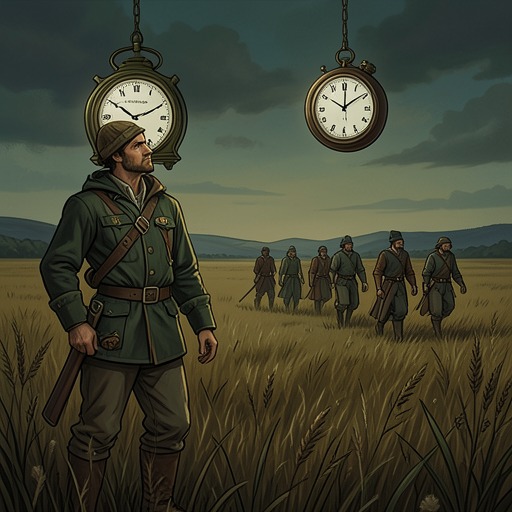
Drought
Don't Leave God Alone: How to Get God's Attention, Remain in His Presence, and Even Change His Mind to Make a Difference in Your WorldDrought in the book is not merely a shortage of rain. It is a prolonged condition of pressure that exposes whether people will remain passive before an apparently immovable circumstance or persist in prayer and prophetic declaration. Its decisive significance lies in the book’s claim that persistent faith can confront environmental crisis and that the return of rain can function as a public sign of answered prayer and divine blessing.
Biblical Pattern and Spiritual Meaning
The book grounds its understanding of drought in the example of Elijah. Elijah declares, "As the LORD God of Israel liveth, before whom I stand, there shall not be dew nor rain these years, but according to my word." His words are presented as having consequences beyond ordinary speech: the absence of rain becomes connected to prophetic authority, while James 3:6 is invoked to support the claim that words can alter the course of nature. Drought therefore appears within a larger theology of the spoken word, in which speech issued from faith is treated as a rod of authority rather than as mere description.
This pattern is linked to the book’s wider contrast between crisis-driven religion and daily fellowship with God. After the September 11 attacks, churches and prayer meetings filled as people sought God amid confusion, but the renewed hunger lasted only briefly. The author argues that this temporary return to prayer is dangerous because people may seek Jesus as Savior during trouble without committing to Him as Lord in ordinary times. Drought belongs to the same moral landscape: it is not only a natural hardship but also a circumstance that tests whether dependence on God will be sustained before relief appears.
The Overseas Drought
The most developed drought account takes place at an overseas conference in a region where it had not rained for months. The heat was described as blazing, its effects were visible everywhere, and people repeatedly complained about both the temperature and the lack of rain. During the evening service, the author was already hot and soaked with sweat while preaching. He then called for the worship team to play, after which he says that a prophetic anointing came upon him.
He addressed the sky and commanded the drought to stop within twenty-four hours. The rain was declared to be a prophetic sign for the nation: it would indicate that the people had elected the right leader and that God was showing blessing upon that choice. The same prophecy connected thunder with the promise that God’s voice would be heard in the heavens. In this account, the drought is given a public and interpretive role. Its end is not treated simply as weather changing, but as an observable confirmation of prayer, prophecy, and national hope.
Delay, Doubt, and Reversal
The immediate aftermath appeared to undermine the prophecy. No rain had been forecast, and pastors and leaders at the meeting reminded the author of what had been said. They began informing other leaders across the nation that rain had been prophesied as a sign, increasing the public pressure attached to the declaration. Yet for hours nothing seemed to happen. The next day the sun appeared to mock the prediction, and the author became increasingly concerned about the prophetic word.
The reversal came later that afternoon. Clouds began to form, and rain fell heavily and continuously. Thunder sounded loudly enough to seem to shake the buildings, while the downpour flooded the streets. News of the rain traveled quickly across the nation, where people were witnessing what the account presents as the end of the drought and the fulfillment of an answered prayer. The narrative’s tension depends on the interval between declaration and visible evidence: the drought does not yield immediately, and the apparent failure becomes part of the test of whether faith will persist during silence.
Prayer, Collective Action, and the Logic of Signs
The drought account is placed beside other stories in which prayer is said to affect public danger. In Florida, the author prophesied in 2004 that two hurricanes would come back-to-back and would stay away if people prayed. Many prayed during the first storm, yet the hurricanes still came, which the author interprets as evidence that prayer needed to rise to a higher level. The following year, hundreds prayed fervently after another prophecy identified a storm and a particular month; that storm never struck the area. The contrast is used to emphasize determination and refusal to accept a negative answer.
The same interpretation is extended to the United States hurricane season of 2006. After record hurricane years, people collectively, individually, and fervently prayed and declared peace over the storms. Although some storms attempted to develop, the author states that no major hurricanes hit the United States that year. These examples establish a recurring framework: danger is announced, prayer is mobilized, the result is assessed afterward, and favorable outcomes are read as evidence that people did not leave God alone about the crisis. The drought thus belongs to a broader pattern of disaster narratives that turn uncertain public events into calls for sustained spiritual participation.
The book also acknowledges that prayer does not always produce the expected immediate outcome. A tornado once came within less than a mile of the author’s house; although he and his wife spoke to it, a huge branch struck the house and they ran to the basement. On another occasion, they spoke to a tornado near a medical office building, and the storm dissipated after the tornado cloud began to form. The differing outcomes do not lead the author to abandon the practice. Instead, the first failure is interpreted as evidence that spiritual growth is progressive and that believers must continue learning how to use the authority they have been given.
The Drought as a Test of Faith
Drought finally operates as a concentrated image of the book’s central demand: do not allow delay, adverse appearances, or an earlier disappointment to end prayer. The author cites the declaration, "Declare a thing, and it will be established for you," and urges readers to decree God’s will over their circumstances and lives. The physical return of rain is therefore inseparable from the book’s account of speech, worship, persistence, and expectation.
The drought’s narrative movement runs from absence to proclamation, from proclamation to apparent embarrassment, and from apparent failure to overwhelming visible change. Its significance is less meteorological than theological. Rain becomes the tangible form of a promised answer, while the preceding dryness becomes the space in which determination is measured. In that structure, drought is both affliction and proving ground: a condition that seems to deny divine involvement, yet is used to argue that persistent prayer can invite God’s power into the very situation that first appeared abandoned.