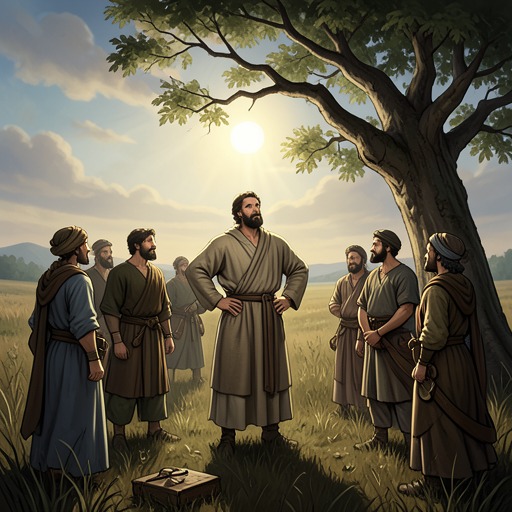
Elijah’s ascension and Elisha’s succession
Don't Leave God Alone: How to Get God's Attention, Remain in His Presence, and Even Change His Mind to Make a Difference in Your WorldElijah’s ascension and Elisha’s succession is the decisive passage from spiritual apprenticeship to inherited responsibility. Elijah’s departure appears at first to threaten the continuity of his ministry, but Elisha’s determined pursuit turns separation into succession: the mentor is removed, the mantle remains, and the disciple is shown to possess access to the same divine power. The event therefore joins loss with transfer, testing with reward, and grief with the beginning of a new prophetic ministry.
The Journey and Its Tests
Elijah was preparing to leave the earth when he led Elisha through a sequence of locations that included Gilgal, Bethel, Jericho, and the Jordan. At Gilgal, Elijah told Elisha to remain behind because the Lord had sent him to Bethel. Elisha answered with a solemn declaration that, as long as Elijah lived, he would not leave him, and he went with him. The same pattern occurred repeatedly: Elijah announced another destination, and Elisha refused to separate from him.
The repeated departures functioned as tests of resolve rather than genuine attempts to dismiss Elisha. Elijah’s apparent desire for solitude exposed whether his spiritual son was committed to the man, the calling, and the God behind the ministry. Elisha’s persistence distinguished hunger for divine power from an ambition to use power for personal purposes. Each refusal strengthened the relationship and moved Elisha closer to the inheritance he sought.
The four stages of the journey also represented tests of Elisha’s heart and commitment. He had to continue through each place without giving up before he could be prepared to walk in miracle power. The geography thus becomes more than a route toward the Jordan: it is a spiritual progression in which perseverance is repeatedly demanded before authority can be received.
The Ascension and the Moment of Loss
As Elijah and Elisha walked and talked, a chariot and horses of fire came between them. Elijah was taken up in a whirlwind, leaving Elisha to witness the sudden removal of the spiritual father who had mentored him. Elisha cried out, “My father, my father! You-the chariot and cavalry of Israel!” and tore his own robe when he could no longer see Elijah. His grief registers the human cost of succession: receiving a ministry does not prevent the pain of losing the person through whom that ministry was learned.
Yet Elijah did not disappear without leaving a sign of continuity. His cloak fell to the ground, becoming the remaining material symbol of the prophet’s anointing. Elisha picked it up and returned to the shore of the Jordan. The movement back toward the river reverses the earlier direction of apprenticeship. Elisha is no longer following Elijah toward a destination; he is returning alone to confront the question of whether the God who empowered Elijah will now meet him.
The Mantle and the Transfer of Authority
At the Jordan, Elisha struck the river with Elijah’s cloak and cried, “Where is the LORD God of Elijah?” The question is both a lament and an act of faith. Elisha does not treat Elijah’s absence as proof that the power has vanished. Instead, he invokes the God associated with his mentor and tests the mantle through action. When the river divided and Elisha crossed through, the succession became visible: the same prophetic authority that had marked Elijah’s ministry was now operating through Elisha.
The mantle therefore signifies more than an article of clothing. Elisha wanted the God who had rested upon Elijah to rest upon him as well, and he longed to resemble the man he loved. His earlier persistence had shown that he valued the anointing as a sacred responsibility rather than as a tool for self-promotion. Once Elijah was taken away, the fallen cloak made that inward commitment outwardly tangible.
Elisha’s readiness came only after his hunger had become evident. The ascension did not create his calling from nothing; it revealed that his sustained pursuit had positioned him to receive what Elijah carried. His refusal to leave his mentor became the practical means by which he entered the next stage of his own ministry.
Prayer, Persistence, and Spiritual Power
The event is presented as a model for persistent relationship with God. Elisha’s repeated refusal to leave Elijah becomes an image of refusing to abandon communion with the Lord until divine power is encountered. The lesson is not that spiritual authority can be seized mechanically, but that devoted pursuit exposes the seriousness and endurance required to carry it.
This principle is connected with the book’s wider teaching that prayer should arise from hunger for fellowship rather than from crisis alone. The account of the September 11 attacks is used to show how people sought God urgently when uncertainty overwhelmed the nation, while later prosperity and familiarity allowed that hunger to fade. The changing intensity of public prayer is contrasted with the steadier devotion represented by Elisha, whose commitment did not weaken when Elijah repeatedly appeared to send him away.
The same logic is applied to collective crises. Prayer for American military personnel was described as strong at the beginning of the war, when a perceived mandate of prayer produced widespread concern, but later weakened as attention diminished. Hurricane accounts likewise distinguish between an initial year in which prayer did not prevent predicted storms and a later year in which hundreds prayed with greater fervency and a named storm failed to strike Florida. In 2006, after collective and individual declarations of peace, no major hurricane hit the United States. These examples extend Elisha’s persistence from a personal succession story into a theology of sustained intercession.
Words That Act and Storms That Yield
The account also belongs to a larger pattern in which spoken faith is treated as an instrument of spiritual authority. The angel’s challenge to Zechariah, “Who art thou, O great mountain? before Zerubbabel thou shalt become a plain,” supplies the book’s language of confrontation: an obstacle is addressed directly and commanded to yield. Elijah’s declaration that there would be no dew or rain “according to my word” is presented as an example of words affecting the course of nature.
A later ministry story develops the same theme through a drought overseas. After months without rain, a prophetic command stated that rain would come within twenty-four hours as a sign of blessing and answered prayer. Although the following hours appeared to contradict the declaration and the next day began under strong sunlight, clouds eventually formed, heavy rain fell, thunder shook the buildings, and flooding spread through the streets. The episode is interpreted through the claim that believers can declare God’s will and expect it to be established.
Storm narratives also preserve the tension between confidence and developing faith. During one tornado, the speaker and his wife commanded the storm to rise, then ran to the basement when a branch struck the house; the tornado passed, but their reaction exposed that their understanding of spiritual authority was still growing. On another occasion, they spoke to a forming tornado near a medical office building, and the storm dissipated after rising back into the sky. The contrast does not erase the earlier failure. Instead, it supports the book’s insistence that believers must continue using the authority they have received even when one apparent result differs from another.
The succession of Elisha provides the governing image for these later applications. He first follows, then grieves, then takes up the mantle, and finally speaks to the Jordan. His question about the God of Elijah is answered not by a private sensation but by a changed physical circumstance: the river divides. In the book’s interpretation, persistent attachment to the source of divine power prepares a person to exercise that power after the visible source has departed.
Narrative Significance and Ending
The event combines the archetypes of ascension, mentor succession, ordeal, and transformation. Elijah’s disappearance is a threshold between two ministries, while Elisha’s return to the Jordan marks his crossing from dependence into action. The decisive value shift moves from threatened abandonment to confirmed continuity: what seemed to end the prophetic line becomes the means of extending it.
Elisha’s ending in this episode is not closure through comfort. He does not receive Elijah back, nor does he avoid grief. He receives responsibility. The torn robe records the loss, while the recovered mantle records the inheritance; together they show that succession requires both mourning what has departed and taking up what remains. Elisha’s power is therefore inseparable from his fidelity, and his new ministry begins with the same refusal that carried him through Gilgal, Bethel, Jericho, and the Jordan: he would not leave until the presence and power of the God of Elijah were made evident.