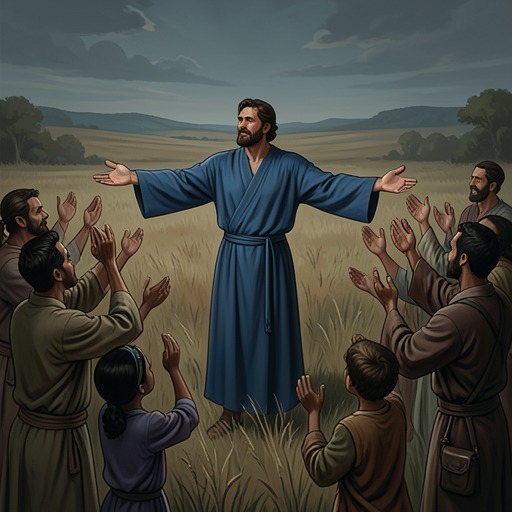
Elisha parts the Jordan
Don't Leave God Alone: How to Get God's Attention, Remain in His Presence, and Even Change His Mind to Make a Difference in Your WorldElisha parts the Jordan after Elijah is taken from him, and the act becomes the decisive proof that spiritual succession has truly occurred. With Elijah’s mantle in his hands, Elisha strikes the river and walks through the divided waters, discovering that the power he pursued in his mentor has not disappeared with him but has been entrusted to the next prophet.
The Departure That Creates a Test
Elisha’s crossing follows a charged scene of separation. As he and Elijah walk and talk, a chariot and horses of fire come between them, and Elijah is carried up in a whirlwind to Heaven. Elisha watches until he can no longer see his spiritual father, then tears his own robe apart. The gesture expresses grief, but it also leaves him facing a practical and spiritual question: how can he continue without the prophet who formed him?
Elijah’s cloak falls to the ground, the last tangible sign of his presence and the symbol of the anointing that had rested upon him. Elisha picks it up and returns to the bank of the Jordan. His movement is not a retreat into mourning. He goes back to the place where the older prophet’s ministry had been visibly marked and tests whether the God who empowered Elijah will answer him as well.
The Mantle and the Cry for Power
Holding the mantle, Elisha cries, “Where is the LORD God of Elijah?” The question is both a plea and a confrontation with uncertainty. He is not merely asking where God is in the abstract; he is asking whether the divine presence associated with Elijah will accompany him now that Elijah is gone.
Elisha then strikes the river with the mantle. The Jordan divides, and he walks through it. The physical change in the river supplies the answer that the question sought: the God of Elijah has not departed with Elijah. Elisha’s refusal to leave his mentor during the journey has led him to the point at which the mantle falls to him and the same power becomes active through his own obedience.
The narrative presents the miracle as the consequence of persistent attachment. Elisha had followed Elijah from Gilgal to Bethel, Jericho, and Jordan, refusing repeated opportunities to remain behind. His persistence was therefore not simple loyalty or sentiment. It prepared him to receive responsibility, and the parted river publicly confirms that he has entered a new stage of ministry.
Jordan as the Place of Crossing
Jordan represents more than a riverbank in the book’s interpretation. It is “the place of crossing,” the boundary at which a person moves into a heavenly inheritance and into God’s purpose. Elisha cannot remain at the spot where he saw Elijah leave; seeing the mantle fall is not enough. He must take it up, strike the water, cross over, and move forward.
This crossing gives the event a clear value shift. Before the river parts, Elisha stands as a grieving successor who has lost the visible presence of his mentor and does not yet know whether the anointing will remain. After the river opens, he is a prophet who has received confirmation and can proceed under a new authority. The water becomes the threshold between dependence on Elijah’s physical presence and responsibility for carrying Elijah’s spiritual legacy.
The four locations in Elisha’s journey—Gilgal, Bethel, Jericho, and Jordan—are treated as successive tests of the heart and commitment. Jordan is the final movement from preparation into action. It signifies progress rather than arrival at a place of permanent rest: the mantle is received so that the bearer can cross and continue, not so that he can remain beside the scene of succession.
Consequences and Continuing Pattern
The parted Jordan is identified as the first of twelve remarkable miracles associated with Elisha after he passes through the places of testing. It demonstrates that he has become living evidence of God’s anointing and that he can cross into the inheritance represented by the river. The miracle therefore functions as both authentication and commission: it validates the succession and equips the successor for the ministry that follows.
The event also establishes a broader pattern for the book’s teaching about persistence with God. Elisha did not leave Elijah alone until he received the power resting on Elijah’s life; in the same way, believers are urged to pursue God until His power comes. The crossing is consequently read as a model of determined spiritual pursuit, in which apparent absence and delay become occasions to act with the authority already given.
That authority is repeatedly connected with speech, faith, and persistent prayer. Moses stands as an example of refusing to withdraw until mercy is shown, while the angel’s declaration to Zechariah presents the great mountain becoming a plain through faith and grace. Elijah’s words are likewise presented as affecting the course of nature, and later accounts of prophetic rain and storms extend the same claim that spoken faith can confront seemingly immovable conditions. Within this framework, Elisha’s blow against the Jordan is the concrete, visible counterpart to the book’s insistence that spiritual authority must be exercised rather than merely admired.
The river crossing thus closes one relationship and opens another kind of vocation. Elijah is gone, but his mantle remains; Elisha’s grief is real, yet it does not become paralysis. By taking up the cloak and crossing the Jordan, he transforms loss into succession, uncertainty into confirmation, and discipleship into active prophetic responsibility.