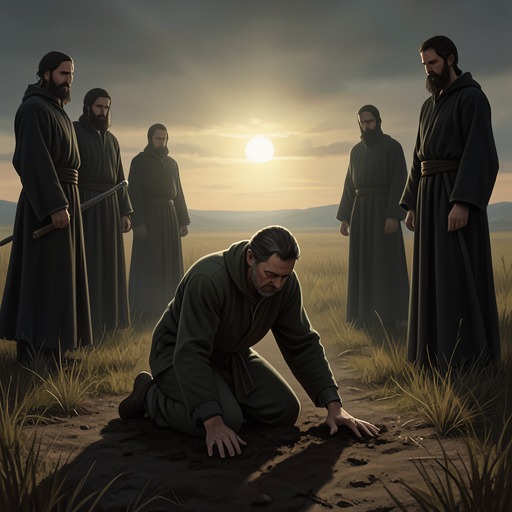
Fall Down and Get Delivered
Don't Leave God Alone: How to Get God's Attention, Remain in His Presence, and Even Change His Mind to Make a Difference in Your World“Fall Down and Get Delivered” is the book’s expression for a paradoxical form of worship: the believer falls physically or spiritually, but that fall becomes the place of renewed allegiance and release rather than defeat. Its central image comes from Shadrach, Meshach, and Abednego, who would not bow before Nebuchadnezzar’s golden image but fell in the fiery furnace before the Son of God. The expression therefore joins bodily surrender to resistance, persistence, and the expectation of God’s delivering power.
The Furnace and the Refusal to Bow
The expression is introduced through the account of Shadrach, Meshach, and Abednego in Daniel 3. They stood against a king and an entire nation committed to idolatry, refusing to exchange their convictions for physical safety. When Nebuchadnezzar offered them a final opportunity to worship the image, they answered that God was able to deliver them, but that even if He did not, they still would not serve the king’s gods or worship the gold image.
Nebuchadnezzar responded with fury and ordered the furnace heated seven times hotter than normal. The flames were so intense that they killed the soldiers who threw the three men into the fire. The apparent movement of the scene is therefore downward into execution: the faithful are cast into the furnace, while the power of the king seems absolute. Yet the fall changes meaning inside the fire. The Son of God appeared with them, and what looked like defeat became the setting of divine presence and preservation.
What “Fall Down” Means
The book emphasizes that “fell down” in this passage translates the Hebrew word naphal, associated with falling down, falling prostrate, prostrating oneself, and lying prostrate. The three men did not fall before the man-made statue as Nebuchadnezzar demanded. They fell in the middle of the fire before the Son of God. The same physical posture that would have signified submission to the king becomes, in the furnace, an act of worship directed to the rightful recipient.
Their posture thus carries a double refusal. They refuse idolatry before entering the flames, and they refuse to abandon worship once the flames surround them. Their convictions do not change under pressure. Because they remain devoted to God, they are supernaturally unharmed: the fire does not touch them, their hair is not singed, their clothing is not scorched, and they do not even smell of smoke. “Fall Down and Get Delivered” consequently describes worship as a practice that can continue in the middle of the trial rather than a response reserved for its conclusion.
Worship as Spiritual Release
The book connects this furnace scene with Jesus Christ’s temptation in the wilderness. Satan offered Jesus the kingdoms of the world if He would fall down and worship him. The temptation depends on the same meaning of bodily prostration: to bow is to express complete devotion and commitment. The devil sought the worship that Nebuchadnezzar demanded, while the three Hebrew men gave that worship only to God.
This understanding also governs the book’s interpretation of true worship. To bow and kiss the feet represents an extreme expression of commitment, a movement in which the worshiper places God above personal fear, failure, and immediate circumstances. The book associates such dedication with the promise that when the righteous cry out, enemies turn back because God is for them. Worship is therefore treated not merely as emotional expression but as a cry for deliverance that reorders authority.
Paul and Silas provide the second major example. They were imprisoned and bound, yet at midnight—their darkest hour—they prayed and sang praises while the other prisoners listened. A great earthquake shook the prison foundations, every door opened, and everyone’s bonds were loosed. Their freedom came while they were still in the atmosphere of confinement, and the book interprets their praise as the action that kept them from leaving God alone in worship. Like Shadrach, Meshach, and Abednego, they worshiped before the visible reversal, and worship became the means through which bondage was broken.
Persistence Beyond the Immediate Crisis
The expression belongs to a broader discipline of refusing to abandon God when prayer appears unanswered. The narrator recalls a season that felt simultaneously like a valley and a desert and lasted about six months. Dissatisfied with prayer that felt boring, with falling asleep while praying, with the absence of sensed divine presence, and with unanswered requests, he went to a camp for three days of fasting and prayer. He even brought a sack full of snacks in case the drought continued. In the nearby woods, he saw deer at a distance and prayed that, if God was hearing him, they would come closer; instead, the deer ran in the opposite direction. The comic disappointment illustrates the same pressure that the furnace and prison stories dramatize: an apparent lack of response can tempt a person to stop pursuing God.
The book answers that temptation with persistence. Jesus Christ’s teaching on importunity is described as shameless, bold, determined, pressing, entreating, and persistent requesting. The believer is instructed to continue pressing in prayer and not grow weary. Elijah’s prayer for rain supplies a further pattern: he placed his head between his knees and prayed seven times before a cloud appeared, initially no larger than a man’s hand. Continued prayer is said to turn that small sign into an abundance of rain. In this framework, falling down is not passive resignation; it is a repeated posture of dependence that remains in place until the answer comes.
From Shame to Deliverance
The book contrasts this posture with the “fig leaf” response to failure. Adam and Eve sinned, felt exposed, hid from God, and covered themselves with sewn fig leaves. The fig leaf represents human effort to appear righteous and justified while keeping distance from God. When people fail in prayer or compromise morally, embarrassment can produce the same withdrawal: they avoid prayer because they fear that God is angry or because they do not want to face another failure.
Against that retreat, the book urges people to run to God rather than away from Him. The blood of Jesus Christ is presented as the covering that makes dependence on self-made fig leaves unnecessary. Forgiveness is not offered as permission to remain distant; it is the reason the failed person can return immediately and continue seeking help. The fall that leads to deliverance is therefore different from hiding. It is an honest surrender before God, free from excuses and sustained by renewed pursuit.
The expression culminates in practical instructions for freedom: refuse to leave God alone, use the Word of God and the name of Jesus, believe that the Lord wants freedom, stand firm, refuse to abandon deliverance, and remain in a church with an anointed pastor who can help. The final invitation extends the same pattern to a person seeking Jesus Christ personally: repent, ask forgiveness, receive the Holy Spirit, and commit to pursuing God until blessing comes. “Fall Down and Get Delivered” thus transforms defeat into a liturgical and spiritual paradox. The worshiper may be thrown down, pressed by fire, confined in chains, disappointed in prayer, or ashamed after failure, but surrender directed toward God becomes the beginning of resistance, freedom, and deliverance.