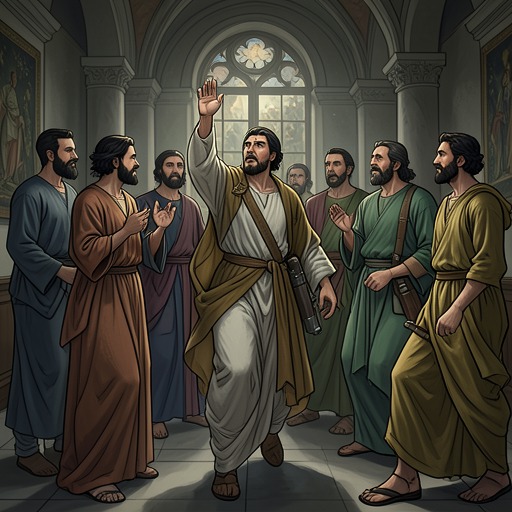
Go to the other side
Don't Leave God Alone: How to Get God's Attention, Remain in His Presence, and Even Change His Mind to Make a Difference in Your World“Go to the other side” names a command, a test, and a promise of completion. Jesus Christ sends the disciples across the water while He withdraws to pray alone; when violent wind turns the crossing into a crisis, the apparent absence of immediate intervention becomes the occasion for faith, speech, and perseverance. The expression therefore reaches beyond a boat on a stormy sea: it describes the believer’s obligation to continue toward the destination God has assigned rather than interpreting resistance as permission to quit.
Command and Test
Jesus Christ’s instruction appears in Matthew 14:22–23, where He sends the disciples away in a boat and tells them to cross to the other side while He remains alone. The separation is deliberate. The disciples are not portrayed as abandoned to an accidental disaster, but as placed in circumstances that will expose their response to His command. While Jesus is alone, a violent wind tosses the boat, making the promised destination seem uncertain and the sender’s involvement difficult to see.
The book interprets this distance as a test of faith and a provocation to action. Jesus Christ wants the disciples to respond to what they have already been told, not to wait passively for conditions to become safe. The storm reveals whether they will trust the order to arrive successfully, or allow the visible danger to redefine the assignment. “Go to the other side” consequently holds together command and assurance: the crossing is difficult, but the difficulty does not cancel the destination.
Remembering Earlier Storms
The disciples’ panic is intensified by their previous experience in Matthew 8:23–27. They had already witnessed Jesus Christ rebuke a storm, yet they had not learned to draw on that example when a later storm confronted them. Their failure is therefore not merely fear in the abstract; it is a failure to apply received revelation. They could have trusted the command to cross, and they could have remembered that Jesus Christ had already demonstrated how to confront a storm.
This recurrence gives the expression a pattern of progressive learning. A previous deliverance does not automatically produce mature faith, but it supplies a testimony that can be used in the next crisis. The disciples’ repeated exposure to storms becomes part of their training: each trial asks whether earlier knowledge will remain passive memory or become present action.
The Rod of Authority and Spoken Faith
The book connects the disciples’ crossing with Moses crossing through the Red Sea by means of his rod of authority. Jesus Christ crossed over as well, and He wanted the disciples to discover that they, too, possessed a form of delegated authority. The central instrument is not a physical staff in their hands but the words they speak in faith. Proverbs 18:21 is invoked to frame the tongue as carrying the power of life and death, while Job 22:28 is presented as support for declaring a matter so that it may be established.
This teaching treats speech as an instrument of spiritual resistance. The believer may lift the “rod of power” and initially see little change, but the book describes spiritual growth as progressive, moving from revelation to revelation and from faith to faith. The instruction is therefore not to judge the authority of a word solely by its immediate visible effect. Continued obedience matters: keep speaking God’s Word, keep confronting the mountain, and keep moving toward the far shore until the passage becomes peaceful and complete.
The same principle is illustrated through two tornado experiences. In the first, the narrator and his wife spoke to a tornado less than a mile from their home, then fled to the basement when a large tree branch struck the house; the tornado passed, but their reaction exposed how incomplete their confidence remained. In a later storm beside a small medical office building, they told nearby doctors that Jesus Christ would calm the storm and spoke to it before taking shelter. That tornado rose back into the sky and the storm dissipated. The contrast does not erase the earlier failure. Instead, it supports the claim that one disappointing result must not end the practice of using the authority already given.
Crossing as Persistence
“Go to the other side” is also aligned with the book’s wider command not to leave God alone. Believers are urged to refuse discouragement after failure, use the Word of God and the name of Jesus Christ, stand their ground, remain committed to deliverance, and stay connected to an anointed church leader. The expression turns persistence into a form of spiritual movement: the believer does not merely endure a storm but continues pressing toward freedom, blessing, and the promised outcome.
That persistence is explicitly associated with importunity, described as being shameless, bold, determined, pressing, entreating, and persistent in requesting. Jesus Christ’s teaching in Luke 11 and His command in Luke 18:1 to pray and not faint are used to establish an attitude that refuses to accept apparent refusal as the final word. The same logic governs prayer for public dangers. After the September 11 attacks, churches and prayer meetings filled as people sought God, but the renewed hunger lasted only briefly. The book calls this dependence on crisis risky and contrasts it with daily fellowship and regular prayer.
The argument is extended to war and storms. The narrator recalls the rapid seizure of Baghdad by American troops after twenty-one days, followed later by a war marked by deaths and widespread violence, and attributes the contrast to a decline in prayer for military personnel. In Jacksonville, Florida, the narrator prophesied in 2004 that two hurricanes would come back-to-back and said prayer could keep them away; many prayed, yet the storms still came. The following year, hundreds prayed with greater fervency around a specifically named storm, and it did not hit them. In 2006, after collective and persistent prayer following years of record hurricanes, no major hurricane struck the United States. These examples are presented as evidence that determined prayer must continue despite a previous disappointment.
The Far Shore as Deliverance
The expression reaches its broadest meaning in the book’s invitation to cross from bondage into freedom. The writer says that Jesus Christ wants people free and identifies refusal to leave God alone as one of the principles for breaking demonic strongholds. The believer is told to trust that deliverance is desired, stand firm, refuse to give up, and continue seeking help within the church. The destination on the far side is thus not only physical safety but restored life under God’s protection.
This logic also governs an intense family medical crisis. After the narrator’s wife’s father developed a fever of 104 degrees during a July 4 camping trip, the fever returned in December. Emergency surgery discovered diverticulitis and a ruptured bowel; months of undetected infection had led to septic shock. He entered a medical coma, swelled to three times his normal size, reached a fever of 105 degrees, and suffered liver, kidney, and lung failure while requiring dialysis and a ventilator. Eight physicians treated him, and the first prognosis gave him less than a 50 percent chance of survival. The family responded with prayer around the clock, treating the crisis as another crossing in which faith had to continue while the visible circumstances moved toward death.
The expression finally becomes a direct invitation to the reader. The book asks those who have not known Jesus Christ personally to begin a life of intimate relationship, daily prayer, repentance, and dependence. Its concluding prayer pledges not to leave God alone until He blesses the believer and presents this decision as the beginning of a new Christian identity. In that closing movement, crossing to the other side means refusing spiritual distance: the believer keeps pursuing God through delay, fear, failure, and danger until fellowship, freedom, and blessing replace apparent abandonment.