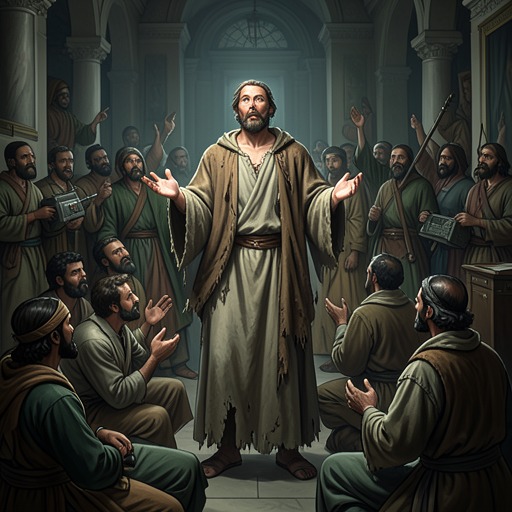
I will not take no for an answer
Don't Leave God Alone: How to Get God's Attention, Remain in His Presence, and Even Change His Mind to Make a Difference in Your World“I will not take no for an answer” names the determined posture at the heart of importunity, the refusal to abandon prayer when an answer appears delayed or circumstances argue against hope. In the book, persistence is not treated as impatience or presumption but as a disciplined way of holding on to God, continuing to ask, seek, and knock until blessing, deliverance, or change is released.
Meaning and Biblical Pattern
The expression is explicitly connected with Jesus’ teaching in Luke 11. Importunity is defined as being shameless, bold, pressing, entreating, and persistent in requesting. Its practical pattern is continual asking, continued seeking, and repeated knocking: prayer does not stop merely because the first request seems unanswered or heaven’s doors appear closed. The related command to “pray and not faint” in Luke 18:1 gives the expression its moral force. The petitioner is called to resist weariness and remain confident that an answer can come through determined prayer.
The midnight friend supplies the book’s central image. A man goes to a neighbor at a late hour because a guest has arrived and he has no bread to offer. His need is not confined to himself; persistence enables him to care for another person. He risks inconvenience, launches out at an unreasonable time, and keeps knocking until the neighbor opens the door and supplies what is needed. The episode therefore presents importunity as both bold dependence and practical intercession: the one who refuses to accept refusal seeks blessing in order to become a blessing to someone else.
Persistence Against Failure and Delay
The expression addresses the recurring failure of believers who give up after feeling that they have disappointed God in prayer. Embarrassment, fear that God is angry, and the memory of repeated failure can lead them to avoid prayer altogether. The book interprets that withdrawal as another form of leaving God alone, comparable to Adam and Eve hiding from God after they sinned. Instead of running away after failure, believers are urged to run toward God, ask forgiveness, and resume fellowship.
The same principle is applied to sickness, troubled marriages, and other circumstances. Silence is presented as surrender: what remains unaddressed in prayer is allowed to remain unchanged. The book contrasts unbelieving complaint with a righteous cry of faith, insisting that the cry must become louder than the circumstance declaring that there is no hope. Holding on to God until blessing comes is portrayed as the point at which circumstances can change and miracles can begin to unfold.
From Personal Prayer to Collective Intercession
“I will not take no for an answer” expands beyond private requests into a theology of intercession. The book describes the righteous cry as a force that must be louder than the cry of evil, drawing on Moses and Abraham as examples of people who stood before God on behalf of others. A believer is therefore not encouraged merely to protect personal interests but to refuse silence concerning churches, towns, cities, and nations.
This collective dimension is illustrated through prayer for the United States. During prayer for the nation, the narrator describes sensing God’s presence and hearing that the nation was being given another chance, as Nineveh had been. The message emphasizes that God was not finished with the United States and that earlier generations’ prayers still mattered. The narrator responds by identifying Moses as one who stood up for his people and argues that persistent intercession can likewise affect a nation’s future.
The book also identifies six demonic influences that persistence in prayer can confront in cities: violence, profanity, corrupt wisdom, defiled sanctuaries, iniquities, and terror or fear. Prayer is thus framed as active resistance rather than passive observation. A church troubled by its condition is told to pray; people disturbed by murder and crime in their town are told not to leave God alone until the numbers go down.
Storms, Churches, and Demonstrated Results
The expression is reinforced by an account of prayer concerning hurricanes in Florida. In 2004, while ministering at a conference in Jacksonville, Florida, the narrator prophesied that two storms would come in succession and that prayer could keep them away. People prayed during the first storm, but the hurricanes still came, suggesting that the initial response had not reached the required level of fervency.
The following year, the narrator again prophesied about a storm expected to rise from the Atlantic Ocean in a particular month, shortly before another conference. Hundreds of people prayed with greater determination and decided that the storm would not be allowed to enter as before. This time it did not hit them. The stated difference was not the absence of a threatening circumstance but the refusal to accept the previous result as final.
The account continues with a word received in late 2005 concerning 2006. The narrator says that God would place His feet over the nation and send storms out to sea. According to the book, no major hurricanes struck the United States in that year, although some attempted to do so. The example presents persistence as both individual and collective: people prayed collectively, individually, and fervently, and the book attributes the changed outcome to their decision not to leave God alone.
The early church in Acts 12 provides a parallel example under more severe stakes. Herod had killed James, the brother of John, and then imprisoned Peter, who appeared likely to suffer the same fate. The church did not rely on a natural campaign, a public demonstration, or an appeal to Herod’s generosity. Instead, it responded through diligent prayer. The church’s power is attributed to its refusal to let go of God, making persistent prayer the decisive response to political violence and imminent death.
Personal Witness and Final Invitation
The narrator gives a humorous personal example involving a sold-out college football bowl game. Unable to obtain tickets or a hotel room, the narrator and a friend flew to the game anyway, trusting that God would provide. Their determination seemed unreasonable to others, and the taxi driver responded with disbelief. At the hotel, after they had apparently failed to secure accommodation, a man called them back and offered a room vacated by another guest, along with two tickets on the fifty-yard line at face value.
The result becomes more than a travel success. The narrator and the friend praised God, and the narrator returned to the skeptical taxi driver, explained what had happened, and encouraged him to give his life to Jesus Christ. Persistence therefore produces two kinds of consequence in the book: it brings the anticipated provision, and it creates an opportunity for testimony and evangelism. What appears to others as a lack of common sense becomes, in the narrator’s interpretation, an occasion to demonstrate trust and speak about Jesus Christ.
The expression finally becomes a direct spiritual summons. Readers are asked to measure their persistence against the midnight friend and to approach God’s throne of grace with confidence rather than retreat when prayer seems ignored. The book insists that this posture is not only for personal needs; believers are to persist so that their lives can become points of contact through which others are touched by God’s power.
The closing invitation turns the expression into a decision and a practice. Readers who have never known Jesus Christ personally are urged to begin an intimate relationship with Him, spend quality time with Him every day, seek forgiveness, receive the Holy Spirit, and pursue deeper fellowship. The model prayer dedicates the believer’s life to refusing to leave God alone until blessing comes, while affirming belief that Jesus Christ died on the cross and rose from the dead. The final formula, “DLGA! Don’t Leave God Alone!” converts the expression from a memorable phrase into a continuing rule of discipleship: remain present, keep praying, and do not interpret delay as a reason to walk away.