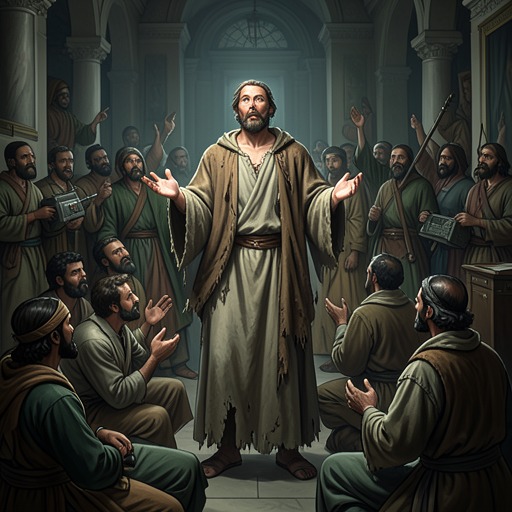
Jesus–blind Bartimaeus relationship
Don't Leave God Alone: How to Get God's Attention, Remain in His Presence, and Even Change His Mind to Make a Difference in Your WorldJesus–blind Bartimaeus relationship is defined by a tension between Jesus’s apparent distance and Bartimaeus’s refusal to stop calling. Bartimaeus is presented not as a passive recipient of mercy but as a determined petitioner whose persistence becomes the means by which his need is brought before Jesus and answered. His restored sight embodies the book’s central claim that faith continues to press toward Jesus even when circumstances and other people seem to say no.
Identity and Introduction
Bartimaeus appears in the book’s catalogue of biblical people who refused to leave God alone. He is identified as blind and as someone who continued seeking Jesus even when he was ignored and when other people attempted to prevent him from reaching the Lord. The account therefore introduces him through a social and physical limitation, but it gives greater narrative weight to his response: he would not permit blindness, public resistance, or apparent inattention to determine the outcome.
The book places Bartimaeus beside Jacob, Moses, Hezekiah, the persecuted church of Acts, and the Syrophoenician woman. Each example joins urgent need to persistence, but Bartimaeus’s case is especially direct. His need is visible, his access is obstructed, and his appeal must continue until Jesus responds. The relationship is thus framed as an encounter in which determination makes a seemingly overlooked person impossible to overlook.
Persistence Against Obstruction
Bartimaeus’s defining action is his refusal to leave Jesus alone. The book states that he persisted even while Jesus appeared to ignore him and while others tried to silence or restrain him. This resistance is not treated as insolence; it is interpreted as faith in action. Bartimaeus’s repeated appeal demonstrates the attitude later described as importunity: being shameless, bold, determined, pressing, entreating, and persistent in requesting.
The contrast between Bartimaeus and those around him gives the encounter its force. The crowd represents the pressure to accept delay or rejection, while Bartimaeus treats Jesus as the one person whose response matters. His persistence keeps the relationship open when social circumstances attempt to close it. The book’s emphasis falls less on the mechanics of blindness than on the moment when an excluded petitioner continues to address Jesus until his cry produces an answer.
This pattern is connected to the book’s broader teaching that Christians should not give up when they feel they have failed in prayer. Many people, the author argues, withdraw from prayer because they believe God is angry with them or because embarrassment makes renewed prayer difficult. Bartimaeus provides the opposite model: need does not justify retreat. Instead, the person in need is urged to continue pressing toward Jesus.
Healing and Relational Recognition
Bartimaeus’s determination results in the restoration of his sight. The healing is presented as the consequence of his refusal to stop rather than as an isolated display of power detached from his conduct. His relationship with Jesus moves from urgent calling, through resistance and apparent nonresponse, to direct intervention and restored vision.
The restored sight also carries relational meaning. Bartimaeus does not merely obtain relief from a condition; he receives access to a new way of seeing and, in the book’s formulation, follows Jesus after being healed. The encounter therefore joins physical restoration with discipleship. Jesus is the source of healing, while Bartimaeus’s response shows that receiving from Jesus includes continuing to orient one’s life toward Him.
The book uses this episode alongside promises of freedom and deliverance. It teaches that Jesus wants people to be free and that believers should use the Word of God and the name of Jesus, stand their ground, remain committed to deliverance, and stay connected to an anointed pastor. Bartimaeus functions as the biblical image behind that counsel: the petitioner keeps calling until the obstruction yields and freedom becomes visible.
The Relationship as a Model of Prayer
The relationship between Jesus and Bartimaeus is ultimately used as a practical theology of prayer. In the book’s discussion of Luke 11 and Luke 18, persistence means refusing to take no for an answer and continuing to pray without fainting. Bartimaeus supplies the narrative example of that principle. His faith is not measured by quiet resignation but by sustained appeal in the face of resistance.
This teaching is placed within a larger summons to maintain daily fellowship with God. The author describes hearing the Lord say, "Please don't leave," after he attempted to leave his prayer and study room, and he interprets that experience as evidence that God desires continued fellowship rather than brief, strictly measured contact. In that framework, Bartimaeus’s refusal to leave Jesus alone is more than a strategy for obtaining one miracle. It is a picture of the persistent relationship the book asks readers to cultivate.
The closing appeal extends the same pattern to readers who do not yet know Jesus Christ personally. The offered prayer asks for forgiveness, repentance, the presence of the Holy Spirit, and a life devoted to knowing Jesus more deeply. Its final commitment is to continue pursuing Him until blessing comes. Bartimaeus’s encounter therefore becomes a bridge from biblical story to present-day decision: his cry is treated as a pattern for anyone seeking healing, freedom, salvation, or a closer relationship with God.