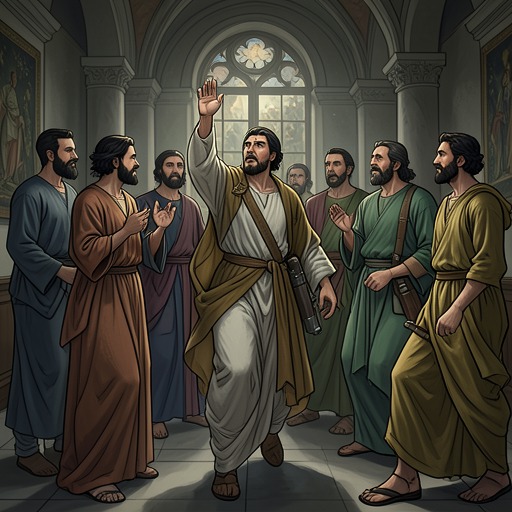
Jesus–disciples mentorship relationship
Don't Leave God Alone: How to Get God's Attention, Remain in His Presence, and Even Change His Mind to Make a Difference in Your WorldJesus–disciples mentorship relationship is defined by a movement from dependence on Jesus toward responsible participation in His ministry. The disciples are taught not only to receive His power but also to recognize His authority, endure apparent abandonment, speak in faith, and carry spiritual power outward to other people. Their formation takes place through instruction, crisis, correction, and repeated opportunities to act on what Jesus has already shown them.
Formation Through Command and Testing
Jesus’s mentorship includes deliberate periods in which the disciples must proceed without His visible presence. In Matthew 14, He sends them away in a boat and tells them to cross to the other side while He goes apart to be alone. A violent wind then tosses the boat, making the disciples feel exposed and doomed to failure. The separation is therefore not presented as rejection; it becomes a test designed to provoke a response and reveal what they have learned.
The command to reach the other side also establishes the goal of the test. Jesus wants the disciples to trust that His instruction contains an intended outcome: they are to arrive successfully rather than interpret the storm as proof that they have been abandoned. His apparent absence becomes part of the lesson, because it requires them to step into the power and faith they have been given instead of waiting passively for Him to intervene.
Correction Through Repeated Crisis
The disciples’ panic in the storm exposes a failure to apply earlier instruction. They had already witnessed Jesus deal with a storm in Matthew 8:23-27, where He rebuked them for unbelief. Yet, when another storm arises, they still do not draw on that previous experience. The narrative thus portrays mentorship as cumulative: an earlier revelation creates an obligation to remember and practice, not merely to admire what Jesus once did.
Two lessons are available to them. They could trust Jesus’s order to cross successfully, and they could learn to speak to the storm because Jesus had already shown them how He dealt with such circumstances. Their fear is not treated as the final definition of their discipleship. It marks the gap between witnessing power and exercising it, a gap that correction and continued training are meant to close.
Imparted Authority and Progressive Practice
The relationship joins Jesus’s example to the disciples’ future use of authority. The book compares their crossing with Moses crossing by means of his rod of authority and with Jesus overcoming obstacles through commanded action. Jesus wants the disciples to use their words as instruments of faith, reflecting the teaching that death and life are in the power of the tongue. The emphasis is not on instant mastery but on progressive growth, moving from revelation to revelation and from faith to faith.
This pattern reaches beyond the boat. In Luke 8 and 9, the twelve disciples are associated with the continuation of Jesus’s power after the account of the woman with the issue of blood and the two girls. They are no longer merely people who initiate contact with divine power or wait to receive a touch from Jesus. They are sent with power, becoming bearers through whom that power can reach others. The mature stage of the relationship therefore requires transmission: what the disciples receive from Jesus must become ministry directed toward the world.
From Recipients to Ministers
The disciples’ development is measured by whether they can touch others with the virtue Jesus has given them. A mature church is described as one that no longer remains like a person hemorrhaging from unresolved issues, but instead takes the power received from Jesus and brings healing and deliverance to other people. The disciples’ mentorship is consequently vocational as well as personal. Jesus forms them for visible works: laying hands on the sick, prophesying, operating in spiritual gifts, casting out devils, ministering the Word of God, and doing the works of ministry.
The relationship also supplies a model for believers who feel that God is not responding. The disciples’ storm is interpreted as a pattern in which apparent silence or distance may conceal a demand for faith-filled action. Their task is to continue toward the appointed destination, use what Jesus has taught them, and grow through the pressure rather than treating pressure as evidence that the relationship has failed.
Narrative and Theological Significance
Jesus–disciples mentorship relationship is presented as neither effortless protection nor simple obedience to commands. It is an apprenticeship in which Jesus teaches by example, withdraws at crucial moments, exposes the disciples’ unbelief, and then expects greater maturity. The same storm that reveals their panic also becomes the setting in which their unused resources are identified: memory, trust, speech, and authority.
The relationship’s final emphasis is multiplication. Jesus’s power is not meant to remain concentrated in the teacher while the disciples remain spectators. They are prepared to become instruments through which others encounter healing, deliverance, and the Word of God. Mentorship therefore culminates not in permanent dependence but in faithful continuation: the disciples must carry what Jesus has placed in them and use it for the freedom of others.