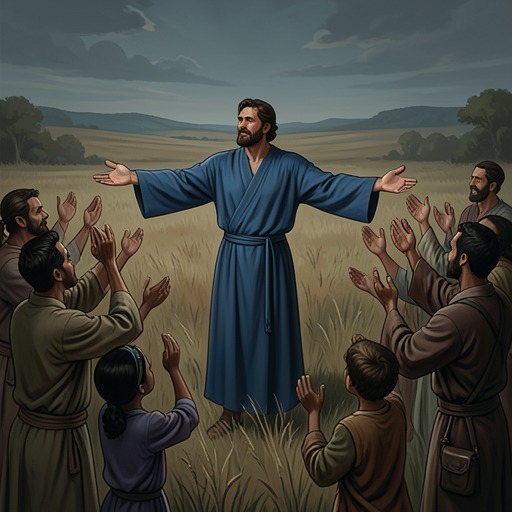
Jordan River
Don't Leave God Alone: How to Get God's Attention, Remain in His Presence, and Even Change His Mind to Make a Difference in Your WorldThe Jordan River is presented as the place where spiritual preparation becomes active inheritance. Elisha reaches it after following Elijah through a demanding sequence of tests, and there he must do more than remain near the memory of his mentor: he must take up Elijah's fallen mantle, act in faith, and cross into the new responsibility before him.
Setting and Symbolic Meaning
The Jordan River functions as a threshold rather than merely a geographical landmark. The book calls it "the place of crossing," the point at which a person steps into a heavenly inheritance and moves into God's purpose. Its meaning depends on motion: remaining on the near side would leave Elisha at the place where he witnessed Elijah's departure, while crossing requires him to advance into a future he has not previously occupied.
The river therefore completes the progression represented by Gilgal, Bethel, Jericho, and Jordan. These places test the heart and commitment of the person seeking God's power. Jordan is the final movement in that sequence, where endurance becomes transition and received anointing becomes exercised authority.
Elisha's Crossing
Elisha arrives at the Jordan after refusing repeatedly to leave Elijah. Elijah had taken him from Gilgal to Bethel, from Bethel to Jericho, and onward toward the Jordan, while Elisha insisted that he would remain with his spiritual father. When Elijah is taken up in a whirlwind amid a chariot and horses of fire, his cloak falls to the ground. Elisha picks it up, returns to the river, and strikes the water with it while calling for the God of Elijah to reveal Himself.
The river divides, and Elisha walks through. This action is the immediate proof that the mantle has not become a mere keepsake. The power associated with Elijah's ministry has passed to Elisha, and the crossing publicly confirms his succession. His earlier persistence receives a concrete consequence: by staying with Elijah through every stage, he is present when the mantle falls and is positioned to carry the work forward.
Crossing as Inheritance and Progress
The Jordan signifies the point at which preparation can no longer remain theoretical. Elisha does not receive the mantle in order to stand beside the river indefinitely; he must use it. The divided water turns the question of succession into an enacted answer, showing that his next step is not to recreate Elijah's departure but to continue the prophetic ministry under a new bearer of the anointing.
The book extends this meaning to believers who are waiting to enter a promised purpose. The mantle may come through people or leaders, but the recipient must choose to pick it up and move. Jordan is consequently associated with continual progress: crossing is an act of faith, and the blessing lies on the other side of the decision to advance.
Relation to Prayer and Spiritual Power
The Jordan also belongs to the book's larger teaching about refusing to leave God alone until His power comes. Elisha's persistence is not portrayed as passive admiration of Elijah; it is a determined pursuit that carries him through each testing place until he receives what he needs. At the river, that determination becomes visible in a physical gesture: the mantle is lifted, the water is struck, and the obstacle yields.
This pattern is contrasted with spiritual neglect elsewhere in the book. The author argues that people who seek God only during crises live dangerously, whereas regular prayer and daily commitment keep them under God's protective hand. Against that background, Jordan represents the positive result of sustained pursuit: the seeker does not merely ask for help in an emergency but is formed through repeated obedience until divine power can be carried into action.
Narrative and Thematic Significance
The Jordan River gathers several of the book's recurring images into one scene. It is a boundary like the storms and mountains that must be confronted, but it is crossed through a mantle rather than through human strength alone. It is also a place of recognition: Elisha discovers that the God who empowered Elijah has not departed with Elijah. The feared separation becomes a transfer of responsibility and power.
The river's divided waters thus provide the book's clearest image of spiritual succession. Elisha begins as a devoted follower, endures the four places of testing, witnesses the loss of his mentor, receives the fallen cloak, and crosses into his own ministry. The Jordan is the threshold where grief gives way to movement and where inherited calling becomes lived purpose.