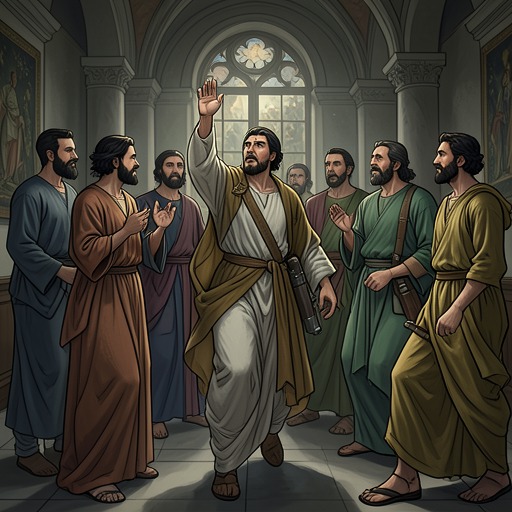
Peter
Don't Leave God Alone: How to Get God's Attention, Remain in His Presence, and Even Change His Mind to Make a Difference in Your WorldPeter, also known as Simon, functions as one of the book’s clearest examples of spiritual transformation through obedience, persistence, and dependence on God. His story moves between failure and abundance: an exhausted fisherman lowers only one net after an empty night, yet receives an astonishing catch; a wavering man becomes the stable “rock” associated with apostolic strength; and a prisoner is released while the church prays without ceasing. Across these episodes, Peter represents both the danger of settling for partial response and the possibility of becoming radically different through continued submission to God.
Identity and Introduction
Peter is introduced through both names that mark the stages of his character. The book explains that Simon’s name signified someone who could “bend in the wind like a reed,” whereas Peter meant “the rock.” This contrast gives his identity a built-in trajectory: he begins as a figure vulnerable to exhaustion, frustration, and human influence, but he is gradually understood as someone capable of stability and spiritual authority.
The discussion of changed biblical names places Peter alongside Abram becoming Abraham, Sari becoming Sarah, and Saul becoming the apostle Paul. In this framework, the new name is not merely a label; it identifies a new nature and a changed way of living. Peter therefore serves as evidence that spiritual identity can develop through a process rather than appearing fully formed at the beginning.
The Empty Nets and the Test of Obedience
One of Peter’s defining scenes occurs after he has fished all night without catching anything. He reports this failure to Jesus in words that convey both labor and discouragement: “Master, we have toiled all night and caught nothing.” Jesus then tells him to launch into the deep and let down his nets for a catch. Peter responds by lowering a single net rather than the plural nets Jesus commanded.
The result is still extraordinary. The catch is so great that the net begins to break, requiring partners in another boat to help; both boats are filled until they begin to sink. Peter and those with him are astonished by the abundance. Yet the book emphasizes that Peter’s response was incomplete. His weariness and frustration led him to do the minimum required rather than obeying the instruction exactly. The abundant catch therefore becomes a double-edged lesson: God’s blessing appeared despite partial obedience, while the unused nets represent the greater blessing Peter might have received through fuller compliance.
This episode establishes Peter as a figure caught between natural limitation and divine possibility. His failed night could have justified resignation, but Jesus redirects him toward deeper water. Peter’s action shows that obedience may begin in disappointment, while the scale of the catch shows how quickly a barren situation can be overturned when he acts on Jesus’s word.
Prison, Prayer, and Miraculous Release
Peter’s imprisonment in Acts 12 places him within a larger crisis facing the early church. Herod had already killed James, the brother of John, and then imprisoned Peter because he expected that Peter’s death would please the Jews. The church could have relied on political persuasion, public protest, or another natural strategy, but the book presents its decisive response as persistent prayer.
The church prayed for Peter without ceasing while he remained in prison. Its prayer is portrayed not as a brief religious observance but as an unwillingness to give up until Peter was released. The outcome confirms the book’s central principle: Peter escaped prison because the church continued to pray. When he arrived at the house where the believers were gathered, they were so surprised that they initially thought he was a ghost. Their astonishment reveals a tension within the scene: they had prayed for an answer, yet the answer exceeded what they seemed prepared to recognize when it appeared at their door.
Peter’s release also connects his personal deliverance to the spiritual condition of the church. The church’s power does not arise from a substitute method or external influence, but from sustained corporate attention to God. Peter is the endangered apostle at the center of the crisis, while the praying community becomes the instrument through which his imprisonment is reversed.
Transformation from Simon to Peter
The book uses Peter’s name change as a compact image of progressive spiritual formation. Simon’s reed-like instability suggests a person who bends according to pressure, fatigue, or the direction of surrounding forces. Peter’s rock-like name points toward firmness. The movement between the two names reflects the book’s teaching that people possess an old nature and a new nature, and that whichever nature they continually nourish becomes dominant.
Prayer, worship, the Word of God, and daily righteous choices are presented as ways of feeding the new nature. Peter’s transformation therefore does not rest on a single emotional moment alone. It develops through repeated decisions that redirect him from instability toward steadfastness. The book specifically describes the process as a series of things that brought Simon from a person bending in the direction of human influence into a stable rock who later became a mighty apostle of the Lord.
Peter’s arc also clarifies the book’s distinction between instant intervention and gradual change. The miraculous catch is immediate, and his prison release is sudden, but the formation of his character takes time. His story joins outward miracle and inward development: God can alter circumstances swiftly, while a disciple must continue walking into a new standard of life.
Narrative and Thematic Significance
Peter embodies the book’s recurring contrast between a limited response and an abundant one. The single net stands for obedience reduced by fatigue; the breaking net and sinking boats reveal what becomes possible when divine instruction is acted upon, even imperfectly. His imprisonment and release shift the emphasis from individual action to the church’s collective refusal to abandon prayer. Together, the episodes make Peter both participant and testimony: he receives deliverance, but his story also teaches others how to pursue God through failure, delay, and danger.
His place in the narrative is especially important because he is not presented as a flawless spiritual hero. The book’s explanation of his two names preserves the memory of weakness within the account of maturity. Peter’s instability is not erased; it becomes the background against which his later solidity can be understood. In that sense, Peter’s significance lies less in an isolated miracle than in the pattern his life illustrates: frustration need not end pursuit, partial obedience need not define a person forever, and a disciple who continues to respond to Jesus and remain within persistent prayer can become someone markedly different from the person who began the journey.