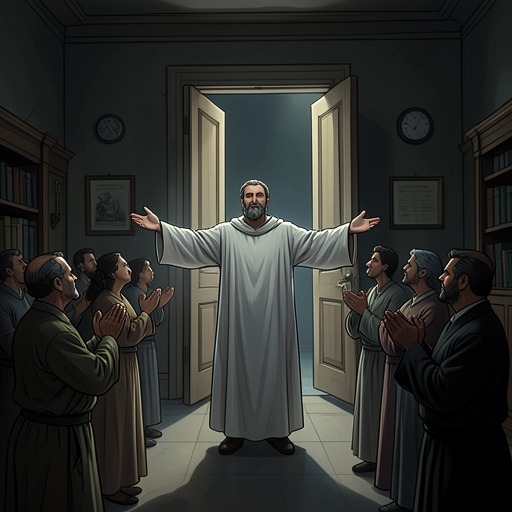
Samson’s destruction of the Philistine temple
Don't Leave God Alone: How to Get God's Attention, Remain in His Presence, and Even Change His Mind to Make a Difference in Your WorldSamson’s destruction of the Philistine temple is the decisive final act in Samson’s movement from consecrated strength to bondage and then to a last, costly recovery of purpose. The temple becomes the place where his humiliation is reversed: the man brought out for public ridicule reaches the pillars of the structure and pulls them down, killing the enemies who celebrate his captivity and demonstrating that failure does not necessarily have the final word.
Causes and Background
Samson’s story begins with a calling rather than with rebellion. In Judges 13–16, he is described as a man to whom God gave supernatural strength to defeat the enemy, and as a Nazirite from his mother’s womb. His Nazirite vows represented consecration, dedication, and purity before God. Yet the places Samson entered and the choices he made increasingly gave the appearance that he was compromising the commitment attached to his calling.
The movement toward bondage is presented as progressive. Timnath represents the point at which a person feels conviction about a course of action but continues toward it anyway. Samson then reaches Gaza, associated in the book’s interpretation with strength, after ignoring those earlier convictions; compromise has become a stronghold. He repeatedly breaks his vows and lies about doing so. The final compromise involving Delilah destroys what remained of his liberty: Samson loses both his anointing and his strength.
The Philistines then bind Samson in chains and remove his eyes. His physical blindness becomes an image of the spiritual blindness produced by strongholds. The man once empowered to defeat the enemy is reduced to a captive whose own repeated decisions have helped create the conditions of his humiliation. The event at the temple therefore grows out of a long chain of choices rather than appearing as an isolated explosion of violence.
The Temple Scene
The Philistines bring Samson to a celebration of his captivity. They want him displayed before everyone so that they can laugh at his defeat. The scene concentrates the reversal that has taken place in his life: his former strength is now a spectacle for his enemies, and his blindness makes him an object of public mockery.
Samson is placed between two pillars. Instead of surrendering to the role assigned to him, he asks a young boy to help him lean against the supports because he intends to pull them down. The pillars are interpreted as images of the strongholds and bondages that occupy the center of many lives. Their physical position gives the scene its symbolic force: Samson’s deliverance requires him to confront the structures that hold him and that have become instruments of his disgrace.
When Samson pushes against the pillars, supernatural strength returns to him. The temple collapses, killing the people inside, including Samson himself. The act is therefore simultaneously Samson’s restoration and his death. He regains the capacity to strike the Philistines, but he does not survive the destruction he causes; the power that reverses his captivity also brings his earthly story to its end.
Reversal, Repentance, and Consequences
The book treats Samson’s final act as evidence that he did not give up even after failing God terribly. His recovery begins not with the denial of his wrongdoing but with determination to correct what he has done. He refuses to leave God alone until the error is addressed, and this persistence is described as the path to his deliverance.
The destruction of the temple changes the apparent meaning of Samson’s life. During his captivity, the Philistines believe they are celebrating a completed victory. Their laughter frames Samson as defeated, bound, and blind. The falling pillars overturn that judgment: the captive becomes the agent of the temple’s collapse, and the public celebration becomes the setting for the Philistines’ destruction.
The account emphasizes the scale of the final consequence by stating that Samson killed more in his death than in his life. His final achievement is thus greater in immediate effect than the victories associated with his earlier strength, even though it comes at the price of his own life. The ending does not erase the damage caused by his compromises, but it shows that repentance can alter the direction and final meaning of a ruined life.
Theological and Narrative Significance
Samson’s destruction of the Philistine temple functions as a deliverance narrative for people who believe their past choices have placed them beyond recovery. The message is not that compromise is harmless; Samson loses his anointing, strength, sight, and freedom, and the consequences are severe. The message is that those consequences do not prevent a determined return to God. Jesus is presented as willing to help people regardless of what they have done, while Samson’s restored strength illustrates the possibility of confronting and tearing down the strongholds that bind them.
The event also extends the book’s larger argument about persistent spiritual action. Elsewhere, prayer is said to protect people in danger, to oppose violence and fear, and to require continued determination when an initial effort seems ineffective. Samson’s final movement follows the same pattern in dramatic form: he has failed, endured the consequences, and still acts rather than accepting captivity as permanent. His hands on the pillars become the physical counterpart of refusing to accept defeat.
As a tragic reversal, the event holds together two truths that the narrative does not simplify. Samson’s deliverance is real, but it is not a return to an untouched past; it comes through sacrifice and ends in death. The temple falls, the Philistines are killed, and Samson’s name is remembered through a final act that is both judgment on his enemies and testimony to the possibility of restoration after profound failure.