Silas
Don't Leave God Alone: How to Get God's Attention, Remain in His Presence, and Even Change His Mind to Make a Difference in Your WorldSilas appears in the book primarily through the prison episode he shares with Paul, yet that episode gives him a decisive narrative function. Chained in confinement at midnight, he joins Paul in prayer and praise, and their worship is followed by an earthquake that opens the prison doors and releases every prisoner. Silas therefore stands as a witness to the book’s larger theology: freedom begins when devotion continues at the hour when circumstances seem most hopeless.
Identity and Narrative Setting
Silas is named as Paul’s companion in the account of their imprisonment. The evidence does not provide his origin, personal history, or independent motives, so his characterization rests on what he does under pressure rather than on biographical description. He is not introduced through status or explanation but through shared suffering, where his partnership with Paul becomes the essential fact of his presence.
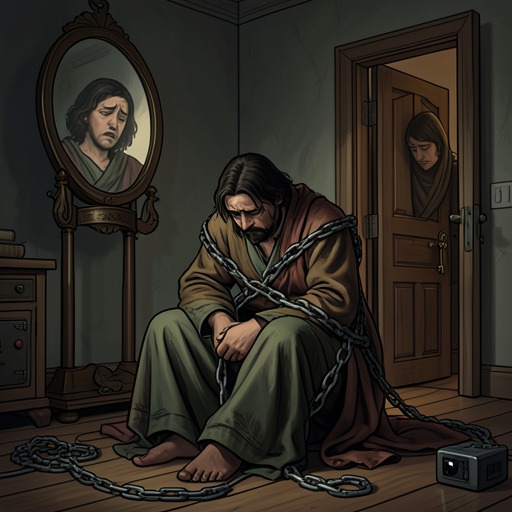
The episode is interpreted through the book’s concept of “prison spirit,” a metaphor for inward and outward forms of bondage. Paul’s natural prison experience is treated as an image of spiritual chains: one kind of bondage is hidden within a person, while another is visible to others. Silas’s place in this framework is practical and exemplary. He is one of the imprisoned men who refuses to let confinement define the final outcome.
Worship at Midnight
The defining action occurs at midnight, described as the darkest hour. Silas does not wait for visible evidence that conditions have improved before worshiping. Instead, he joins Paul in prayer and song while the pain and humiliation of bondage remain present. Their praise is therefore portrayed not as a response to release but as an act that precedes it, a deliberate elevation of God above personal failure, suffering, and fear.
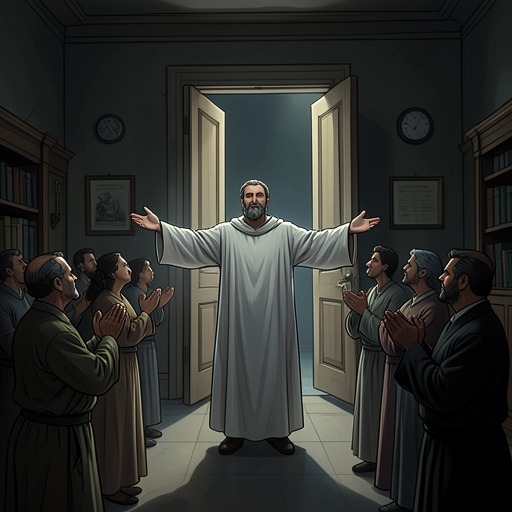
The account emphasizes that the other prisoners heard Paul and Silas praying and singing. Their worship is consequently both private devotion and public testimony: it changes the atmosphere around them before the physical prison changes. The narrative gives the paired voices a communal force, making Silas part of an audible declaration that captivity is not sovereign.
The Earthquake and Release
The turning point follows suddenly. After Paul and Silas pray and praise God, a great earthquake shakes the foundations of the prison; the doors open, and everyone’s chains come loose. The consequence extends beyond the two men. Their worship is associated not merely with their own release but with the loosening of every prisoner’s bands, giving Silas’s action a corporate dimension.
The book presents this reversal as the result of persistence. Paul and Silas could have remained bound, and the text specifically stresses that they would not have been free if they had abandoned God in worship. Silas’s significance lies in this refusal to stop at the moment when stopping would have seemed most reasonable. Midnight becomes the threshold between continued bondage and unexpected freedom.
Relationships and Thematic Significance
Silas’s principal relationship is with Paul, and the narrative defines it through unity in prayer, song, danger, and deliverance. Neither man is treated as acting alone. Their partnership shows worship as a shared discipline, one person’s persistence reinforcing the other’s when circumstances offer no encouragement. Silas is thus not a passive companion but an active participant in the response that the book identifies as spiritually decisive.
His story is also connected with the three Hebrew boys, who likewise worshiped rather than submit to bondage. The comparison places Silas within a recurring biblical pattern in which worship becomes a cry for deliverance. The book further links worship with David’s playing before King Saul, when evil spirits departed in the atmosphere of praise. Across these examples, Silas helps establish a repeated contrast between captivity and exaltation: bondage claims the body and mind, while worship reorders attention toward God and opens the way to freedom.
Because the book supplies no later episode for Silas, his ending is the ending of the prison scene rather than a developed personal arc. He emerges as a concentrated emblem of steadfastness: a man whose identity is revealed by what he continues to do when release has not yet appeared. His narrative role is to make persistence visible, audible, and consequential, turning a midnight prison into the setting for deliverance.