Spiritual blindness
Don't Leave God Alone: How to Get God's Attention, Remain in His Presence, and Even Change His Mind to Make a Difference in Your WorldSpiritual blindness is the condition in which a person cannot perceive God's presence, power, direction, or promises, even when they are near enough to receive them. In the book's framework, it is both an inward state and a consequence of spiritual bondage: the eyes may be physically damaged, the mind may remain shaped by past failure, or fear may obscure the heavenly resources already available. Against that blindness, the recurring remedy is determined pursuit of God until perception and action are restored.
Definition and Spiritual Pattern
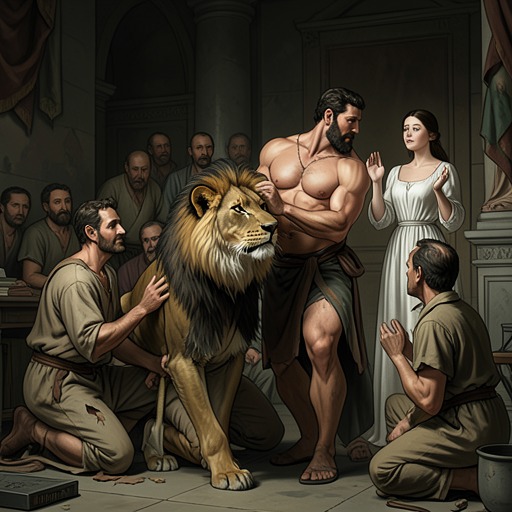
Spiritual blindness appears most explicitly in the account of Samson. After repeatedly breaking his vows and compromising his convictions, Samson lost both his anointing and his strength. The Philistines then bound him in chains and poked out his eyes, making his physical condition an outward picture of the spiritual stronghold that had already developed in his life. The book therefore connects compromise with a progressive loss of sight: what begins as ignored conviction can end in bondage, captivity, and an inability to see clearly.
The image also carries a broader meaning. A stronghold does not merely restrict movement; it distorts a person's awareness of what is possible and of where deliverance may be found. In Samson's case, the Philistines represent demonic spirits, while his blinded eyes represent the way bondage prevents a person from recognizing the truth or responding freely to God. His public humiliation, when the Philistines brought him to their celebration so they could laugh at his defeat, shows the social consequence of this condition as well as its inward pain.
Resistance, Battle, and Perception
The book associates spiritual sight with the testing ground of Jericho. Jericho is described as the place where resistance is confronted, the powers of darkness are opposed, and an overcoming spirit is developed. Its walls symbolize intimidating obstacles, but the emphasis is not simply on the existence of opposition; it is on learning to recognize and use God's power in the face of opposition.
The contrast between visible and hidden battles is developed through the images of lions and bears. Lions represent outward attacks that appear suddenly and roar in order to make a person feel powerless. Bears represent inward battles that may seem dormant before returning in a later season, hungrier than before. Suppressing such problems is not considered genuine deliverance. Spiritual sight requires recognizing recurring inward bondage as well as obvious external threats, then confronting both through the spiritual weapons and anointing the book attributes to God.
This pattern reaches its clearest biblical expression in Elisha's encounter with the surrounding army. When Israel was encircled by a great enemy force, Elisha caused his servant's eyes to be opened so that he could see a heavenly army greater than the army threatening them. The servant's circumstances had not yet changed, but his interpretation of those circumstances did. What had looked like helpless isolation was revealed as supernatural protection. Spiritual sight thus changes the field of battle before it changes the visible outcome: it allows the threatened person to act from the reality of God's greater power rather than from the apparent dominance of the enemy.
Blindness After Deliverance
Spiritual blindness can remain even after a person or dream has been released. The account of Lazarus supplies the book's most developed metaphor for this persistence. Lazarus came out of the tomb alive, yet he was still bound in graveclothes around his hands, feet, and face. The book applies those bindings to revived dreams and destinies: resurrection is real, but former habits and mental patterns can continue to restrict the new life.
The bindings on Lazarus's face represent several forms of continuing blindness. Covered eyes signify a lack of vision, direction, or fresh purpose. A covered mouth prevents a person from speaking and declaring God's Word. Covered ears prevent the hearing of a fresh rhema word and leave only the negative voices of the past. Restricted thoughts keep a person interpreting the present through former failures, mistakes, and disappointments rather than through a renewed mind. In this sense, spiritual blindness is not only failure to see; it is also failure to speak, hear, and think in accordance with new life.
The command to remove the graveclothes establishes an important distinction between revival and freedom. A dream may come out of the grave, yet remain limited if its old mental and behavioral restraints are not removed. The destiny does not end at the tomb, and the person must not remain there celebrating a breakthrough while still unable to move forward. Spiritual sight is therefore part of the continuing work of deliverance, not merely the first sign that deliverance has begun.
Persistence as the Antidote
The book repeatedly places spiritual blindness in tension with persistence. Jacob's struggle at Peniel is interpreted as an encounter with God Himself, and the significance of the episode lies in Jacob's refusal to stop before receiving the blessing and answer he needed. The lesson is that God is not distant or unreachable, even when circumstances make Him seem a million miles away. He is within reach, but persistent faith must press toward Him until the answer becomes manifest.
The same principle governs the book's reading of prayer. Luke 11 presents persistence as continual asking, seeking, and knocking: asking without quitting, seeking without abandoning the search, and knocking even when heaven appears closed. Importunity is not passive waiting for God to initiate contact; it is a refusal to leave the relationship to occasional attention. The woman with the issue of blood embodies this active movement. After twelve years of suffering and after trying every other option, she initiated contact by pressing through the crowd to touch the hem of Jesus's garment. Her action exchanged her weakness for His strength and expressed confidence that she would be made whole, even though Jesus was moving in another direction and appeared positioned to overlook her.
The hem itself becomes a concrete image of refuge and renewed strength. It was the lowest part of Jesus's garment, and reaching it required the woman to act from her lowest point of need. The book connects the garment's border with the tassels, or “wings,” of the Jewish prayer shawl and with the biblical imagery of healing and refuge under God's wings. Spiritual blindness is answered when desperation does not produce withdrawal but reaches toward God's presence.
Prayer, Blessing, and Restored Sight
The book also uses the image of a rain cloud to explain how persistent prayer restores spiritual expectancy. Prayer and sacrifice fill a heavenly account, just as moisture forms a cloud; when the cloud is full, it releases rain as blessing. A desert with little rain is compared to a life marked by little prayer and no sacrifice. The metaphor makes spiritual dryness a condition of depleted participation rather than proof that blessing has ceased to exist.
This model links sight with readiness. A person who regards the apparent drought as the whole truth may remain passive, but one who continues praying recognizes that unseen accumulation is taking place. Persistence fills the cloud until blessing can be released. The same logic underlies the book's insistence that spiritual blindness must not be mistaken for divine absence: an unanswered prayer, a threatening circumstance, or a revived dream still covered in graveclothes may conceal God's activity without disproving it.
The personal testimonies reinforce that claim through crises in which ordinary perception seemed to offer no hope. On a dark interstate, the narrator saw a man lying in the highway after being struck by a car; the scene appeared to be a fatal emergency, yet the narrator responded by relying on an established relationship with God. In another account, an elderly hospital patient lay unresponsive in a coma, and the narrator believed the person would die at 4:00 p.m. unless someone intervened so that the patient could awaken and hear the gospel. A newborn girl with a failing liver, a blood disease, and only an 11 percent chance of living likewise seemed to be slipping beyond recovery while the church prayed and continued speaking God's promises of healing.
The same testimony pattern appears in the narrator's family crisis. After a fever of 104 degrees during a July 4 camping trip, the narrator's wife's father seemed to recover, but the fever returned in December. Doctors discovered a ruptured bowel and severe infection, followed by septic shock, a medical coma, a temperature of 105 degrees, multiple-organ and renal failure, dialysis, and a ventilator. These conditions were treated as the visible evidence of a dying dream, yet the family's continued faith became an insistence that the apparent ending was not the final reality. Even a neighbor who fell from a highway overpass and landed in mud, unable to move and feared to have brain damage, is presented as a life preserved amid circumstances that seemed to dictate death.
Spiritual blindness therefore names the gap between what circumstances display and what persistent faith perceives. Its images move from Samson's blinded eyes, to Elisha's servant seeing the heavenly army, to Lazarus's covered face, to the woman's hand reaching for Jesus's garment. Across those scenes, blindness is not overcome by denial of danger but by refusing to let danger define the whole field of vision. The book's central claim is that continued contact with God—through prayer, resistance, faith-filled speech, and determined pursuit—can expose hidden help, remove inherited restraints, and lead a person from captivity into purposeful action.