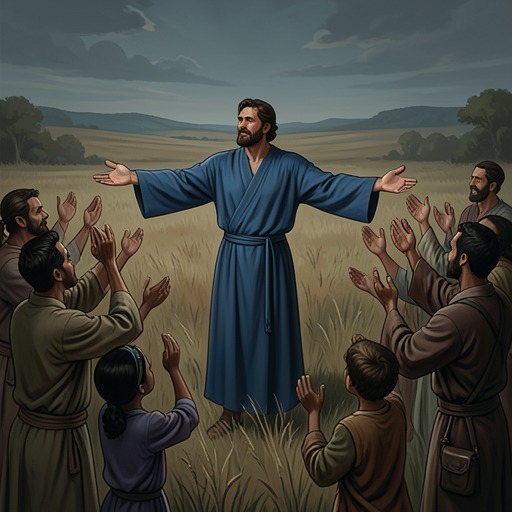
The Shunammite woman receives a son
Don't Leave God Alone: How to Get God's Attention, Remain in His Presence, and Even Change His Mind to Make a Difference in Your WorldThe Shunammite woman receives a son when Elisha prophesies that her barrenness will end, an event the book presents as a concrete expression of God’s power to make barren things fruitful. The episode also becomes part of the book’s larger argument that persistent pursuit of God can bring an apparently impossible promise into visible life.
Background and Participants
The event belongs to the sequence of miracles associated with Elisha after he passes through the spiritual places of testing. The book treats those tests as preparation for a ministry marked by extraordinary interventions, and it places the Shunammite woman’s experience among twelve examples of what may follow when people refuse to leave God alone. Elisha is the prophetic agent through whom the promise is spoken, while the woman is the person whose previously barren condition becomes the focus of that promise.
The event is also presented as an example for readers rather than as an isolated biblical curiosity. The book lists Jacob, Moses, Hezekiah, the church of Acts, the Syrophoenician woman, and blind Bartimaeus as people who persisted until blessing, deliverance, healing, or intervention came. In that company, the Shunammite woman represents the possibility that a life described by lack can receive a new future through divine action.
The Prophecy and Its Fulfillment
Elisha prophesies that the barren woman will have a child. The book emphasizes the reversal contained in that declaration: what had not produced life will bear fruit. The promise is therefore more than a prediction of pregnancy; within the book’s teaching framework, it illustrates the prophetic capacity that comes from seeking the heavenly Father. Those who pursue God may speak words that come to pass, and barren areas of life may become productive.
The miracle is explained through the book’s seed imagery. Everything in the kingdom is described as beginning with a seed, and lasting fruit grows from what is planted and cultivated. The Shunammite woman’s son functions as the visible outcome of a condition that had been barren, making the event a narrative picture of delayed fruitfulness becoming tangible. The account is not expanded with a detailed scene of the child’s birth, but its consequence is stated clearly: a barren woman receives a child through Elisha’s prophetic word.
Connection with Elisha’s Other Miracles
The son’s birth is one movement in a broader pattern of restoration. In the same catalogue, Elisha parts the Jordan River, heals bad water with salt, brings water to a valley without wind or rain, multiplies a widow’s oil, raises the Shunammite woman’s dead son, neutralizes poisoned stew, makes a lost axe head float, opens a servant’s eyes to the heavenly army, and signals victory through an arrow. These miracles move across nature, provision, illness, danger, perception, warfare, and death.
The placement of the woman’s pregnancy beside these acts gives it a distinctive emphasis. The multiplied oil meets an existing debt, while the restored axe head recovers a lost tool; the Shunammite woman’s son represents new life emerging where fruitfulness had been absent. The later raising of the same woman’s son extends that pattern from the arrival of life to the restoration of life after death, although the book treats the birth and resurrection as distinct events.
Consequences and Significance
The book draws a direct lesson from the event: when people seek God, they may receive power to prophesy things that will come to pass, and barren things may bear fruit. The woman’s experience thus becomes a promise-shaped model for readers facing dead ends, infertility of circumstances, or long-standing frustration. It is used to encourage confidence that God can alter conditions that appear fixed.
This application is joined to a broader call to persistence. The book urges readers not to retreat when their issues have continued for many years, but to initiate contact with God’s power and continue seeking Him until those issues stop. The Shunammite woman’s son therefore carries both a result and a method: the result is fruitfulness, while the method is sustained reliance on God rather than resignation to barrenness.
The episode also participates in the book’s tension between failure, shame, and return. Elsewhere, sin and compromise are compared with hiding behind fig leaves, while readers who have failed are told to run back to God rather than conceal themselves. The promise of the Shunammite woman’s child belongs to the same theology of return and confidence: human limitation does not have to be the final covering or final verdict. God’s intervention can create a future where the prior condition offered none.
Narrative and Theological Role
As a story within the book’s catalogue of biblical persistence, The Shunammite woman receives a son is less a fully dramatized episode than a concentrated testimony. Its force comes from the contrast between barrenness and fruit, impossibility and fulfillment, absence and the arrival of a child. Elisha’s prophetic speech acts as the hinge between those states, while the woman’s experience supplies the concrete evidence for the book’s claim that divine power can transform circumstances.
The event ultimately supports the book’s central exhortation that one person’s pursuit of God can produce consequences beyond private comfort. Just as other persistent figures are said to have affected nations, healed families, or altered the course of events, the Shunammite woman’s promised child embodies a future brought forth through divine intervention. Her story is consequently remembered not only as a miracle of childbirth, but as an invitation to expect fruit where life has seemed absent and to continue seeking God until the promised change becomes visible.