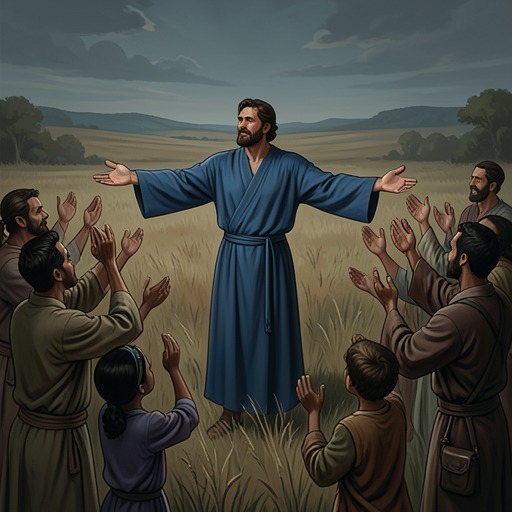
Elisha reveals the heavenly army
Don't Leave God Alone: How to Get God's Attention, Remain in His Presence, and Even Change His Mind to Make a Difference in Your WorldElisha reveals the heavenly army in the midst of an apparently hopeless military crisis, making spiritual protection visible to a terrified servant. The episode’s decisive significance lies in its reversal of perspective: the enemy is real, but it is not the greatest power present. Prayer opens the servant’s eyes to a heavenly host greater than the forces surrounding the city.
Crisis and Hidden Protection
The servant rises early and sees that the city is surrounded by a great army. His first response is terror, because the visible circumstances suggest that Elisha and those with him are trapped and outnumbered. The scene establishes the central contrast on which the episode depends: human sight registers enemy soldiers and imminent danger, while the spiritual realm contains a larger force that ordinary perception has concealed.
Elisha does not respond by denying the danger or by treating the servant’s fear as evidence that the situation is hopeless. Instead, he tells him not to fear and insists that those with them are more numerous than those with the enemy. His confidence rests on a reality the servant cannot yet see, so the reassurance initially sounds impossible from the standpoint of the city’s visible circumstances.
Elisha’s Prayer and the Opening of Sight
Elisha prays that the servant’s eyes will be opened into the spirit. The prayer does not create the heavenly army; it discloses the protection already present around them. The servant’s need is therefore not merely for courage but for a transformed apprehension of reality, one capable of recognizing divine resources beyond the reach of natural sight.
The Lord answers Elisha’s prayer. The servant sees the mountain full of horses and chariots of fire surrounding Elisha. The image converts hidden protection into a concrete vision: the heavenly host is not distant or abstract but positioned around the prophet while the enemy army surrounds the city. What looked like isolation is revealed as encirclement by a superior power.
The Heavenly Army and the Majority of Power
The account presents the heavenly army as more numerous than the enemy soldiers. The book uses this detail to teach that the righteous are not abandoned when hostile forces appear dominant. Elisha’s servant sees the potential for a fight and is filled with terror, but the opened vision shows that the balance of power has never favored the enemy as much as visible circumstances implied.
The passage is also connected to the book’s broader account of angelic protection. Those who fear God are described as people who stay close to Him, pursue Him, and refuse to leave Him alone in persistent prayer. Psalm 34:7 is invoked as a promise that the angel of the Lord encamps around those who fear God and delivers them, while Hebrews 1:14 is used to describe angels as sent to minister for the heirs of salvation.
The explanation extends beyond this single scene: the book states that one-third of the angels fell when Lucifer fell, leaving two-thirds of heaven’s angels available to God’s people. Within that theological framework, the vision of horses and chariots of fire becomes evidence that the righteous possess the majority of spiritual forces, even when their immediate surroundings appear controlled by danger.
From Revelation to Spiritual Battle
Elisha’s revelation is treated as a model for believers facing battles they cannot win by natural means. In a later list of Elisha’s works, the opening of his servant’s eyes is presented as an anointing that enables God’s people to see prophetically and supernaturally so that they can win great battles. The event therefore functions not only as an account of protection but also as an example of spiritual discernment: victory begins when the threatened person recognizes the forces aligned with God.
This emphasis belongs to the book’s larger teaching on persistent prayer. The author argues that prayer can affect cities and nations, oppose violence, profanity, corrupt wisdom, defiled sanctuaries, iniquity, and terror, and mobilize believers into collective action. The heavenly army supplies the unseen dimension of that struggle. Persistent prayer is portrayed as the human response that keeps believers close to God, while angelic beings work around them in deliverance.
Narrative and Thematic Significance
The episode’s dramatic movement runs from alarm, through Elisha’s calm assurance, to supernatural recognition. Its central reversal is not the disappearance of the enemy but the unveiling of a greater presence. The servant’s circumstances change first in interpretation: what he thought was an isolated and doomed position becomes a place surrounded by heavenly defense.
For the book, Elisha reveals the heavenly army as a recurring promise that visible opposition does not define the whole situation. The event encourages believers to resist fear, continue in prayer, and expect divine help even when no natural solution is available. Its final force lies in the opened eyes of the servant: the battle is real, but the unseen army around the righteous is greater.