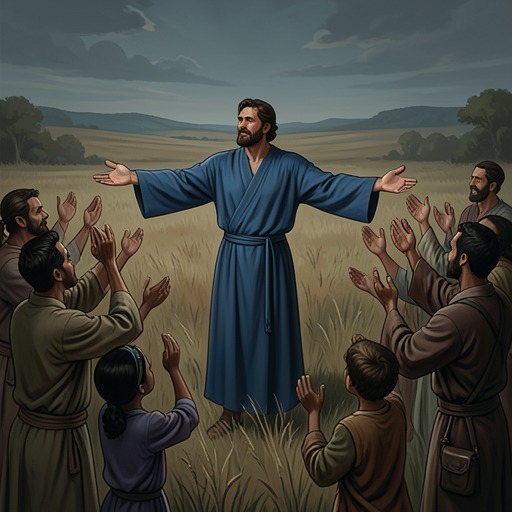
Elisha reveals the heavenly army at Dothan
Don't Leave God Alone: How to Get God's Attention, Remain in His Presence, and Even Change His Mind to Make a Difference in Your WorldElisha reveals the heavenly army at Dothan in a scene where visible danger is overwhelmed by an unseen but superior reality. When Israel is surrounded by a great army, Elisha’s servant responds with terror, but Elisha perceives that the decisive issue is not the enemy’s proximity; it is the servant’s inability to see the protection already present. Elisha therefore prays for his servant’s eyes to be opened, and the servant sees the mountain filled with horses and chariots of fire around Elisha.
Crisis and Visible Danger
The episode begins with Israel surrounded by hostile forces, creating the immediate prospect of battle and defeat. The servant rises early, goes out, sees the army encircling the city, and is filled with fear. His reaction represents the logic of ordinary sight: the enemy is visible, numerous, and close, while deliverance appears absent. The scene’s tension depends on that restricted vision, since the threat is not denied but placed within a larger spiritual field.
The contrast between the servant’s terror and Elisha’s composure establishes the prophet’s distinctive authority. Elisha does not answer the military situation with a natural strategy or an attempt to calculate the enemy’s strength. Instead, he insists that those with Israel are more numerous than those arrayed against it. The claim sounds impossible from the servant’s perspective until prayer changes what can be perceived.
The Opening of Spiritual Sight
Elisha’s decisive action is prayer. He asks the Lord to open the servant’s eyes, and the request produces revelation rather than merely reassurance. The servant is permitted to see into the spirit, where the mountain is full of heavenly horses and chariots of fire surrounding Elisha. The enemy army remains part of the situation, but it no longer defines the situation.
The revelation transforms fear through a change in scale. What seemed like an isolated prophet facing overwhelming forces is shown to be a protected servant surrounded by a heavenly host. Fire and chariots also connect the scene with the book’s recurring imagery of divine power and deliverance. The spiritual realm is not presented as distant abstraction; it is active around people who pursue God and remain close to Him.
Protection, Prayer, and Persistent Faith
The event becomes a central example of the book’s teaching that prayer keeps believers from leaving God alone in moments of danger. The text presents angelic beings as sent to minister for the heirs of salvation and cites the promise that the angel of the Lord encamps around those who fear Him and delivers them. In this interpretation, fearing God means remaining near Him, pursuing Him, and continuing in prayer rather than turning to God only when a crisis becomes visible.
The heavenly army is also used to explain why persistent prayer is necessary in public and personal emergencies. The book links prayer with protection during war, hurricanes, tornadoes, accidents, and medical crises. It argues that prayer coverage can be abandoned when an emergency fades from public attention, leaving people exposed to danger. The Dothan vision supplies the theological image behind that warning: deliverance may already be present, but faith must continue to seek and recognize it.
The same principle appears in the author’s accounts of storms. During one tornado threat, the author and his wife spoke to the storm, then fled to the basement when a branch struck the house; the tornado passed, but the experience exposed their incomplete understanding of how to confront danger in faith. In another incident, after they declared that Jesus would calm a forming tornado, the storm dissipated. These stories do not erase the earlier failure; instead, they reinforce the book’s claim that spiritual growth is progressive and that believers must continue lifting their “rod of power” even when circumstances do not immediately change.
Collective Action and Spiritual Perception
The Dothan event is extended beyond an individual lesson into a model of collective responsibility. The book argues that persistent prayer can affect cities and nations, citing the author’s interpretation of storms in Florida. A first year of prayer did not prevent predicted hurricanes, but the following year hundreds prayed with greater fervency, and the named storm did not strike the region. The author further connects widespread prayer with the absence of major hurricanes hitting the United States in 2006.
The same framework is applied to war. After the September 11 attacks, churches and prayer meetings filled as people sought God, but the renewed hunger lasted only a short time. The book contrasts the rapid seizure of Baghdad after twenty-one days with the later period of deaths and widespread violence, attributing the difference, in part, to the decline of prayer for military personnel. Whether the threat is an army surrounding a city or a public crisis unfolding across a nation, the narrative treats prayer as sustained spiritual coverage rather than a temporary reaction.
This collective dimension also informs the discussion of cities and nations. The book calls believers to pray against violence, profanity, corrupt wisdom, defiled sanctuaries, iniquity, and terrorism or fear, drawing these dangers from its reading of Ezekiel 28. Silence is portrayed as surrendering public space to demonic influence, while determined prayer gives ordinary believers a role in resisting it.
Narrative Significance
Elisha’s revelation of the heavenly army functions as a reversal from terror to recognition. The servant first sees an apparently conclusive defeat; prayer then discloses that the visible enemy is outnumbered by heavenly forces. The episode therefore teaches that faith is not denial of danger but the discovery of a reality that danger conceals.
The scene also gives the book one of its clearest images of spiritual perception: mountains that seem occupied by enemies are already filled with heavenly protection. Its significance lies less in removing every threat than in correcting the believer’s interpretation of threat. Through Elisha’s prayer, fear loses its authority, courage becomes possible, and the community is summoned to continue seeking God until the unseen reality of His protection becomes perceptible and consequential.