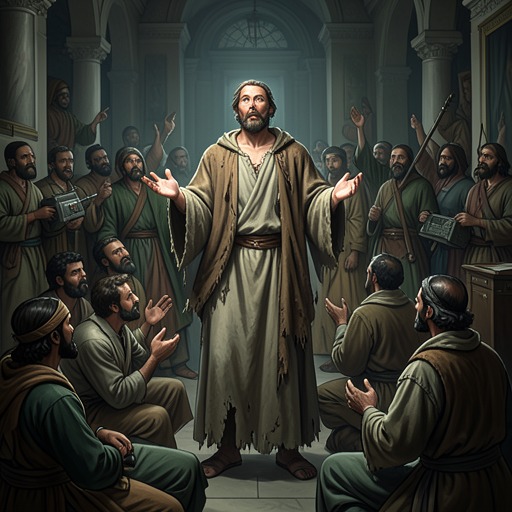
Healing of Bartimaeus
Don't Leave God Alone: How to Get God's Attention, Remain in His Presence, and Even Change His Mind to Make a Difference in Your WorldHealing of Bartimaeus is portrayed as a complete passage from marginalization and darkness into sight, discipleship, worship, and testimony. The event’s decisive force lies not only in the restoration of his vision but also in the persistence that brings him into Jesus’ presence: when others try to silence him, Bartimaeus intensifies his cry until Jesus stops and answers him.
Setting and Crisis
The episode occurs as Jesus leaves Jericho with His disciples and a large crowd. Bartimaeus, identified as the son of Timaeus, is blind and sits beside the highway begging. The setting gives the encounter an immediate urgency: Jesus is moving on, while Bartimaeus remains physically stationary, socially overlooked, and trapped in an unchanged condition. His opportunity appears temporary, perhaps his only chance to reach Jesus before Jesus goes another direction.
Bartimaeus responds when he hears that Jesus of Nazareth is passing by. He cries out, “Jesus, thou son of David, have mercy on me!” His appeal names Jesus in a messianic way and joins a request for mercy to the recognition that Jesus possesses the authority to change what Bartimaeus cannot change for himself. The narrative emphasizes the contrast between the crowd’s movement and Bartimaeus’s need: he cannot see how near his answer is, so he depends on hearing and on the force of his repeated cry.
Persistence Against Opposition
The crowd attempts to quiet Bartimaeus, but opposition makes him cry out even more. His first cry is described through the Greek word boao, meaning to shout or cry out deeply and loudly. When the crowd tries to suppress him, his cry rises to another level of intensity, represented by krazo, a louder and more disruptive appeal. The change in the language of the cry marks a change in his conduct: he refuses to let social pressure, discouragement, or the apparent silence of Jesus determine the outcome.
At first, Bartimaeus’s request seems ignored or unheard. The delay could have confirmed his fear that he would remain blind for another day, but his persistence turns apparent nonresponse into the threshold of transformation. His cries stop Jesus in His tracks. The account therefore treats persistence as active faith rather than passive waiting. Bartimaeus does not know how close he is to healing, yet he continues calling until his appeal receives an answer.
The event is also used to define a broader principle of change. Bartimaeus wants his condition altered rather than merely comforted. When Jesus asks what he wants, he answers specifically, “Lord, that I might receive my sight.” His answer contains no hesitation and no vague request for general improvement. The specificity of his desire demonstrates that change has become a settled heart decision: he is dissatisfied with the darkness, stumbling, and dependence that have marked his life.
The Gesture of Abandonment
When Jesus calls him, Bartimaeus casts away his garment, rises, and comes to Him. The garment had served practical and economic purposes. It covered him, kept him warm, and could be spread out for passersby to place money upon. Throwing it aside therefore represents more than a hurried movement toward Jesus. It signifies his willingness to release a familiar form of security and leave behind the visible arrangement of life that had been associated with his blindness and begging.
This gesture places bodily action beside verbal persistence. Bartimaeus does not only shout for change; when the opportunity arrives, he responds by moving toward Jesus. The account presents change as requiring both an insistent appeal and a willingness to step beyond a settled identity. He does not preserve the garment as a guarantee that he can return to the old condition. He rises from the roadside and enters a new relation to the one who has called him.
Restoration and New Identity
Bartimaeus’s healing is described as a conversion to a whole new identity. He was known as “blind Bartimaeus,” but after receiving his sight, blindness can no longer define him. The transformation is therefore physical, social, and spiritual at once: the condition that had organized his public identity is removed, and the narrative refuses to leave him enclosed within his former label.
The change is immediate in its visible result, but its significance extends beyond the instant of restored sight. Bartimaeus moves from sitting and begging to rising and following Jesus. This movement is treated as the mark of true discipleship. He no longer appears merely as someone waiting for assistance; he becomes someone who chooses to follow, having denied the old pattern of dependence and answered the call to come near.
He also becomes a worshiper. Luke’s account says that he immediately received his sight, followed Jesus, and glorified God. His attention turns outward from his former need toward the God whose power has acted in his life. The contrast is explicit: the beggar’s mentality centers everything on the self, whereas the worshiper’s mentality centers everything on God. Healing thus produces a changed direction of life, not merely a repaired capacity.
Finally, Bartimaeus becomes a public testimony. When the people see what has happened, they give praise to God. His changed life communicates the power of Jesus to the surrounding crowd and functions as an evangelistic sign. The man who had been overlooked beside the road becomes evidence that persistent approach to Jesus can bring a person from darkness to light.
Narrative and Spiritual Significance
The episode is presented as a model for pressing toward the Lord until change comes. Bartimaeus does not permit the crowd to regulate the volume of his faith, and he does not interpret apparent delay as final refusal. His example is applied to situations in which people feel abandoned, ignored, or increasingly trapped. The central lesson is that one may be closer to transformation than circumstances reveal, making continued appeal crucial precisely when the answer seems distant.
The event also forms part of a repeated pattern in the book: desperate need leads to an intensified cry, the cry brings a person into contact with divine power, and the resulting change produces a visible testimony. That pattern is connected with the woman with the issue of blood, whose condition became worse despite medical treatment and whose hope was fixed on touching Jesus. It is likewise connected with the author’s accounts of prayer for a severely injured young man on an interstate, a newborn girl given an 11 percent chance of living, and a relative suffering septic shock and multiple organ failure. In each comparison, the narrative places human limitation beside persistent prayer and interprets survival or healing as evidence of God’s intervention.
Bartimaeus’s healing also supplies the book’s clearest image of refusing to accept silence as the final word. The event begins with a blind man seated at the margins and ends with a seeing man following Jesus and glorifying God. Its reversal is therefore not only from blindness to sight but from exclusion to recognition, from immobility to movement, from begging to discipleship, and from private need to communal praise. The miracle’s proof is the life that follows it.