Jesus heals the multitudes after John the Baptist’s death
Don't Leave God Alone: How to Get God's Attention, Remain in His Presence, and Even Change His Mind to Make a Difference in Your WorldJesus heals the multitudes after John the Baptist’s death is presented as a decisive reversal: news of a violent loss drives Jesus toward solitude, yet the people’s determined pursuit turns that secluded retreat into a scene of public mercy. The event establishes compassion as stronger than withdrawal and persistence as a form of faith that Jesus does not reject.
Grief and the Search for Solitude
The episode begins when Jesus learns that John the Baptist, his cousin and the forerunner of his ministry, has been beheaded. John had publicly declared Jesus’ significance as the one who takes away the sin of the world, so his death represents both a personal bereavement and the removal of a figure who understood Jesus’ purpose. The account emphasizes that Jesus received the news only after John’s disciples had taken away and buried the body, intensifying the shock of the delayed disclosure.
Jesus responds not with panic but by departing by boat to a deserted place. His movement toward isolation is portrayed as understandable: after hearing of John’s death, he seeks a quiet place to gather his thoughts and be alone. The retreat creates the event’s central tension, because Jesus’ need for solitude is genuine even as the needs of the multitude remain urgent.
The Multitude Follows
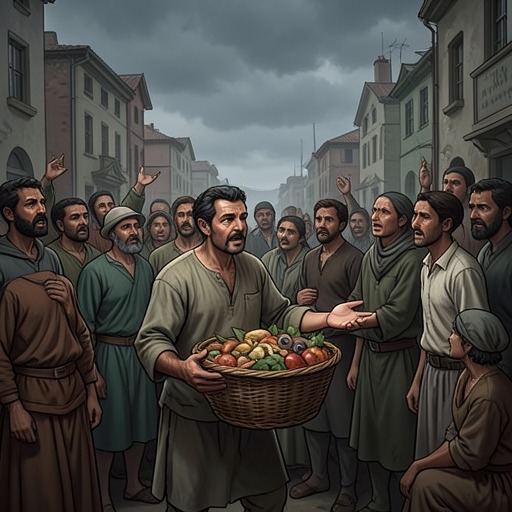
The people discover where Jesus has gone and follow him on foot from the surrounding cities into the wilderness. Their action is described as a refusal to leave him alone, not as casual curiosity. They pursue him beyond the normal setting of his ministry and into the deserted place, carrying their need into the very space he had chosen for withdrawal.
This pursuit changes the scene before Jesus speaks or performs any public act. The crowd’s persistence becomes the immediate force that brings private grief and public ministry into contact. The event therefore presents access to Jesus as something the people actively seek rather than passively await, with determination functioning as the outward form of their hunger for help.
Compassion and Healing
When Jesus sees the great multitude, he is moved with compassion toward them and heals their sick. The healing is the concrete climax of the encounter: the people’s pursuit does not result in rejection, reprimand, or dismissal, but in direct care for those who are ill. The wilderness, initially a place of separation, becomes a place where suffering bodies are met by divine power.
The account treats Jesus’ compassion as the decisive response to the crowd. Although he had intended to be alone, he does not allow his personal grief to close him against those who have followed him. His action joins emotional sorrow to practical mercy; he acknowledges the human need before him by healing the sick rather than sending the multitude away.
Persistence as Faith
The event is used to illustrate a broader principle of persistent prayer. The people continue pursuing Jesus until he responds, and the narrative interprets their determination as evidence that he will answer those who seek him persistently. The emphasis is not on momentary relief but on continuing to pray until the answer becomes visible.
The author presents the episode as revealing that Jesus can respond to human pursuit even when his immediate intention was different. His change from seeking solitude to healing the multitude is interpreted as evidence of his love and willingness to answer a hungry people. In this reading, persistence does not overcome an unwilling savior; it exposes the compassion already present in him and draws it into action.
Narrative and Theological Significance
Placed after John the Baptist’s death, the event contrasts the finality of violence with the life-giving work of Jesus. John’s burial marks an ending, while the healing of the sick opens a scene of restoration. The sequence does not erase grief, but it shows grief becoming the setting in which compassion is enacted.
The episode also becomes a model for the book’s recurring appeal to remain engaged with God rather than turning away when circumstances are painful or answers seem delayed. Jesus’ retreat and the multitude’s pursuit form a memorable pattern: solitude is interrupted by need, need is met by compassion, and persistence culminates in healing. The event’s significance lies therefore both in what Jesus does for the sick and in what the account teaches about continuing to seek him through crisis.