Jesus–John the Baptist relationship
Don't Leave God Alone: How to Get God's Attention, Remain in His Presence, and Even Change His Mind to Make a Difference in Your WorldJesus–John the Baptist relationship joins family affection to prophetic significance. John the Baptist is described as Jesus’s cousin and as the forerunner of His ministry, the figure who recognized and publicly declared Jesus’s purpose. Their relationship therefore carries both personal intimacy and a larger sacred function: John’s witness helps identify Jesus, while his death becomes one of the sharpest personal shocks recorded in Jesus’s earthly ministry.
Kinship and Prophetic Recognition
John the Baptist is introduced not merely as a religious associate but as Jesus’s cousin, the person who seemed to understand the purpose of His ministry. His proclamation, "Behold! The Lamb of God who takes away the sin of the world!" is treated as a defining act of recognition. John’s role is thus both relational and interpretive: he stands close to Jesus in family connection while also announcing Jesus’s identity to others.
The account gives John’s death particular weight because he had been the forerunner of Jesus’s ministry. His witness was not an incidental compliment but part of the narrative’s explanation of how Jesus’s mission was declared. The relationship consequently links personal loss with the public meaning of Jesus’s work: the one who announced the mission is gone, but the mission continues.
News of John’s Beheading
Jesus did not hear about John’s death until after John’s disciples had taken away his body, buried it, and reported the news to Jesus. The delayed arrival of the news intensifies its force. Jesus learned that His cousin had been beheaded only after the burial had already occurred, leaving no possibility of immediate farewell or intervention.
The narrative emphasizes that Jesus was visibly affected. Rather than presenting Him as untouched by the loss, it shows Him departing by boat to a deserted place by Himself. His withdrawal is a recognizable response to bereavement: after receiving devastating news, He sought a moment away from the crowds. The desire to be alone is therefore framed as a human need within the life of the Son of God, not as a rejection of His calling.
Solitude Interrupted by the Multitudes
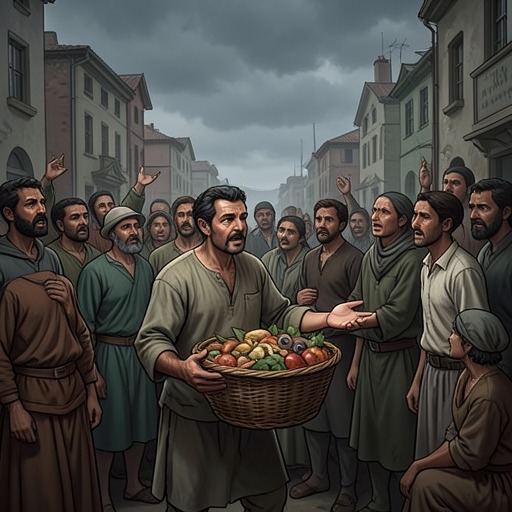
Jesus’s attempt to withdraw did not succeed. The multitudes discovered where He had gone and followed Him on foot from the surrounding cities into the wilderness. The scene creates a tension between private grief and public demand. Jesus had gone away after learning of John’s death, yet the people’s determination brought their needs directly into the space He had chosen for solitude.
The account does not depict Jesus turning the people away. When He saw the great multitude, He was moved with compassion and healed their sick. Their pursuit consequently transformed the meaning of the solitary retreat. The death of John remained the reason Jesus withdrew, but the encounter with the crowd produced healing rather than dismissal. Personal sorrow and public mercy occupy the same scene, with compassion becoming Jesus’s response to the people who would not leave Him alone.
Relational and Narrative Significance
The relationship between Jesus and John the Baptist is built from three movements: recognition, loss, and continued service. John recognizes Jesus as the Lamb of God and prepares the way for His ministry. John’s beheading then confronts Jesus with the death of a cousin and prophetic companion. Finally, Jesus carries the immediate burden of that loss into a deserted place, only to meet the multitudes and heal them.
This pattern distinguishes Jesus’s relationship with John from the book’s broader teaching about persistent pursuit of God. Elsewhere, the narrative describes people who refuse to leave God alone until they receive an answer; here, Jesus Himself initially seeks to be left alone after John’s death. Yet the result is not emotional detachment. His grief coexists with compassion, and the crowd’s arrival reveals that John’s death does not end the ministry John had helped announce. The relationship therefore gives the chapter a poignant contrast: Jesus seeks solitude because of John, but responds to others in a way that continues the work John had recognized and proclaimed.