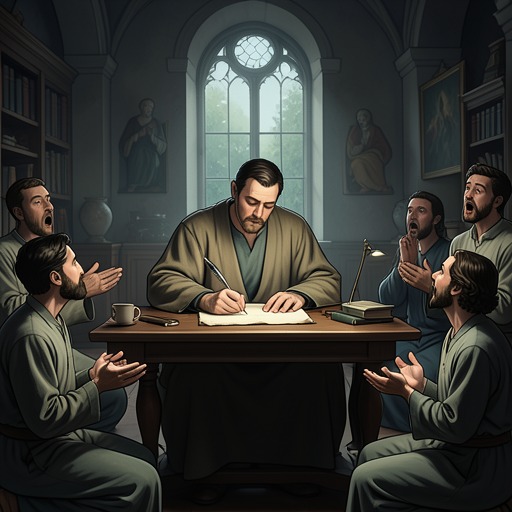
Pray for Others
Don't Leave God Alone: How to Get God's Attention, Remain in His Presence, and Even Change His Mind to Make a Difference in Your WorldPray for Others is a rule of persistent intercession: prayer is directed beyond the self toward another person, community, city, or nation, and its defining test is whether the petitioner continues when the answer appears delayed, the circumstances worsen, or rejection seems final. The book treats this practice as a form of spiritual responsibility whose effects may include protection, changed circumstances, deliverance, healing, and an opening to proclaim the gospel.
Definition and Biblical Pattern
Pray for Others is introduced through Jesus’ midnight story in Luke 11:5-6. A friend receives a traveler but has no bread to set before him, so he goes to another friend at midnight and asks for three loaves. The request is made for someone else, not merely for the petitioner’s own need. Its persistence brings blessing both to the person who asks and to the guest whose need prompted the request.
The same passage joins intercession to persistence in prayer. Luke 11 describes importunity as continual asking, seeking, and knocking that does not stop because an answer seems absent. In this framework, praying for another person is not a single emotional appeal but an ongoing practice: the petitioner keeps seeking until help is released. The rule therefore combines an outward focus with endurance, making another person’s need a reason to remain engaged with God.
Personal Practice and Spiritual Preparation
The book connects intercession with private preparation. After a long day at work, the narrator lay on his bed and prayed into the early evening, repeatedly seeing faces while interceding. Later, he joined a street-witnessing team and entered a national pizza chain crowded with high school football players and parents. There he encountered a large football player arm wrestling at a table. Although the narrator was a very young, exceptionally thin man with no natural prospect of winning, he accepted the challenge, was mocked as “stick boy,” and became part of a public David-and-Goliath spectacle.
The arm-wrestling encounter became an occasion for intercession’s public consequence. When the narrator’s opponent stopped the contest, the narrator asked those present to listen, and almost everyone in the restaurant, including workers, gathered to hear the gospel. The faces seen during prayer were understood as the people later reached through that encounter. The episode presents prayer for others as preparation for service: private intercession precedes a public opportunity, and the resulting witness is interpreted as an overflow of time spent seeking God’s power.
The rule also appears in a period of personal spiritual dryness. The narrator describes feeling both a valley and a desert for roughly six months, with prayer becoming boring, unanswered, and marked by falling asleep. He withdrew to a camp for three days of fasting and prayer, even bringing a sack of snacks in case the drought continued. During a walk in the woods, he saw deer in a distant field and recalled the scriptural image of a deer panting for water as a picture of the soul longing for God. He asked God to bring the deer close; instead, they ran away. The scene gives intercession a comic but revealing setting: persistence is practiced not only in triumphant moments but also when spiritual experience seems to contradict the prayer.
Intercession for Communities and Nations
Pray for Others expands from individual need to collective responsibility. The narrator describes praying for the United States while his head was buried in a couch and asking God for mercy. He sensed a holy fear and a presence close beside him, then heard a message that the nation was being given another chance, in the manner of Nineveh, because its work was not finished. The image of sands held in God’s palms and soaked with the tears of forebears’ prayers frames national intercession as accumulated, remembered labor rather than an isolated request.
This national concern is interpreted through Moses’ appeal after the Golden Calf. Moses confronted God’s threatened judgment and argued that the Egyptians might misinterpret the Exodus, asking God to turn from fierce wrath and remember the agreement with the people. The book presents Moses as refusing to withdraw until mercy prevailed, and it extends that example to readers praying for their own nation. The narrator rejects anticipation of national destruction and argues that the cry of the righteous must be louder than the cry of evil; otherwise, evil will prevail.
The same logic is applied to cities. Silence about a city’s condition is associated with six destructive influences drawn from Ezekiel 28: violence, profanity, corrupt wisdom, defiled sanctuaries, iniquities, and terror or fear. The proposed response is determined prayer. Church frustration, murder and crime rates, and disturbing news are treated as reasons to approach God repeatedly rather than merely complain in unbelief. Intercession thus becomes a form of collective action: a shared enemy is named, a common identity as praying people is assumed, and repeated prayer is presented as the means by which destructive influence can be resisted.
A pair of hurricane accounts illustrates the book’s distinction between an initial request and determined communal persistence. In 2004, while ministering at a conference in Jacksonville, Florida, the narrator prophesied that Florida would face two back-to-back hurricanes and that prayer could keep them away. Many prayed, but the hurricanes still came, which the account interprets as evidence that prayer needed to rise to a higher level. The following year, the narrator again named a storm and a particular month, and hundreds prayed fervently, deciding that the storm would not be accepted as inevitable. That storm did not hit them. The difference is attributed to collective determination rather than resignation after an earlier disappointment.
The account continues with a message concerning 2006: after years of record hurricanes, people collectively, individually, and fervently prayed and declared peace over the storms. No major hurricane hit the United States that year, and unsuccessful attempts by storms to make landfall are presented as confirmation of what sustained intercession can accomplish. The example gives the rule a public scale, while also revealing its interpretive structure: setbacks are explained as calls for greater persistence, and later favorable outcomes are read as evidence that the community refused to accept no.
Protection, Deliverance, and Witness
The book presents intercession as a means of standing between danger and another person. The narrator recounts that, several weeks before a neighbor’s tragic event, he felt directed to pray for the man more than ever before. He became persistent in that prayer. Afterward, the neighbor appeared at home with his head and body wrapped in bandages, leaving only his eyes and mouth visible. The neighbor explained that he had been working on a highway overpass, lost his balance while prying back a board, and fell into the mud below. He remembered looking at a coworker and saying, “Later!” before plunging downward; doctors were chiefly concerned about brain damage, yet he remained alive.
The narrator interprets the survival not as luck but as the result of persistent prayer for the man’s soul. The event created the opportunity the narrator had sought: he shared the gospel, some members of the family were saved, and the injured man began asking questions about the Lord. In this telling, intercession has a chain of consequences. Prayer precedes survival, survival creates access, access permits witness, and witness extends the blessing beyond the original person prayed for to his family.
The principle is also embodied by the Syrophoenician woman, who approached Jesus on behalf of her daughter, seeking deliverance. Jesus’ response about not taking the children’s bread and throwing it to dogs sounded insulting, and her identity as a Syrophoenician placed her outside the people to whom the stated mission was directed. Nevertheless, she continued pressing her request. Her persistence is important precisely because the apparent barriers were personal, ethnic, and theological; she did not abandon her daughter’s need when the response seemed to exclude her.
The woman with the issue of blood supplies a related image for the body of believers. The book argues that people should not persist only for their own needs but should become points of contact through whom God’s power reaches others. Whoever encounters such a person may be changed by that power. Intercession therefore turns personal spiritual life outward: the desired outcome is not simply private relief but the capacity to carry blessing into another person’s crisis.
Worship, Testing, and Persistence
Intercession is linked to worship as a response to bondage. Paul and Silas prayed and sang praises at midnight while imprisoned; an earthquake shook the foundations, the doors opened, and every prisoner’s bonds were loosed. Their praise occurred at the darkest hour, when they did not naturally feel like worshiping. The book interprets worship as a cry for freedom that places God above personal failure, pain, and sin. Leaving God alone in worship would mean remaining bound, whereas continued praise becomes an active refusal to surrender.
The same pattern is read in the account of Shadrach, Meshach, and Abednego. When they fell into the furnace, their posture is interpreted not as submission to the king’s image but as prostration before the Son of God in the flames. The furnace was heated seven times hotter, and the soldiers who threw them in died, yet the three men emerged without singed hair, scorched clothing, or even the smell of smoke. Their worship remains consistent under extreme pressure, and that unaltered conviction is presented as the condition through which deliverance becomes visible.
The book further models persistence through Elisha’s pursuit of Elijah from Gilgal to Jordan. The four places along that route are described as places of testing in which determination is formed until a person knows how to grasp God’s power and never let it go. Gilgal represents new beginnings, total conversion, the establishment of God’s kingdom in one’s life, and a commitment demonstrated through submission. This progression makes intercession more than verbal insistence: it requires obedience, sacrifice, and a life positioned to receive and steward power.
Elijah’s prayer for rain gives persistence a repeated bodily form. He put his head between his knees seven times, and only after the seventh prayer did a cloud appear, initially no larger than a man’s hand. The small cloud became the sign of abundant rain, while continued prayer is portrayed as the force that allowed the initial sign to develop into an outpouring. The image captures the book’s central rhythm: a response may begin in a form too small to satisfy expectation, but persistent prayer keeps the petitioner in position for blessing.
Finally, the rule is joined to a holy attitude of victory. David challenged Goliath’s intimidation by asking, “Who is this uncircumcised Philistine?” and the angel’s message to Zechariah similarly confronts the mountain before Zerubbabel, declaring that it will become a plain and calling for grace. The book applies that language to prayer for seemingly immovable circumstances: faith speaks to the mountain instead of accepting it as final. Intercession is therefore both pleading and resistance, a disciplined insistence that another person’s suffering, a city’s violence, or a nation’s danger will not be treated as beyond the reach of God’s response.