Spiritual stronghold
Don't Leave God Alone: How to Get God's Attention, Remain in His Presence, and Even Change His Mind to Make a Difference in Your WorldSpiritual stronghold is presented as a condition in which a person is held in defeat, bondage, oppression, or torment by forces that the book describes as spiritual jailers. Its defining power is not merely an isolated temptation but a structure that keeps captivity in place: it may operate through a sin habit, a demonic stronghold, a generational curse, or a private sin, while making freedom seem continually out of reach.
Definition and Forms
A spiritual stronghold functions like a prison. The book uses Peter’s imprisonment as a metaphor, noting that he was bound between two chains while guards kept watch outside the door. From this image, it distinguishes two forms of spiritual bondage. One chain represents inward, hidden bondage that other people may not see; the other represents outward bondage that is publicly recognizable. Both restrict movement, but the hidden form can be especially difficult because it remains concealed behind ordinary appearances.
The stronghold may attach itself to a relationship, a repeated behavior, a family pattern, or a private compromise. In this account, the person often already knows both the bondage and the habit to which it is connected. The spiritual jailer therefore works through recognition without release: the captive may understand the problem and still feel unable to leave it. Praise and worship are identified as the beginning of freedom from this imprisoning power.
Samson and the Architecture of Captivity
Samson provides the central image of a stronghold becoming progressively more severe. He first ignored his early convictions, then repeatedly broke his vows and lied about doing so. His compromises culminated in his relationship with Delilah, after which he lost both his anointing and his strength. He was taken to Gaza, a city associated in the book with the meaning “the strong,” making the location an emblem of the fortified condition into which his choices had led him.
The Philistines then bound Samson in chains and put out his eyes. In the book’s interpretation, the Philistines represent demonic forces, while Samson’s blindness represents the spiritual blindness produced by strongholds. Captivity thus affects more than conduct: it alters perception, leaving a person unable to see a way beyond the power that has confined him.
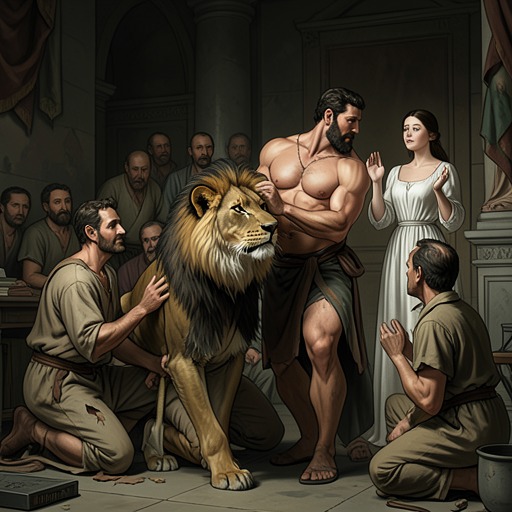
Samson was brought to a Philistine celebration so that his enemies could display and mock his defeat. They placed him between two pillars and treated his bondage and blindness as entertainment. The pillars become a second architectural image of the stronghold: visible supports holding up an entire structure of humiliation and captivity. Samson asked a young boy to help him lean against them, then pushed them down with renewed supernatural strength. The collapse killed those inside, including Samson, but the book emphasizes that he killed more in his death than in his life. His repentance and determination to make amends were honored, and his final act becomes a sign that even severe failure does not make deliverance impossible.
Conditions of Escape
The book does not treat a stronghold as an unchangeable identity. Samson’s significance lies precisely in the fact that he did not give up after catastrophic failure. He refused to leave God alone until he addressed what he had done, and that persistence became the path of his deliverance. The same principle is applied to anyone bound by a stronghold: repentance, perseverance, and a willingness to place one’s hands on the figurative pillars are required before the structure can fall.
The proposed practice is direct and repetitive. A person is to refuse to leave God alone, use the Word of God and the name of Jesus, believe that freedom is God’s will, stand firm, refuse to abandon the pursuit of deliverance, and remain connected to a church with an anointed pastor who can help. The stronghold is therefore opposed through both spiritual declaration and sustained communal practice rather than through a single moment of emotional relief.
Persistent prayer is treated as an active assault on captivity. In Luke 11, continual asking, seeking, and knocking are described as importunity: prayer that continues when no answer appears and that does not interpret delay as rejection. The same persistence is directed against the enemy. By resisting temptation and fighting for time with God, the believer remains connected to God instead of allowing darkness to establish or reinforce the prison.
Strongholds, Shame, and False Covering
The book connects strongholds with the instinct to hide after failure. After Adam and Eve sinned, they felt exposed, became ashamed of their nakedness, and sewed fig leaves together as a covering. The fig leaves symbolize human efforts to appear righteous and justified, but they also stand between the person and God’s presence. Shame can therefore strengthen captivity by persuading the sinner to withdraw from the very presence in which help is available.
The prescribed alternative is to return directly to God rather than construct an appearance of self-sufficiency. Failure is not presented as a reason to remain distant: because of the blood of Jesus, the sinner need not rely on a self-made covering. This movement from hiding to return is crucial to the book’s theology of deliverance. A stronghold grows through secrecy, avoidance, and excuses; it begins to weaken when the person abandons the fig-leaf remedy and seeks help openly.
Extended Metaphors of Bondage and Release
Several recurring images broaden the meaning of Spiritual stronghold. In the account of Lazarus, a person can emerge from death and still remain bound in graveclothes. The hands symbolize restrictions on serving and working, the feet symbolize habits and sins that cause repeated falls, and the face represents impaired vision, speech, hearing, and thought. A resurrected dream may therefore be alive while still limited by the mental and behavioral remnants of the former life. Release requires that these graveclothes be removed so the new life can move beyond the tomb.
Another image is the heavenly “rain cloud of blessing.” Persistent prayer and sacrifice are said to fill this cloud until it releases blessing, whereas little prayer and no sacrifice leave a person in a spiritual desert. The metaphor gives stronghold and freedom an economic and atmospheric form: captivity is not only a locked cell but also a depleted environment in which the conditions for renewal have not been sustained. Prayer is treated as a continuing practice that supplies the moisture from which blessing can fall.
The woman with the issue of blood embodies a contrasting movement from confinement to contact. After twelve years of suffering and after trying other remedies, she initiated contact with Jesus, pressed through the crowd, and believed that touching the hem of His garment would make her whole. The hem is interpreted as the strongest, double-layered part of the garment and as the lowest point that a person must reach to touch. Her action exchanges her strength for His strength and illustrates the book’s larger claim that the captive must move toward God rather than wait passively for release.
Social and Cosmic Dimensions
Spiritual strongholds are not limited to private struggles. The book argues that separation between God and people gives the devil access to kill, steal, and destroy, and it extends persistent prayer to churches, cities, and nations. Silence concerning a community is associated with demonic influences such as violence, profanity, corrupt wisdom, defiled sanctuaries, iniquity, and terror or fear. Prayer is consequently presented as a way to confront public conditions as well as personal bondage.
The same framework appears in the vision of a church auditorium guarded by imposing angels with drawn swords. Evil beings in brown robes entered, mocked the congregation and the prayer room, ridiculed the pulpit, and announced that they would divide the church within a year. The vision makes division itself appear as an organized spiritual assault, while the angels’ inaction underscores the book’s insistence that believers must not surrender their involvement with God or assume that passive observation will defeat the intruders.
The book’s final emphasis is that strongholds can be broken because God is portrayed as faithful and committed to deliverance. Whether the bondage resembles Samson’s pillars, Peter’s chains, Lazarus’s graveclothes, Adam and Eve’s fig leaves, or the frogs a person is tempted to tolerate for “one more day,” the decisive response is continued return, continued resistance, and continued prayer. Spiritual stronghold names the prison, but persistence names the way out.