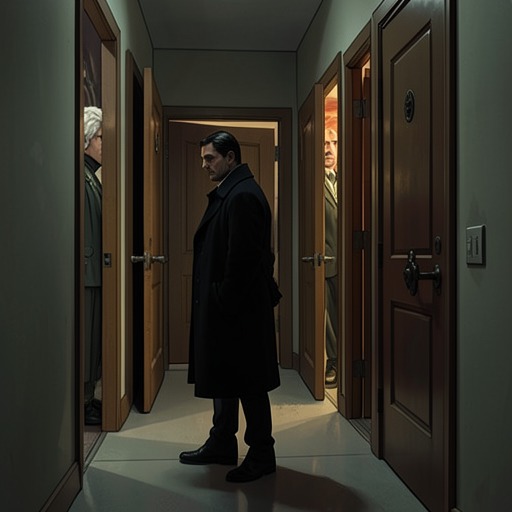
The church youth-camp gang confrontation
Don't Leave God Alone: How to Get God's Attention, Remain in His Presence, and Even Change His Mind to Make a Difference in Your WorldThe church youth-camp gang confrontation recounts a night when a church youth pastor and the boys in his care faced an apparently imminent gang attack on the church campus. Its decisive significance lies in the contrast between physical vulnerability and a sudden, unexplained reversal: after the children reached safety, the pastor was surrounded, yet the gang members retreated in shock and fled. He interprets the confrontation as a moment in which the authority of God became effective through an imperfect but immediate act of faith.
Setting and Warning
The incident occurred during a special overnight event for boys held on a church campus. The group later went outside to play capture the flag, turning the campus into a recreational space until the youth pastor began to feel that something was wrong. He told the other youth leaders that the game should end and that everyone should return indoors, although he could not initially explain the reason. An off-duty police officer serving as one of the leaders asked what was wrong, and the pastor answered that he believed the Holy Spirit was warning him about something.
The warning became concrete when the leaders heard a heavy bass beat from a car stereo and saw a large group of cars entering the parking lot. The pastor began urging the children to hurry inside while the noise grew louder. In the darkness and fear, the arriving group appeared to number about seventy-five cars. The off-duty police officer went to another area to retrieve his badge and weapon, since he was scheduled to work a few hours later, while the pastor continued checking that the children were being brought indoors.
The Confrontation
All the children made it inside, but the pastor remained outside while crossing the grounds to make certain that everyone was safe. Before he understood what was happening, he found himself surrounded by gang members. One man, whom he suspected to be a leader, walked toward him wearing a long coat and carrying some kind of long object. The man spoke in a foreign language, while the pastor stood frozen and unable to answer.
The pastor believed he needed to do something immediately, even though fear had taken away his ability to speak. He put a stern expression on his face, glared at the approaching man, and thrust up his arm with one finger pointing toward the man's face. The gesture was not presented as the result of calm confidence or careful planning. It was the only action that came to him in the instant, and it expressed a decision to act rather than surrender to panic.
Sudden Reversal and Deliverance
The gang members could have killed the pastor, but the confrontation changed as soon as he pointed. The apparent leader looked at him, his eyes widened, and he and the others began backing away in shock. The pastor never learned what they saw or heard. Instead of attacking, the gang members ran frantically back to their cars, and several vehicles were involved in minor fender benders as they hurried to leave the parking lot.
By the time the off-duty police officer returned, the group was almost gone. Those present could not explain what had happened, but they understood the outcome as deliverance by God. The pastor continued to wonder what caused the gang members to flee, while remaining convinced that something occurred when he raised his finger. The narrative therefore preserves the event's uncertainty rather than supplying a visible mechanism: the danger is unmistakable, the gesture is concrete, and the reversal is witnessed through its immediate consequences.
Spiritual Interpretation
The confrontation is placed within a wider teaching about acting on the power of God. The pastor connects his response with the biblical image of Moses standing before the Red Sea with the rod of authority. In both cases, the person facing danger must do more than affirm belief in deliverance; he must act upon the authority he believes God has given. The pastor admits that he did not feel confident, but emphasizes that he stepped forward anyway.
The episode also illustrates the book's recurring distinction between passive expectation and determined spiritual action. Elsewhere, the book urges believers not to leave God alone about cities, nations, storms, war, sickness, and threatened dreams. In this encounter, the same principle appears in compressed and physical form: an approaching crowd creates an immediate crisis, prayer and spiritual warning precede the confrontation, and a small bodily gesture becomes the vehicle through which the narrator believes divine protection operated.
Narrative Function and Significance
As a testimony, the event follows a recognizable pattern of crisis, warning, action, reversal, interpretation, and exhortation. The youth pastor first recognizes danger, then protects the vulnerable children, confronts the threat while personally exposed, and finally reads the gang's inexplicable retreat as evidence that God delivered the group. The story's force comes from the gap between the pastor's visible circumstances and the result: he is alone and surrounded, yet the attackers become frightened and flee.
The event also strengthens the book's larger theology of persistence and spiritual authority. It is not offered as proof that fear disappears before faith or that the believer always understands what has happened. The pastor remains frightened, speechless, and uncertain about the precise cause of the deliverance. What he claims to know is that God was for him and that obedience to an immediate spiritual prompting mattered. The confrontation thus becomes both a remembered danger and a teaching scene, urging readers to respond to threatening circumstances with faith-filled action rather than paralysis.