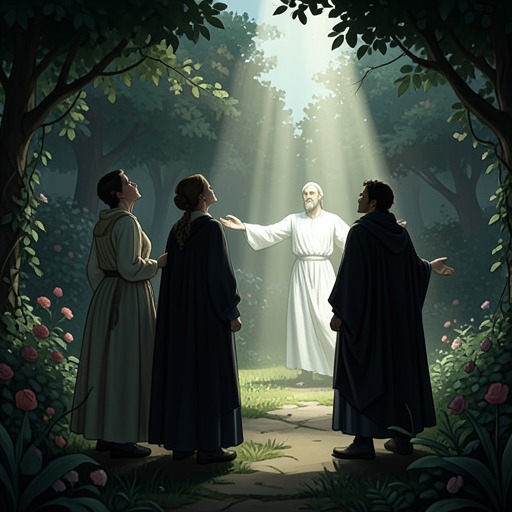
The forbidden fruit of Adam and Eve
Don't Leave God Alone: How to Get God's Attention, Remain in His Presence, and Even Change His Mind to Make a Difference in Your WorldAdam and Eve’s fig leaves are both a literal covering in the Genesis account and a governing metaphor for human attempts to hide sin, shame, and failure from God. They represent self-made righteousness: an improvised defense that seems to offer protection but actually stands between people and divine presence. The book contrasts this fruitless covering with direct return to God, where failure is addressed through the blood of Jesus Christ rather than concealed by personal effort.
Origin in Eden
After Adam and Eve ate from the forbidden tree, God came looking for the fellowship He regularly shared with His friends. Instead of remaining openly in His presence, they hid themselves and covered their bodies. Their movement from unashamed companionship to concealment marks the fig leaves’ first significance: sin altered how they understood both themselves and their relationship with God.
The leaves were not merely practical clothing. Adam and Eve had been accustomed to walking with God and to being clothed with His presence, although they had always been physically naked. After their disobedience, they suddenly felt exposed, recognized their nakedness, and sewed fig leaves together as an alternative covering. The handmade garment therefore became a visible barrier between them and the presence they had previously welcomed.
Symbol of Shame and Self-Righteousness
The book uses the fig leaves to describe the recurring human response to spiritual failure. When people sin or compromise, they often feel embarrassed and withdraw from God rather than approach Him. The “fig leaf” becomes a shield behind which they try to avoid being seen in their nakedness. Skipping prayer, becoming absorbed in distraction, and failing repeatedly can lead people to construct excuses and defensive habits instead of returning to fellowship.
In this interpretation, fig leaves are efforts toward righteousness produced by human beings themselves. They allow a person to feel justified without actually repairing the breach with God, but they cannot provide a righteousness by which anyone can truly approach Him. The leaves are therefore less a solution than an attempt to manage guilt through appearance. They cover the outward condition without transforming the inward one, and the covering remains an obstacle precisely because it is placed between the person and God.
The recommended response is not continued avoidance. When someone has failed or has left God alone through prayerlessness, the book urges that person to run back to Him rather than flee from Him. The blood of Jesus Christ is presented as the true covering for sin, making dependence on a self-constructed fig leaf unnecessary. This movement from hiding to return gives the image its pastoral force: shame may explain withdrawal, but it must not determine the ending.
The Fruitless Fig Tree
The metaphor is reinforced through Jesus Christ’s encounter with the fig tree in Jerusalem. After entering the temple and observing what was taking place there, He later saw a fig tree covered with leaves but found no fruit on it. He cursed the tree, and the book reads this action prophetically alongside Adam and Eve’s fig-leaf covering. Leaves created the appearance of life and adequacy, yet the tree offered nothing that could be harvested.
The connection makes the fig leaf a sign of fruitlessness. Adam and Eve’s substitute covering produced no fruit for them, just as a leafy tree without figs could not fulfill its purpose. Human attempts to cover failure may appear active, religious, or respectable, but they cannot generate the spiritual result that comes from returning to God. The lesson is not simply that concealment is inadequate; it is that the effort invested in concealment can never become the harvest people seek.
The book also links the fig tree to human methods replacing God’s methods. Jesus’ inspection of the temple and His subsequent action against the money changers and sellers of doves are treated as connected with the cursing of the fruitless tree. In that reading, the leaves point beyond private shame to institutional and religious substitutes: practices that may surround sacred activity while displacing the purpose and presence of God. The fig-leaf remedy is rejected because it offers appearance without fruit and method without divine life.
A Pattern of Covering and Release
The fig-leaf image belongs to a larger pattern in which visible conditions conceal or restrict spiritual reality. A revived dream, for example, may be alive while still wrapped in “graveclothes,” the habits and mind-sets associated with the past. As Lazarus emerged from the tomb still bound at the hands, feet, and face, a person may enter a new season while remaining limited in service, movement, vision, speech, hearing, or thought. The difference is that graveclothes must be removed, just as the fig-leaf covering must be abandoned rather than trusted.
This pattern contrasts self-protection with active contact with God. Jacob wrestled with God at Peniel until he received the blessing he sought; the woman with the issue of blood pressed through the crowd and touched the hem of Jesus Christ’s garment rather than waiting passively; and Jesus taught persistence through continual asking, seeking, and knocking. These examples replace hiding with approach. The faithful posture is not to construct a safer distance from God, but to remain within reach of Him until transformation and blessing become manifest.
The same principle governs the book’s account of prayer and provision. A newly formed church faced the loss of its meeting space only days before a Sunday service, yet its members prayed and refused to give up. An unknown business professional intervened, and the church was moved from one small bay to three bays, eventually gaining seven times the original space. Likewise, a brand-new luxury car was given to Hank Kunneman after a persistent visitor insisted on delivering it, despite Hank’s first impulse to question whether he deserved it. These episodes dramatize the difference between withdrawing under embarrassment and continuing to receive what has been provided.
Theological and Narrative Significance
The fig leaves organize a central opposition in the book: concealment versus fellowship, human works versus grace, appearance versus fruit, and withdrawal versus persistence. Their material simplicity makes the spiritual claim concrete. A few leaves sewn together can become a whole theory of self-justification, while their failure exposes the limits of relying on personal effort to manage guilt or secure acceptance.
The image also establishes a cycle of shame and avoidance that the book seeks to break. People fail in prayer, fear that God is angry, feel embarrassed, and then run farther from the very relationship that could restore them. The fig leaf gives that cycle a physical form: it is something people make, wear, and place between themselves and God. Yet the proposed alternative is equally physical and more decisive—the blood of Jesus Christ as the covering that allows return.
For that reason, the fig leaves are not remembered as a successful solution but as a warning against substituting religious appearance for living relationship. Their lasting significance lies in the command implicit throughout the book: when the handmade covering begins to define the person’s distance from God, it must be set aside. Direct prayer, persistent seeking, obedience, sacrifice, and trust in God’s provision are presented as the path from exposed failure to restored fellowship and fruitful life.