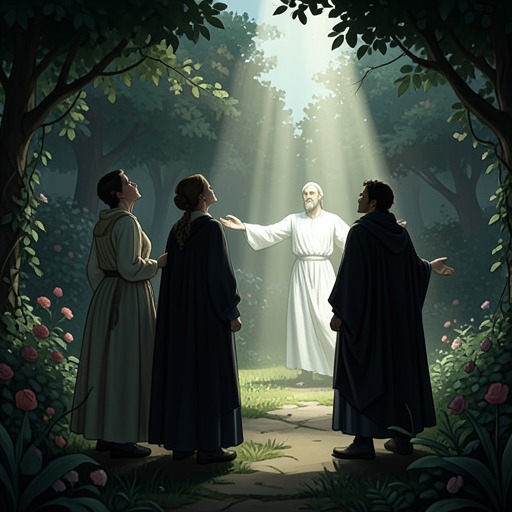
Adam
Don't Leave God Alone: How to Get God's Attention, Remain in His Presence, and Even Change His Mind to Make a Difference in Your WorldAdam is portrayed as the first human being, fashioned in God’s image to think, walk, and speak in a way that reflected his Creator. He receives the earth as a sphere of responsibility and becomes the central biblical pattern through which the book explains human authority, companionship with God, spiritual failure, shame, repentance, and the recovery of what has been surrendered. His decisive significance lies in the contrast between the dominion he was meant to exercise and the withdrawal that followed his disobedience: Adam’s failure becomes both a warning against relinquishing authority and a reason for returning persistently to God rather than hiding from Him.
Identity and Creation
Adam appears first as God’s “most intimate creation,” a human masterpiece made in God’s own image. The account emphasizes that he was not merely another creature among the things God had made; he was formed to resemble God in thought, movement, and speech, and was given the created world for his enjoyment and stewardship. Humanity’s likeness to God also explains the need for fellowship: Adam was created with an inward capacity to relate to God and with a corresponding need for another human companion.
The book interprets God’s declaration that it was not good for man to be alone as revealing both Adam’s condition and God’s desire for communion. Adam lacked another person in human form who could meet him on his own level, so God created Eve as his helper and companion. Eve’s emergence from within Adam parallels the larger claim that God brought humanity forth for fellowship with Himself. Adam therefore stands not only as the first man but also as evidence that human existence is designed around relationship rather than isolation.
Authority and Responsibility
Adam’s mandate is summarized through four commands: to be fruitful, multiply, replenish the earth, and subdue it. These commands define four levels of authority that the book later sees reflected in the victories of the heroes of faith in Hebrews 11:33. To subdue means to conquer, bring into subjection, or exercise control. Adam was intended to remain the steward and possessor of what God had given him rather than surrendering those possessions to the devil.
The same authority is extended through four realms named in the creation account. Fish of the sea represent the unseen depths and, in the book’s spiritual interpretation, authority over the demonic realm. The fowl of the air represent high places and the heavenly realm associated with the enemy’s activity. Cattle and the earth signify the visible physical sphere, including governments, commerce, kingdoms, territories, and the unruly nature of human flesh. Every creeping thing represents another area of influence over forces that move low to the ground. Adam is thus the prototype for a human being designed to rule across visible and invisible dimensions, not to live as a passive victim of them.
The teaching repeatedly treats Adam’s loss of authority as a continuing danger. When people abandon prayer, compromise begins, and they may release possessions or promises that should have been held through faith. The church’s response to the boy who fell from a window is presented as an opposite pattern: prayer enabled believers to stand their ground and take back what the devil sought to steal. Adam’s example supplies the negative background for this insistence that authority must be actively maintained.
Sin, Shame, and the Fig-Leaf Covering
Adam and Eve’s crisis begins when they eat from the forbidden tree. When God comes in the cool of the day for the regular fellowship He shares with His friends, they no longer meet Him openly. Instead, they hide from His presence and cover themselves. The change is described as a movement from unashamed intimacy to embarrassment: they become conscious of their nakedness and seek a substitute covering.
Their sewn fig leaves become the book’s governing image for self-made righteousness. A fig leaf is an effort to justify one’s actions, conceal failure, or stand before God through personal works rather than through God’s provision. It offers a surface of protection while leaving the underlying exposure unresolved. Sin and compromise therefore produce not only guilt but also withdrawal; people may feel safer behind excuses, religious effort, or carefully assembled appearances than in the presence of the God who sees them.
The fig-tree episode in the ministry of Jesus is interpreted as a prophetic continuation of Adam and Eve’s failure. Jesus finds leaves but no fruit, and the tree is cursed. The leaf-covered tree represents the fruitlessness of the covering Adam and Eve chose. The image also points toward human methods replacing God’s methods: Jesus observes the temple, curses the barren fig tree, and then returns to remove the money changers and sellers. In this reading, Adam’s fig leaves are not merely inadequate clothing; they symbolize an entire system of substitution in which outward arrangements displace living obedience and the presence of God.
Failure, Return, and Ongoing Influence
Adam’s instinct after failure is to leave God alone by hiding. The book treats that instinct as a recurring human pattern. Believers who repeatedly fail in prayer may avoid prayer because they feel ashamed, imagine that God is angry, or fear facing another failure. Adam’s response becomes a diagnostic picture of spiritual withdrawal, but it is not presented as the final word. The prescribed answer is to run straight back to God, trusting that the blood of Jesus provides the covering that fig leaves cannot supply.
This movement from shame to return creates a tension between grace and discipline. Failure does not justify continued avoidance, because forgiveness is available; yet restored fellowship is expected to become a daily practice. The book connects Adam’s covering with the need for honest confession, persistent prayer, and continual choices of righteousness. In the Lord’s Prayer, forgiveness is placed alongside dependence, worship, the coming of God’s kingdom, and deliverance from evil. Adam and Eve hid after sin, but believers are urged to ask for forgiveness while cultivating forgiveness toward others so that sin does not become a permanent separation.
Adam’s example also supports the book’s seed-and-harvest teaching. Every daily decision is treated as a seed, and righteousness grows through repeated choices in thought, attitude, conduct, and obedience. The discussion of repentance distinguishes a temporary apology from a genuine change of direction. Persistent repentance is not merely feeling bad after repeating a failure; it is turning away from the behavior and producing a life that bears corresponding fruit. In this framework, Adam’s fall explains the need for correction, while the believer’s repeated return to God supplies the path toward changed conduct.
Narrative and Thematic Significance
Adam functions as the book’s foundational negative and positive model. Negatively, he illustrates what happens when a person relinquishes God-given authority, accepts a substitute for God’s presence, and retreats into shame. Positively, the creation account establishes that people were made for fellowship with God, so prayer is not portrayed as an alien religious demand but as a return to the relationship for which Adam was created.
His story also gives coherence to the book’s teaching on persistence. The four levels of authority, the four realms of influence, the call to sow righteousness, and the appeal to keep returning after failure all answer the same historical pattern: Adam was entrusted with what he did not successfully retain. Later believers are urged not to repeat that surrender. They are to pursue God, hold what has been given, reject fruitless self-covering, and continue asking until the consequences of failure are transformed.
Adam therefore remains present beyond the opening creation story. His nakedness becomes the “fig leaf” metaphor; his lost dominion becomes the rationale for exercising authority; his companionship with God becomes the basis for persistent prayer; and his hiding becomes the behavior the book most urgently asks readers to reverse. The character’s lasting role is to define the human problem and the intended remedy at once: humanity was made to live openly with God and govern faithfully, but whenever shame causes withdrawal, the proper response is not another covering or another excuse—it is renewed fellowship and determined return.