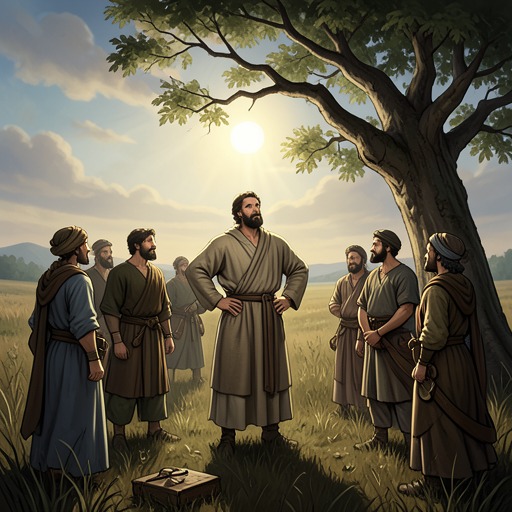
Elijah's Outer Garment
Don't Leave God Alone: How to Get God's Attention, Remain in His Presence, and Even Change His Mind to Make a Difference in Your WorldElijah's mantle is the garment left behind when Elijah is taken from the earth, and it becomes the tangible sign through which Elisha recognizes that the power associated with his spiritual father has been entrusted to him. More than clothing, it represents anointing, succession, tested love, and the passage from devoted follower to responsible prophetic minister.
Appearance and Immediate Setting
Elijah's mantle appears at the decisive moment of Elijah and Elisha's journey through Gilgal, Bethel, Jericho, and the Jordan. Elijah is preparing to leave the earth, while Elisha refuses repeated opportunities to remain behind. The journey therefore gives the garment a setting already shaped by testing: it is not presented as a magical object detached from relationship, but as the material remnant of a mentor whose departure Elisha has deliberately followed to the end.
The final scene is marked by extraordinary movement. A chariot and horses of fire come between the two men, and Elijah goes up in a whirlwind to eternal dwelling place in Heaven. When Elisha can no longer see him, he tears his own robe, a gesture of grief and rupture. Then he picks up Elijah's cloak, returns to the shore of the Jordan, and stands before the river with the only visible thing left from his spiritual father.
Transfer of the Mantle and Anointing
The mantle becomes the instrument of Elisha's first public act after Elijah's departure. Holding it, Elisha cries, "Where is the LORD God of Elijah?" and strikes the Jordan. The river divides, and he walks through. The action answers the apparent absence expressed in the cry: the God who empowered Elijah has not disappeared with Elijah, and the mantle is the sign that Elisha has been clothed with the same power.
The book emphasizes that Elisha did not receive the mantle merely because he happened to be present when Elijah left. Elijah had repeatedly told him to stay behind, but Elisha answered that he would not leave his spiritual father. Those refusals tested whether Elisha loved Elijah himself and valued the anointing for its divine source, rather than seeking power for personal promotion. Once his hunger and commitment were evident, Elijah was taken away and the mantle fell to him.
Elisha's response shows that the garment carries both emotional and vocational meaning. He cries out, "My father, my father!" as Elijah departs, revealing that the mantle is bound to filial love as much as to ministry. He wants God to be present in the coat as God had been present in Elijah, and he wants the divine power that rested on his mentor to rest upon him. Picking up the mantle therefore means accepting the responsibility of standing in the place Elijah can no longer occupy.
The Jordan and the Four Tests
The mantle's power is confirmed at the Jordan, the fourth place in Elisha's progression. Gilgal, Bethel, Jericho, and Jordan are treated as successive tests of the heart and of commitment. Elisha must continue after each apparent stopping point, even when returning would seem reasonable. His perseverance through all four places positions him to receive the garment and to cross into a new stage of service.
Jordan signifies continual movement and progress. Elisha does not enter it before receiving the mantle; he follows the lead of another, receives the anointing, and then uses what has been placed in his hands to move forward. The garment thus links inheritance with action. It is not a keepsake that allows Elisha to remain beside the memory of Elijah; it equips him to cross the river and continue the work in a changed condition.
The book extends this pattern beyond Elisha. Believers are encouraged to remain with God through their own places of testing rather than retreat in fear. The mantle becomes a model for receiving spiritual responsibility: power follows commitment, and blessing is connected with the refusal to stop pursuing God before the promised manifestation arrives.
Symbolic Network of Power and Release
Within the book's wider imagery, Elijah's mantle belongs to a network of physical objects that make spiritual authority graspable. Moses's rod functions as a rod of authority, words are described as capable of moving mountains, and the touch of Jesus's garment becomes the point of contact for healing. In each case, an embodied thing or gesture connects faith with action. Elijah's mantle gives Elisha something concrete to lift, carry, and apply at the Jordan.
The garment also contrasts with the graveclothes surrounding Lazarus. Lazarus comes out of the tomb alive but still bound, and Jesus commands that he be released from the coverings that restrict his hands, feet, face, eyes, mouth, ears, and thoughts. Elijah's mantle has the opposite movement: it does not preserve the limitations of the past but clothes Elisha for forward movement. One set of cloths represents habits and restraints that remain after resurrection; the other represents anointing and responsibility received after departure.
The same logic appears in the book's account of persistent prayer. A person must initiate contact, press toward God, and continue asking, seeking, and knocking rather than waiting passively for a touch. Elisha's handling of the mantle gives this principle a visible form: he pursues his spiritual father to the point of departure, reaches for what remains, and discovers that persistence has prepared him to carry power.
Narrative Significance and Legacy
Elijah's mantle marks a reversal from apparent loss to succession. Elijah's ascent seems to leave Elisha alone, but the fallen garment turns separation into inheritance. Elisha's grief is not erased; it becomes the setting in which he assumes a new identity and tests whether the God of Elijah will meet him in his own obedience.
The garment's decisive significance lies in what it proves. Elisha's refusal to leave Elijah alone was not wasted attachment or mere admiration. It demonstrated love for the mentor, hunger for God's presence, and willingness to endure every test. When Elisha lifts the mantle and the Jordan divides, the object confirms that the anointing has not ended with Elijah's departure. It has become Elisha's charge, enabling him to step into large responsibilities and carry on a powerful ministry.