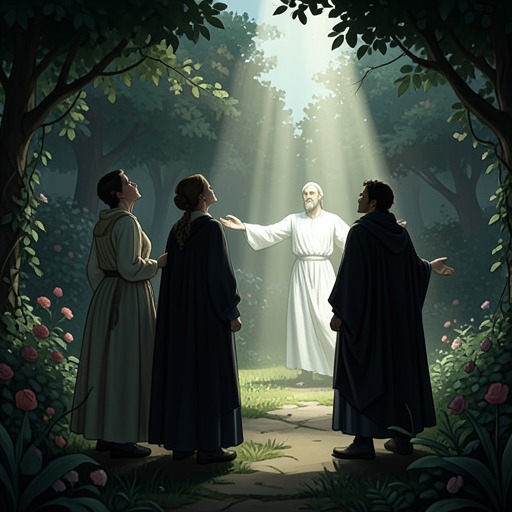
Fall of Adam and Eve
Don't Leave God Alone: How to Get God's Attention, Remain in His Presence, and Even Change His Mind to Make a Difference in Your WorldThe Fall of Adam and Eve is the decisive biblical event through which the book explains humanity’s first departure from fellowship with God. Adam and Eve had been created in God’s image for companionship, but sin made them withdraw from the divine presence; their hiding became the prototype of spiritual separation, shame, and self-made coverings. The event therefore functions not merely as an account of an ancient failure but as the origin of the book’s central contrast between abandoning communion with God and returning to Him through Jesus Christ.
Creation for Fellowship
The narrative begins with humanity’s distinctive identity. God created mankind in His own image, intending human beings to think, walk, and speak as reflections of Him. Adam received the created world, yet the account emphasizes that something remained incomplete while he had no other human companion. God declared that it was not good for man to be alone and made Eve as Adam’s helper and companion, answering a need for relationship that Adam could share on his own level.
The book extends this account into an interpretation of God’s own desire for companionship. Just as Eve was brought forth for Adam so that Adam would not remain alone, people were created for God’s fellowship so that God would not be without beings like Himself with whom to commune. Humanity’s purpose is consequently defined relationally: people are not presented only as recipients of creation but as companions formed to satisfy God’s longing for fellowship.
The Rupture and Its Immediate Effect
When Adam and Eve sinned in the garden, their relationship with God was broken by their response to sin. Instead of remaining near Him, they hid. The book stresses that God already knew where they were, so their concealment did not represent successful escape; it revealed the inward change produced by disobedience. Those who had once been unashamed in God’s presence now experienced embarrassment and separation.
Their shame also altered how they understood their bodies and their standing before God. They recognized their nakedness and attempted to cover themselves by sewing fig leaves together. The fig leaves became a barrier between them and God’s presence, an image the book uses for human efforts to appear righteous or justified after failure. Such coverings may make people feel safer, but they cannot restore the fellowship that sin has damaged.
Separation, Shame, and the Pattern of Leaving God Alone
The Fall of Adam and Eve establishes the book’s recurring spiritual pattern: sin and compromise encourage people to move away from God precisely when they most need to approach Him. Shame creates the impulse to hide, while self-made righteousness offers a substitute covering. The book explicitly warns that people who have failed should not run from God; they should return directly to Him, because the blood of Jesus covers sin more fully than any human work.
This pattern is connected to the book’s wider argument about spiritual risk. After the September 11 attacks, churches and prayer meetings filled as people sought the Lord amid uncertainty, but the renewed hunger lasted only briefly. The author contrasts crisis-driven appeals with regular fellowship, arguing that dependence on God should not begin only when disaster arrives. The Fall supplies the underlying image for this danger: separation from God is not safety or independence but exposure to spiritual and earthly peril.
Restoration Through Jesus Christ
The event does not end with concealment as the final word. Although sin separated Adam and Eve from God, the book says that God was already planning how to call humanity back. Jesus Christ was sent so that people could be reconnected with God, and Jesus’s teaching on prayer provides the means of renewed relationship rather than mere verbal religion.
The disciple’s request, “Lord, teach us to pray,” is treated as recognition that prayer is the key to connection with God. Prayer is described as fellowship with a real and powerful God who invites human response to His love. Jesus Christ’s own long hours with the Father exemplify this restored communion: He sought God’s face so deeply that He could say, “If you have seen me, you have seen the Father.” In this framework, redemption answers the isolation introduced by the Fall and makes possible the relationship for which humanity was created.
Consequences in the Book’s Prayer Theology
The Fall’s central consequence is relational separation, but the book applies that consequence to collective as well as personal life. It interprets later crises—including war, hurricanes, tornadoes, criminal violence, church division, and medical catastrophe—through a theology of prayerful involvement. The author argues that when people stop praying, they leave God alone concerning matters that require divine intervention; when they persist, they participate in resisting destructive spiritual influence.
That interpretation appears in the account of military prayer during the Iraq war. The author contrasts the rapid seizure of Baghdad after twenty-one days with later scenes of soldiers dying and violence spreading, attributing the change to the loss of sustained prayer coverage. The same logic is applied to Florida storms: an initial prayer effort did not prevent predicted hurricanes, but a later response involving hundreds of people praying fervently was followed by the storm’s failure to hit. The author further reports that collective prayer preceded a year without major hurricanes striking the United States in 2006.
The book also uses personal crises to dramatize the need to return to God rather than accept apparent defeat. During a tornado near the author’s home, an initial command spoken toward the storm was followed immediately by a branch striking the house, sending the family to the basement; on another occasion, a tornado dissipated after the author and his wife spoke against it. A family medical emergency likewise became a spiritual battle when the author’s father-in-law suffered a ruptured bowel, septic shock, medical coma, fever of 105 degrees, and multiple-organ failure, with physicians estimating less than a 50 percent chance of survival. These accounts extend the Fall’s basic movement—from danger and separation toward renewed dependence—into the book’s testimony-driven call for persistent prayer.