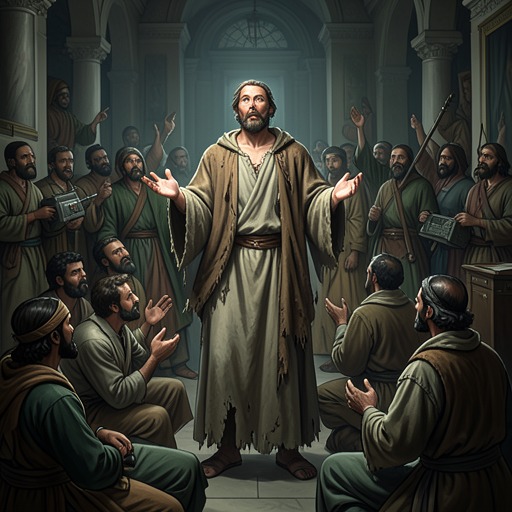
Fear and Intimidation
Don't Leave God Alone: How to Get God's Attention, Remain in His Presence, and Even Change His Mind to Make a Difference in Your WorldFear and Intimidation is the condition that makes an obstacle appear sovereign before it has actually prevailed. In the book, it is not merely an inward feeling but a force that can freeze action, narrow expectation, revive the authority of past oppression, and persuade people to abandon prayer when circumstances become difficult. Against it, the narrative sets Moses raising his rod at the Red Sea, David confronting Goliath, families praying through medical catastrophe, and communities refusing to leave God alone concerning storms, violence, or war.
Definition and Spiritual Logic
Fear first appears as the sensation of being surrounded by impossibility. When Pharaoh pursued the Israelites, the Red Sea stood in front of them and the Egyptian army approached from behind. Moses cried to the Lord, yet the divine response seemed, at first, to question why he was crying. The apparent silence or rebuke could make a desperate person conclude that God was not listening or did not see the urgency. The book interprets the moment differently: God was not indifferent, but was calling Moses to act on the confidence he had already spoken to the people.
The command was therefore movement rather than paralysis. Moses was told to tell the people to go forward, raise his rod, and divide the sea so that the Israelites could cross on dry ground. Fear had fixed their attention on the enemy behind them, while faith required them to face the way ahead. The obstacle was real, but camping beside it in the wilderness would leave them exposed to pursuit. In this logic, intimidation becomes dangerous when it converts a temporary barrier into a permanent residence and turns remembered defeat into a prophecy of future defeat.
The book also links fear to separation from God. After 9/11, churches and prayer meetings filled as people sought the Lord amid national uncertainty, but the renewed dependence lasted only briefly. The text calls this pattern risky because people may treat Jesus as Savior in crisis without committing to Him as Lord in ordinary life. A similar argument is applied to the war in Iraq: the early seizure of Baghdad after twenty-one days was contrasted with later deaths and widespread violence, which the author associates with the decline of prayer for military personnel. Whether the danger is national tragedy or private distress, the proposed protection is regular communion with God rather than emergency devotion alone.
Pharaoh Spirit and the Inheritance of Slavery
A central explanation for intimidation is the “spirit of Pharaoh,” described as a slavery mindset carried out of Egypt by people who had lived under domination for four hundred years. The Israelites had learned how to be controlled, and liberation from a physical captor did not automatically erase the expectation of being overcome. Fear could therefore survive the collapse of the system that created it.
The Pharaoh spirit is said to keep people feeling bound through control and manipulation. It can abort destiny, as Pharaoh’s mass killing of children represents an attempt to destroy an ordained future before it develops. It can also produce a diminished view of the self: the Israelites had become accustomed to seeing themselves as lesser than the Egyptians and as worthless victims. Finally, it hardens the heart, reproducing the rebellion and resistance associated with Pharaoh even after the people have left Egypt. The result is an inward captivity that makes the rod of authority seem unavailable, despite the evidence of what God has already done through it.
The book presents this mindset as a recurring explanation for hesitation. People may be intimidated by the “Pharaoh” that held them back for years because they cannot imagine themselves overcoming it. The remedy is not denial of the mountain but a holy attitude of victory: an intentional refusal to grant the threatening power the final word. David’s confrontation with Goliath supplies the model. His question, “Who is this uncircumcised Philistine?” treats the giant’s intimidation as an illegitimate challenge rather than an established verdict. The same posture is expressed through the declaration, “I will not leave You alone, God, until this mountain moves!”
Fear in Crisis, Storm, and Deliverance
The disciples’ panic during a storm demonstrates how fear can persist even after earlier revelation. They had already witnessed Jesus deal with a storm, yet when He sent them across the sea, they panicked again. The narrative identifies two resources they neglected: trust in Jesus’s command to reach the other side and the learned practice of speaking to the storm. Fear made previous experience inaccessible at the very moment it was needed.
The author recounts two tornado experiences to illustrate uneven growth rather than effortless mastery. In the first, tornado sirens sounded, the wind intensified, and a report placed the tornado less than a mile from the house. The couple spoke commands toward the storm, but a huge branch struck the house, sending them running to the basement. The tornado passed, and they later laughed at their reaction. In another storm near a small medical office building, the couple told nearby doctors that Jesus would calm the storm, spoke to it, and saw the tornado rise back into the sky as the storm dissipated. The difference between the two accounts becomes a lesson in persistence: one apparently unsuccessful attempt did not cancel the practice of using the authority they believed God had given them.
Fear also governs decisions about deliverance. Scripture’s comparison of frogs with demonic spirits gives the book an image for tolerated bondage: a person may know that destructive influence is present and still ask for one more day before breaking with it. The account of a woman who remained with an unhealthy man illustrates the cost. She postponed decisive separation, and years later the author saw her transformed by drug addiction, pain, and abuse. Her additional day became an extended captivity, showing how intimidation and delay can cooperate until bondage appears normal.
The same fear is confronted in a deliverance scene involving a demonized man locked in a basement. The author, then a young Christian rather than a pastor, heard demonic screams, went downstairs, and commanded the evil spirits to leave. After several minutes, the man was restored to himself. In a later encounter, the author faced a man whose behavior seemed like a literal Goliath, stopped retreating in fear, rebuked the demon in the name of Jesus, and watched the spirits come out. The sequence turns inner intimidation into a physical contest of stance and speech: the mountain crumbles when fear yields to authority.
Collective Risk and Prayerful Resistance
The book expands Fear and Intimidation beyond individual psychology into a theory of collective vulnerability. When people leave God alone, the enemy is said to gain access to kill, steal, and destroy. Silence concerning cities and nations permits violence, profanity, corrupt wisdom, defiled sanctuaries, iniquity, and terror or fear to spread. Persistent prayer is presented as an intervention capable of interrupting those influences, especially when frustration with crime, murder, or the condition of the church might otherwise produce resignation.
Two hurricane accounts show how the text handles apparent failure. In 2004, the author prophesied that Florida would face two back-to-back hurricanes and that prayer could keep them away. Many prayed, but the hurricanes still came, suggesting that the first response had not reached the required level of fervency. The following year, the author named a storm expected to emerge from the Atlantic Ocean near the time of another conference. Hundreds prayed with determination, refusing to accept the previous outcome as decisive, and the storm did not hit them. The narrative interprets the contrast as a change in collective resolve rather than as evidence that the earlier disappointment should end prayer.
The same framework is applied to 2006. After record hurricane seasons, people prayed and declared peace over the storms, and the author says that no major hurricanes struck the United States that year. Some storms formed but did not succeed in reaching the nation. The account therefore treats fear as a public force that can be met by coordinated spiritual action: collective, individual, and fervent prayer becomes a form of resistance against an apparently uncontrollable risk.
A vision of a church auditorium dramatizes the consequences of unchallenged intimidation. Huge angels stood at the doors with drawn swords pointed toward the ground, yet hooded evil beings in brown robes entered, mocked the congregation and the prayer room, ridiculed the pulpit, and announced that they would divide the church within a year. The angels’ inactivity is the disturbing feature of the scene. The vision does not portray the threatening figures as stronger than the heavenly beings; it portrays evil moving through a space in which authority is not being exercised. Fear therefore appears not only as terror produced by an enemy but as the passivity that allows the enemy to occupy the room.
Fear, Delay, and the Recovery of Hope
Fear repeatedly tries to keep a future confined to the past. In the Lazarus teaching, the danger is identified directly as fear and worry. Jesus had previously faced hostility in Judea, where people wanted to stone Him, but He did not allow that earlier attack to immobilize Him or alter His future purpose. The warning “Are You going there again?” represents the mind’s attempt to convert a former danger into a permanent prohibition. Past failure, past attack, and past disappointment can all become arguments against trying again.
A family medical crisis gives this pattern its most severe personal form. During a July 4 camping trip, the author’s wife’s father developed a fever of 104 degrees. Doctors did not diagnose its cause, and antibiotics controlled the fever after three weeks, but weakness remained. By early December, the fever returned violently; he awoke faint and seeing spots, and an ambulance was called. Doctors transferred him by helicopter, initially suspecting a heart problem, but emergency surgery found diverticulitis and a ruptured bowel.
The undetected rupture had produced septic shock, leaving him near death within hours. Surgery repaired the bowel, but the infection had poisoned his body so severely that he entered a medical coma. He swelled to three times his normal size, reached a temperature of 105 degrees, required nineteen intravenous bags of medicine, fluids, blood, and food, and was treated by eight physicians. His liver, kidneys, and lungs began shutting down; dialysis and a ventilator were required. The surgeon estimated less than a 50 percent chance of survival, but the family answered the statistic with prayer around the clock. The crisis becomes an example of fear’s pressure to accept the worst conclusion and faith’s refusal to let an unfavorable probability dictate the ending.
The book’s larger argument is that Fear and Intimidation gains power through withdrawal: ceasing to pray after 9/11, abandoning intercession for soldiers, stopping after a hurricane arrives, retreating before a storm, remaining one more day in bondage, or allowing a past attack to determine a future decision. Its counterpractice is equally recurrent. People remain in fellowship with God during prosperous as well as desperate seasons, speak with confidence, raise the rod of authority, move forward toward the promised land, and persist until the circumstance changes or the believer has learned to cross through it. Fear is thus not treated as an unavoidable final state but as a contested condition whose authority can be challenged by expectation, obedience, collective prayer, and continued reliance on God.