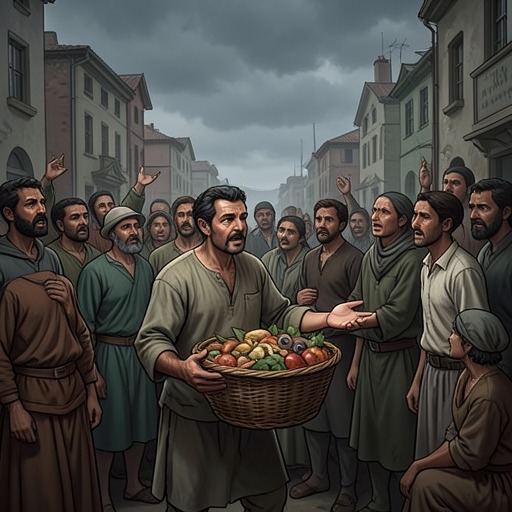
Feeding of the five thousand
Don't Leave God Alone: How to Get God's Attention, Remain in His Presence, and Even Change His Mind to Make a Difference in Your WorldThe Feeding of the five thousand is presented not merely as a miracle of provision but as a measure of human hunger. The multitude stayed when Jesus Christ supplied physical food, yet the book uses that response to expose how readily people pursue material needs while neglecting prayer and fellowship with God.
Setting and Participants
The event is recalled as part of the ministry of Jesus Christ among large crowds. The people are described as hungry in a literal sense, and their continued presence becomes the central observable fact: when Jesus fed the multitudes, five thousand men, together with women and children, remained around Him. Their persistence contrasts with the smaller attendance commonly seen when churches call people to prayer rather than to fellowship meals or other social gatherings.
The episode is also connected with the period after the death of John the Baptist. Jesus Christ withdrew by boat to a deserted place after learning that John the Baptist had been beheaded, seeking solitude after the burial of His cousin and forerunner. The multitudes discovered where He had gone and followed Him on foot from the cities, refusing to let His withdrawal end their pursuit.
Course and Response
The book emphasizes the crowd’s determination rather than reconstructing the practical details of the meal. The people followed Jesus Christ out into the wilderness even though He had gone there to be alone. When He saw the great multitude, He was moved with compassion toward them and healed their sick. Their physical hunger and their pursuit of His presence therefore converge: the crowd sought Jesus Christ, and He answered them with healing and provision.
This response is deliberately set against the scene in which a disciple asked Jesus Christ to teach the disciples to pray. No one in that account asked to be taught prophecy, evangelism, or miracles; the disciple’s hunger was for prayer. By contrast, when Jesus Christ fed the multitudes, nobody left. The numerical image of five thousand men, besides women and children, becomes evidence of the difference between appetite for immediate provision and spiritual hunger for communion with God.
Consequences and Meaning
The crowd’s refusal to leave Jesus Christ alone is interpreted as a form of persistent faith. Although Jesus Christ had intended to be apart from people, their determined pursuit drew compassion from Him, and the result was healing and blessing. The book presents this as evidence that continued pursuit can move a person beyond a temporary answer and toward the manifestation of a desired result.
The event thus functions as a teaching example for prayer. Readers are urged not to approach God only when tragedy creates an emergency, but to cultivate a spiritual hunger and a daily commitment to fellowship with Him. Regular prayer is described as a place of safety, while withdrawal from communion with God is treated as exposure to danger and estrangement.
Relation to Other Examples of Persistence
The multitude is grouped with other persistent seekers. Zacchaeus climbed a sycamore tree until Jesus Christ visited him; the woman with the issue of blood pressed through the crowd until she touched Jesus Christ; and the Syrophoenician woman continued asking for healing for her daughter even when the answer appeared delayed. In each case, persistence turns need into active pursuit rather than passive waiting.
The Feeding of the five thousand is therefore both a provision narrative and a communal model. Unlike an isolated petitioner, the multitude acts collectively, following Jesus Christ from the cities into the wilderness. Its shared movement illustrates how a group’s determination can become the visible expression of spiritual hunger, while the resulting healing and food make that hunger publicly legible.
Narrative Significance
Within the book’s wider argument, the event establishes a recurring contrast between crowds gathered for benefit and believers gathered for prayer. Physical provision draws a large response, whereas prayer requires a deeper desire for God Himself. Yet the crowd’s pursuit also shows that imperfect or materially motivated hunger can become an encounter with divine compassion.
The episode’s lasting force lies in that tension. Jesus Christ does not turn away the multitude because its initial need is physical. He responds when the people continue toward Him, and their persistence leads to healing and provision. The book consequently treats the event as a summons to move from seeking what God can give to seeking fellowship with God, without denying that persistent pursuit may bring both spiritual response and practical blessing.