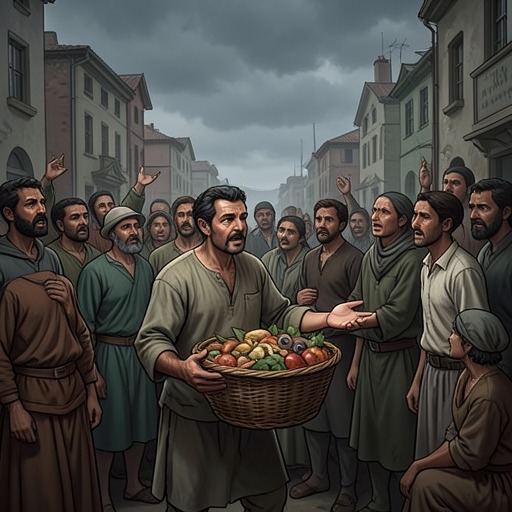
John the Baptist’s beheading
Don't Leave God Alone: How to Get God's Attention, Remain in His Presence, and Even Change His Mind to Make a Difference in Your WorldJohn the Baptist’s beheading is the decisive loss that sends Jesus Christ away from the crowds for a brief moment of solitude, but it does not end in withdrawal. The execution of His cousin and forerunner becomes the immediate background to a reversal: grief leads Jesus Christ into the wilderness, where the people’s persistence meets His compassion and the sick are healed.
Death of the Forerunner
The account begins with news that John the Baptist had been beheaded. John was not treated as a marginal figure in Jesus Christ’s story; he was His cousin and the forerunner of His ministry, the one who had declared, "Behold! The Lamb of God who takes away the sin of the world!" His death therefore removed someone who seemed uniquely able to understand and announce Jesus Christ’s purpose.
The timing intensifies the shock. The disciples first took John’s body, buried it, and then went to tell Jesus Christ what had happened. Jesus Christ did not hear the news before the burial but afterward, when the irreversible fact of the death had already been established. The narrative gives no account of an immediate public reaction or panic. Instead, the loss produces a deliberate departure from the ordinary movement of ministry.
Withdrawal into Solitude
After hearing of John the Baptist’s death, Jesus Christ departed by boat to a deserted place by Himself. The movement is described as a search for aloneness: after the loss of His cousin, He wanted a moment away from the crowds and the demands surrounding His work. The deserted place thus becomes both a physical retreat and a narrative space in which grief briefly interrupts public ministry.
The withdrawal also reveals the tension between Jesus Christ’s human need for solitude and the continuing needs of the people. The crowd did not discover Him accidentally and disperse; the multitudes followed Him on foot from the cities. Their pursuit prevents the secluded place from remaining secluded and changes the direction of the scene from private mourning to public encounter.
Compassion After Loss
When Jesus Christ saw the multitude, He did not turn the people away. The account says that He was moved with compassion toward them and healed their sick. The response is significant precisely because it follows John the Baptist’s beheading and Jesus Christ’s attempted retreat. His compassion does not erase the death or deny the need for solitude; it shows that grief and mercy coexist within the same episode.
The people’s refusal to leave Jesus Christ alone therefore has a direct consequence in the narrative. Their determination is met not with rejection but with blessing. The one who had gone into the wilderness after receiving devastating news resumes serving those who have followed Him, and the scene presents healing as the public outcome of a moment that began in bereavement.
Narrative and Theological Significance
John the Baptist’s beheading functions as a hinge between death and ministry. It confirms that the prophetic witness connected with Jesus Christ can be violently removed, while also showing that the disappearance of the forerunner does not halt Jesus Christ’s work. John’s burial marks an ending, but the story immediately moves toward Jesus Christ’s compassion and healing.
The episode also establishes a recurring pattern in the book’s treatment of persistence: a person may seek to be left alone, yet determined pursuit can lead to an unexpected manifestation of mercy. Elsewhere, the book applies the same principle to prayer, describing persistent people such as Elijah, Jacob, Moses, Hezekiah, the Syrophoenician woman, and blind Bartimaeus as refusing to give up. In the account of John the Baptist’s beheading, however, the pattern is embodied by the multitude’s pursuit of Jesus Christ. Their persistence does not force a doctrinal argument; it creates the setting in which compassion is revealed.
The event is therefore remembered not only as the execution of John the Baptist but as the crisis immediately preceding Jesus Christ’s healing ministry among the multitudes. A private wound becomes the threshold of public mercy, and the deserted place becomes the setting where loss, persistence, compassion, and healing meet.