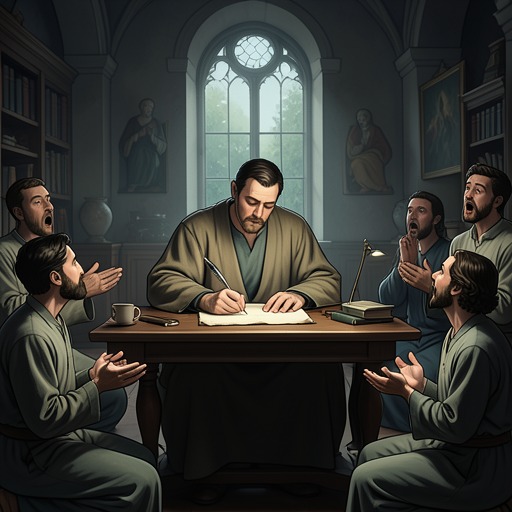
Midnight
Don't Leave God Alone: How to Get God's Attention, Remain in His Presence, and Even Change His Mind to Make a Difference in Your WorldMidnight functions in the book as more than a point on the clock. It is the hour when ordinary resources have failed, an unexpected need has arrived, and the petitioner must decide whether apparent resistance will end the pursuit. In Jesus Christ’s teaching, this darkness becomes the setting in which persistent prayer turns an urgent lack into provision and teaches believers not to abandon their relationship with God when an answer seems delayed.
The Midnight Request
Luke 11:5-6 presents a host whose friend arrives during the night, leaving him without food to set before his guest. He therefore goes to another friend and asks to borrow three loaves. The request is practical and immediate: hospitality has created an obligation, but the petitioner has nothing in the house with which to meet it. Midnight marks the collision between responsibility and helplessness, making the need too pressing to postpone until morning.
The three loaves are interpreted as representing the Father, the Son, and the Holy Spirit. They signify the divine source from which people receive what they need in order to feed others. The bread is described as available around the clock, and the fact that it is requested at midnight emphasizes that God is accessible at every hour, regardless of how late or inconvenient the circumstance may appear. The petitioner comes not because he possesses a sufficient supply, but because he knows where supply can be sought.
Apparent Refusal and Persistent Action
The neighbor initially answers that he should not be troubled: the door is shut, the children are asleep, and the hour is late. In this telling, the friend seems unwilling to rise even for another friend. The scene therefore introduces a deliberate gap between the petitioner’s urgent expectation and the response he receives. The need is real, yet the first answer sounds like postponement or rejection.
Jesus Christ uses that apparent refusal to define importunity as shameless, bold, determined, pressing, entreating persistence. The petitioner does not interpret the neighbor’s words as a final command to stop. He continues knocking until the neighbor rises and gives him what he needs. The decisive action is not a change in the petitioner’s need but his refusal to let the closed door determine the outcome.
The book connects this midnight resistance with other biblical scenes in which God appears distant or unresponsive. Jacob wrestled until he received blessing; Moses was told to leave God alone; the Israelites cried for four hundred years before deliverance came; Lazarus died while Jesus Christ did not immediately go to him; Bartimaeus cried out as Jesus Christ seemed to be leaving; and the woman with the issue of blood had to initiate contact while Jesus Christ moved in another direction. These examples are presented as patterns in which apparent distance provokes a stronger pursuit rather than proving divine indifference.
Ask, Seek, and Knock
The midnight story leads directly to Luke 11:9 and the threefold command to ask, seek, and knock. Asking means coming to God with the need; seeking means continuing to pursue Him and building a relationship with Him; knocking means pressing against the apparent barrier because the answer is understood to lie behind the door. Persistence therefore includes both petition and relationship. It is not merely repeated demand for an object, but continued movement toward God.
The broader teaching divides the practice of refusing to leave God alone into four areas. The first is personal fellowship with the Father, cultivated through planned time, worship, and attention to His character. The second is praying for others, illustrated by the man who seeks bread not only for himself but for a visiting friend. The third is persistence in prayer, expressed through continual asking, seeking, and knocking. The fourth is overcoming the enemy by binding the strongman, resisting temptation, and defending time with God against forces that would separate believers from Him.
Midnight consequently becomes an image of prayer under pressure. The petitioner is not encouraged to accept silence as proof that the request is wrong or that God has abandoned him. Instead, the delay tests whether he will continue to seek, and the eventual opening of the door turns the value of the scene from deprivation to provision. The movement is from apparent refusal to received supply, with persistence serving as the action that carries the petitioner across that reversal.
Midnight, Need, and Spiritual Provision
The book repeatedly treats blessing as something that must be approached with persistent prayer. Its image of a rain cloud of blessing describes prayer and sacrifice as spiritual moisture: when the cloud is filled, it releases rain. Midnight belongs to the same symbolic system. It is the dry or empty moment in which the petitioner discovers that ordinary resources are insufficient and must return to the divine source.
This pattern also explains why the text warns Christians not to run away from God after failure. People may feel ashamed that they have repeatedly failed in prayer, assume that God is angry, and avoid Him rather than face the failure again. The book contrasts that response with the need to run toward God, even after sin, just as Adam and Eve instead hid themselves after disobedience. Midnight prayer thus represents more than endurance during an unanswered request; it embodies the decision to maintain fellowship when embarrassment, fear, or disappointment encourages withdrawal.
The same principle appears in the book’s teaching on deliverance. Believers are told to refuse to leave God alone, use the Word of God and the name of Jesus Christ, believe that the Lord wants them free, stand their ground, refuse to give up on deliverance, and remain in church with an anointed pastor. The midnight petitioner models this stance: he approaches the source of help, continues despite resistance, and expects the closed door to yield.
The Lasting Meaning of the Hour
Midnight gives the teaching its strongest contrast. It is late, the household is settled, the door is closed, and the petitioner has no bread; yet the hour does not place God beyond reach. The book presents God as sometimes appearing to be too far away or unwilling to be bothered in order to provoke a response of faith. The point is not that God lacks compassion, but that persistent pursuit reveals whether believers will continue to press toward Him.
For this reason, midnight becomes a recurring emblem of holy persistence rather than abandonment. It is the hour of the friend who risks inconvenience, the hour at which provision is requested for another person, and the hour in which a refusal is treated as an invitation to continue. The book finally extends the principle into a call to daily fellowship and conversion, urging readers to begin a new life of knowing Jesus Christ and not leaving God alone. Midnight therefore gathers the book’s central promise into one scene: freedom, blessing, and answered prayer are found by those who keep knocking when the night seems to say that the door will remain shut.