Plague of frogs in Egypt
Don't Leave God Alone: How to Get God's Attention, Remain in His Presence, and Even Change His Mind to Make a Difference in Your WorldThe Plague of frogs in Egypt functions in the book as more than an ancient judgment on Pharaoh’s land. It becomes the governing image for postponed deliverance: bondage may be painful, but a person can still choose to keep it for one more day rather than surrender it immediately. The event therefore gives the book its sharpest picture of delayed obedience and the danger of treating suffering as preferable to change.
Biblical Setting and Participants
The episode is located in Egypt, where the Israelites were held in bondage and the Lord brought a plague of frogs upon Pharaoh and the land. Pharaoh summons Moses and Aaron and promises to let the Israelites go if the plague will end. Moses places the timing of relief before him, asking when he should pray for Pharaoh, his officials, and his people so that their houses may be rid of the frogs. The stated offer makes the crisis a moment of decision: Pharaoh can connect deliverance with an immediate act of repentance and release.
The Delayed Request
Pharaoh’s response is the event’s decisive reversal. Rather than asking for relief at once, he says “tomorrow.” The book emphasizes the contrast among immediate action, prompt prayer, and deferred change: Pharaoh does not request an end to the plague as soon as possible, but elects to spend another day with the frogs. His answer transforms an available deliverance into a chosen postponement, making the ruler’s will—not the absence of divine power—the immediate obstacle.
The Image of One More Day
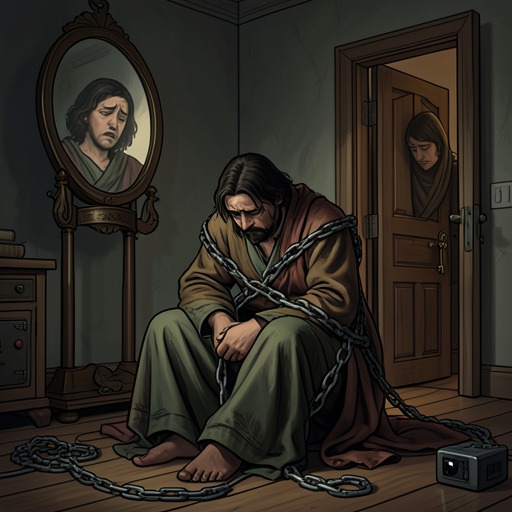
The book names this attitude “one more day with the frogs.” It describes people who possess power through God to cast demonic strongholds out of their own lives and the lives of others, yet prefer to remain bound because the familiar bondage seems easier than the demands of freedom. They dislike the pain and suffering produced by the stronghold, but still keep it a little longer rather than working toward deliverance.
This interpretation extends the Egyptian scene into a recurring spiritual pattern. The frogs represent bondage that has become tolerated rather than merely imposed. Their presence is not accepted because it is good; it is retained because the sufferer delays the decisive response. The episode thus exposes the contradiction between wanting the consequences of bondage removed and refusing to relinquish bondage itself.
Consequences and Warning
Pharaoh’s mistake carries consequences beyond a single unpleasant day. The book states that keeping his bondage a little longer resulted in the downfall of his kingdom, converting delay into eventual ruin. What is postponed today may therefore become the cause of tomorrow’s downfall. The proverb-like warning gives the plague a forward-reaching structure: the first consequence is continued affliction, but the greater consequence is that tolerated bondage can consume the power and stability of the one who protects it.
The same principle is applied to personal and communal crises elsewhere in the book. After the September 11 attacks, people in the United States turned to the Lord in unprecedented numbers, churches and prayer meetings filled, and a renewed hunger for God appeared; the author says this dependence lasted only briefly. The danger, in that account, is seeking God only when trouble comes while refusing regular commitment when prosperity returns. The plague’s “tomorrow” therefore describes not only an individual’s delayed deliverance but also a public habit of postponing prayer until disaster forces attention.
Narrative and Thematic Significance
The event belongs to the book’s larger argument that believers must not leave God alone in matters requiring intervention. The author contrasts failed or incomplete responses with determined prayer: in Florida, one year of prayer did not keep the predicted back-to-back hurricanes away, while the following year hundreds prayed fervently and the named storm did not hit; after record hurricane seasons, collective and individual prayer accompanied a year in which no major hurricane struck the United States. These later examples do not retell the Egyptian plague, but they repeat its central question of persistence versus resignation.
The same contrast appears in accounts of a near-fatal child’s highway accident, a newborn girl given an 11 percent chance of living, and a relative whose ruptured bowel caused septic shock, medical coma, and multiple organ failure. In each case, the book praises continued prayer rather than surrender to the first report or the first apparent failure. Against that pattern, Pharaoh’s answer stands as the negative model: he is willing to endure one more day of the very condition from which he has been offered release.
The Plague of frogs in Egypt consequently serves as a compact theology of urgency. Deliverance is not portrayed as unavailable; the obstacle is the decision to delay it. Its lasting significance lies in the warning that bondage can become familiar enough to defend, while postponement can turn a temporary affliction into a kingdom-destroying course.