Samson
Don't Leave God Alone: How to Get God's Attention, Remain in His Presence, and Even Change His Mind to Make a Difference in Your WorldSamson is the biblical embodiment of strength placed under the pressure of compromised desire. Chosen by God and endowed with supernatural power to defeat the enemy, he begins as a Nazirite consecrated from his mother's womb, but his story traces a destructive movement from purity and liberty into spiritual bondage. His significance lies not only in his fall, but also in his refusal to surrender after failure: even when he has lost his strength and sight, Samson turns again toward God, receives strength once more, and brings down the stronghold that has held him captive.
Identity and Consecration
Samson's calling is defined by the Nazirite vows of consecration, dedication, and purity before God. The strength given to him is more than physical ability in the book's interpretation; it represents the kind of spiritual strength believers are meant to possess in order to defeat the devil and remain delivered. His identity therefore contains a demanding tension: he carries extraordinary power while being required to live within an extraordinary discipline.
That tension becomes visible in the places he chooses to enter. Samson's movement toward Timnath is treated as the beginning of his progression toward a stronghold. Timnath is associated with a portion, allotment, or allotted portion, and functions as the place where conviction confronts a person who continues along a questionable course. Samson's problem is not described as a single sudden collapse. His choices create an outward appearance that he is compromising the commitment represented by his Nazirite status, and the apparent compromise becomes the first visible sign of a deeper inward departure.
Descent into Bondage
The road from conviction to captivity grows progressively worse. Samson begins breaking his vows and then lying about those violations, so that compromise becomes not merely an isolated action but a repeated pattern. His outward strength cannot compensate for the inward weakness created by his refusal to heed conviction. The narrative thus makes bondage cumulative: each ignored warning makes the next surrender easier.
His arrival at Gaza marks a further stage in that descent. Gaza is associated with strength, but Samson's presence there reveals strength transformed into a stronghold. Because he ignores his early convictions and compromises anyway, the power that once enabled him to defeat enemies no longer protects him from captivity. The contrast is central to his character: he can overpower external foes while failing to govern the desires that are eroding his own freedom.
The decisive compromise comes through Delilah, the woman in the Valley of Sorek whom Samson loved. The book stresses that he should never have placed himself alone with her, because the time a person permits to consume private attention discloses what has become that person's chief affection. Delilah's voice becomes more influential to Samson than the voice of conviction. Although he possesses outward strength, he lacks the inward strength to say no, and his affection for her becomes the channel through which his calling is surrendered.
Captivity, Blindness, and Public Humiliation
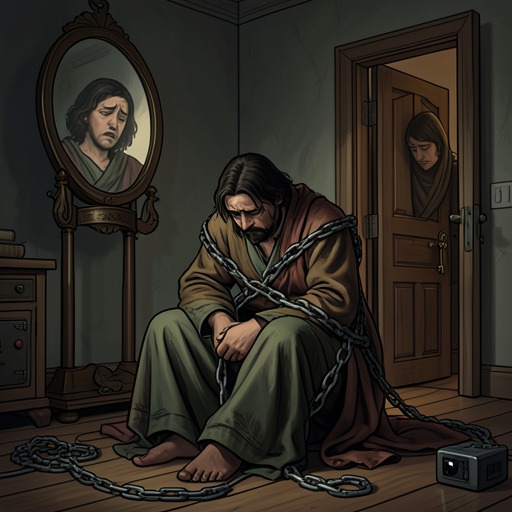
Samson's final compromise costs him both his anointing and his strength. The Philistines then bind him in chains and put out his eyes. Within the book's spiritual interpretation, the Philistines represent demonic spirits, while Samson's physical blindness becomes an image of the spiritual blindness produced by strongholds. Captivity is therefore shown as both external restraint and damaged perception: the bound person loses freedom and also loses the ability to see the condition clearly.
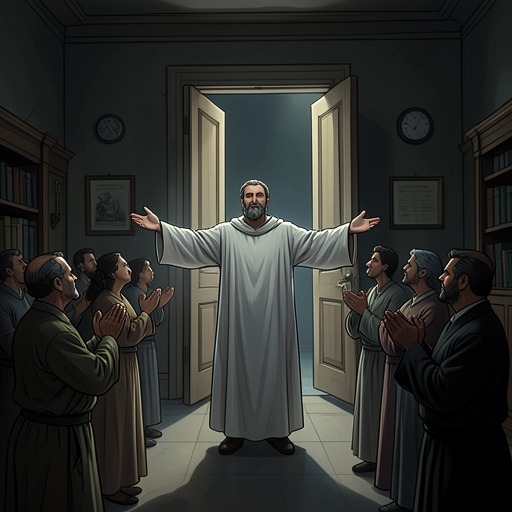
The Philistines bring Samson to a feast celebrating his captivity and place him before the gathered crowd so that they can laugh at his defeat. His humiliation is made into public entertainment. The scene represents the condition of people, including Christians, whom the devil keeps in bondage while mocking their defeat and blindness. Samson is not merely imprisoned; he is displayed as proof of the power of those who have conquered him.
Yet humiliation does not become the final meaning of his life. Even after he has failed God completely, Samson does not give up. He becomes determined to correct what he has done wrong, and the book presents God as honoring that repentance and determination. His hope does not arise from denying the severity of his failure. It arises from the possibility that failure can still be met by a changed direction.
The Pillars and the Final Act
While the Philistines are laughing, Samson asks a young boy to help him lean against the two pillars supporting the house. The request is practical, but the pillars also carry the book's central symbolism: they represent the strongholds and bondages standing in the middle of many people's lives. Samson's final action is therefore both a physical act against the Philistine structure and a spiritual picture of confronting the supports that keep captivity in place.
When Samson pushes against the pillars, supernatural strength returns. The house collapses, killing everyone inside, including Samson himself. His ending is consequently both victory and death, deliverance and self-sacrifice. The biblical conclusion that he killed more in his death than in his life gives the reversal its full force: the man whose calling had been wasted through compromise accomplishes his greatest defeat of the enemy at the end of his life.
The result does not erase the consequences of Samson's choices. His sight is not restored in the account presented here, his death remains part of the collapse, and the destruction is inseparable from the judgment that has overtaken the house. Nevertheless, the book interprets the ending as evidence that God honored Samson's repentance and his desire to make amends. The final scene transforms the pillars from instruments of public ridicule into the points at which bondage is torn down.
Relationships, Temptation, and Legacy
Samson's relationship with Delilah exposes the difference between external and internal power. His physical anointing enables extraordinary feats, but his susceptibility to Delilah shows that spiritual authority cannot be treated as immunity from temptation. The danger develops through proximity, affection, secrecy, and repeated refusal to act on conviction. Samson's downfall is therefore connected to the choices he makes with his time and attention long before the Philistines bind him.
The book sets Samson beside Joseph to clarify this moral contrast. Joseph responds to private temptation by recognizing the wrongness of sin against God and continually looking for a way of escape, whereas Samson entertains temptation and gives Delilah's voice priority. The comparison does not make Samson a figure without hope; it identifies the precise weakness that leads to his bondage. His tragedy is that he has the outward strength of a champion but not, until the end, the inward resolve required to resist.
Samson's legacy is consequently double. He warns that repeated compromise can carry a consecrated person from conviction to a stronghold, from strength to chains, and from sight to blindness. At the same time, he offers hope to those who have failed terribly. His refusal to leave God alone until he corrected his error becomes the pattern of his deliverance. In this reading, Samson's hands on the pillars signify the believer's determination to confront bondage rather than merely complain about its pain. His final act insists that repentance can still become active resistance, and that a ruined life may yet be used to bring down the structure that held it captive.