Separation from God
Don't Leave God Alone: How to Get God's Attention, Remain in His Presence, and Even Change His Mind to Make a Difference in Your WorldSeparation from God is the spiritual distance produced when people stop pursuing God or hide from His presence. In the book’s central argument, this distance is never merely passive: prayerlessness permits separation to re-form, while persistent prayer, worship, and repentance restore connection and make room for intervention, healing, deliverance, and changed circumstances.
Definition and Spiritual Stakes
Separation begins when the relationship between God and human beings is treated as something that can be left unattended. The book describes Satan’s purpose in stark terms: he wants people to leave God alone and wants God to leave people alone. Once God and humanity are separated, Satan is said to gain access on earth to kill, steal, and destroy. The separation therefore carries practical consequences, not only emotional or devotional ones; it becomes the condition in which danger, bondage, fear, and unanswered need appear to remain uncontested.
The book also distinguishes this condition from God’s deepest intention. Jesus Christ’s death on the cross is presented as having removed the barrier between God and humanity, opening access to the throne of grace for mercy and help in time of need. Yet prayerlessness can recreate the very distance that the cross made it possible to overcome. Separation is thus portrayed as a relational rupture maintained by human withdrawal rather than as an unavoidable divine decree.
Shame, Hiding, and the Refusal to Withdraw
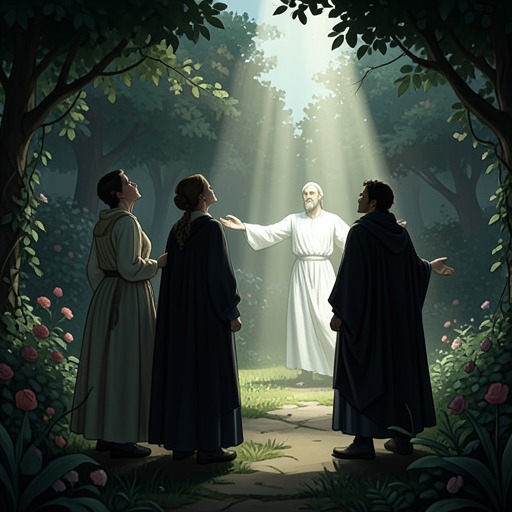
The pattern is illustrated through Adam and Eve after they ate from the forbidden tree. They had previously lived without shame and had enjoyed fellowship with God, but sin immediately produced embarrassment and concealment. When God came seeking the regular fellowship He desired with His friends, Adam and Eve hid from His presence and covered themselves. Their hiding becomes another form of leaving God alone: guilt does not merely expose wrongdoing but tempts people to withdraw from the relationship in which restoration could occur.
The book applies the same pattern to Christians who feel they have failed in prayer. Instead of returning to God, they may avoid prayer because they believe God is angry or because they are ashamed of repeated failure. The prescribed response is the opposite of concealment: they should run to God rather than to the fig leaf. Forgiveness remains available, and the failure of a previous prayer life is not treated as a reason to abandon prayer altogether.
Dryness, Delay, and the Work of Persistence
Personal experience gives the condition an emotional texture. During a period that seemed to combine a valley and a desert for roughly six months, prayer became boring and discouraging. The narrator felt as though God had gone on vacation, had forgotten him, and was no longer answering or making His presence felt. He withdrew to a camp for three days of fasting and prayer, yet even this retreat carried uncertainty: he brought a sack full of snacks in case the spiritual drought continued.
In the woods near the camp, he saw deer in a distant field and recalled the biblical image of a deer panting for water. He asked God to bring the deer close if God was hearing him; the deer instead ran in the opposite direction. The incident dramatizes the apparent silence that can intensify separation: even a small hoped-for sign seems to move away. Yet the book interprets dry periods as occasions to pray through rather than as proof that God has abandoned the person.
The same principle governs the account of Elijah’s prayer for rain. Elijah prayed seven times before the answer became visible. The first sign was only a cloud the size of a man’s hand, but continued prayer was said to enlarge that small beginning into an outpouring of rain. Persistence functions as the bridge across apparent distance: what looks like divine inattention becomes the setting in which determined prayer continues until blessing appears.
Prayer and Worship as Reconnection
The institutional expression of reconnection is the house of prayer. Jesus Christ called God’s house a house of prayer rather than defining it chiefly by evangelism, worship, teaching, deliverance, prophetic ministry, apostolic ministry, programs, or public appearance. Those activities may have a place, but prayer is presented as the defining identity. The book therefore criticizes churches that have removed regular prayer services because attendance was low, replacing them with meals or brief teaching. It suggests that the weakening of prayer commitment may be connected with the scarcity of miracles and with the reduced opportunity for the Holy Spirit to move powerfully.
Worship is another form of refusing separation. Shadrach, Meshach, and Abednego were thrown into the fiery furnace, where the flames were so intense that the soldiers who cast them in were killed. The three men fell prostrate in the fire, not before the king’s man-made statue but before the Son of God, and they remained unharmed: the fire did not touch them, their hair was not singed, their clothing was not scorched, and they did not smell of smoke. Their physical posture becomes a sign of spiritual allegiance under pressure.
Paul and Silas likewise worshiped at midnight, while imprisoned and bound in chains. Their prayers and songs were heard by the other prisoners, and an earthquake shook the prison foundations, opened every door, and loosened everyone’s chains. Worship is therefore described as a cry for freedom. It places God above personal failure and bondage, turning the darkest hour into an act of renewed connection rather than withdrawal.
Crisis, Healing, and Restored Contact
The book’s healing narratives present renewed contact with God as an active response to worsening circumstances. After a highway collision, a young man lay bleeding in a fetal position; his head was so swollen that his features were difficult to recognize, and his survival itself appeared miraculous. The narrator knelt beside him, placed hands on him, prayed in the spirit, prophesied that he would live, and declared that none of his bones would be broken. The young man began coughing and moaning, then repeated a request for Jesus Christ to enter his heart. He later visited the church as what the narrator regarded as living proof of a walking miracle.
A newborn girl in the narrator’s church faced an incurable disease attacking her liver and blood. Her platelet count was extremely low, her liver was failing, and doctors gave her only an 11 percent chance of living. The church prayed while the condition continued to worsen, but the narrator, the child’s parents, and others refused to accept the apparent silence as the conclusion. They continued speaking God’s promises of healing until the child recovered. The account connects persistence with a communal refusal to allow separation, even when medical prognosis and visible circumstances seemed to move in the opposite direction.
The medical crisis involving the narrator’s father-in-law is presented on an even more severe scale. After a fever first appeared during a July 4 family camping trip and returned in December, emergency surgery revealed diverticulitis and a ruptured bowel. Septic shock followed months of undetected infection. He was placed in a medical coma, swelled to three times his normal size, received nineteen intravenous bags of medicine, fluids, blood, and food, and required eight physicians, dialysis, and a ventilator as his liver, kidneys, and lungs began shutting down. The family prayed around the clock despite a reported survival chance of less than 50 percent. The narrative places medical treatment and sustained prayer together, while interpreting the crisis through the language of spiritual battle and hoped-for recovery.
The woman with the issue of blood represents the same movement from worsening isolation toward deliberate contact. She had suffered through many physicians, spent everything she had, and was “nothing bettered, but rather grew worse.” With other resources exhausted, she fixed her attention on touching Jesus Christ. Her condition makes separation visible as a downward spiral, while her reaching out becomes the decisive refusal to remain cut off from the source of healing. The narrator’s own account of a persistent, violent cough follows this pattern: after doctors offered changing medicines without identifying or curing the ailment, he and Brenda became determined, spoke God’s Word over the condition, and commanded the coughing to stop in Jesus’s name. The cough eventually ended after they pressed into God rather than accepting worsening circumstances as final.
Narrative Significance
Separation from God organizes the book’s recurring contrast between withdrawal and pursuit. It appears in the desert of unanswered prayer, the shame that drives Adam and Eve into hiding, the church that substitutes programs for prayer, the prisoner’s chains, the furnace’s pressure, and the medical crises in which death seems near. Against each form of distance, the book places a bodily or communal practice: fasting, praying, kneeling, laying on hands, prophesying, worshiping, speaking Scripture, and continuing after the first attempt appears fruitless.
The concept also explains why the book repeatedly insists that God does not truly want to be alone. Even when divine silence or apparent delay feels like rejection, the narrative interprets it as a summons to determined faith. Moses’s intercession is the governing biblical pattern: when God declared that Moses should leave Him alone, Moses pleaded for Israel, and God changed His mind about the harm He had said He would do to His people. Separation is therefore not the desired ending of the relationship but the crisis that persistent prayer is meant to interrupt. Its opposite is not vague religious optimism but sustained reconnection through prayer, worship, repentance, and an active refusal to abandon the presence of God.