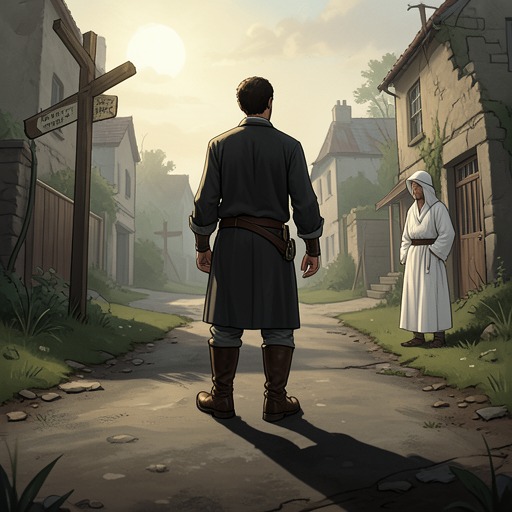
The four lepers' advance into the Syrian camp
Don't Leave God Alone: How to Get God's Attention, Remain in His Presence, and Even Change His Mind to Make a Difference in Your WorldThe four lepers' advance into the Syrian camp is presented as a turning point born from refusal: four men facing famine and social exclusion decide that remaining where they are is no safer than moving forward. Their advance illustrates the book's central claim that change often begins when people stop accepting paralysis, act despite limited options, and refuse to leave God alone about an impossible circumstance.
Famine, Exclusion, and the Logic of Despair
A severe famine had overtaken the land, while the prophet Elisha had announced that the famine would end by the following day. Outside the city gate sat four men with leprosy, positioned at the edge of both the starving city and the decision that would determine their future. Their condition made them vulnerable, but the famine meant that no available position offered security. The crisis reduced their alternatives to a stark calculation: entering the city appeared likely to end in death, while staying outside guaranteed death through hunger.
The men’s situation is therefore not portrayed as a choice between safety and danger. It is a choice between passive death and purposeful risk. Their reasoning exposes the false comfort of immobility: sitting still may feel less frightening than advancing, but in a crisis it can simply conceal the certainty of decline. The scene’s force comes from the way external pressure and internal decision meet. Famine creates the emergency, yet the decisive change begins with the men’s attitude toward it.
“Why Sit We Here Until We Die?”
The four lepers articulated their crisis by asking, “Why sit we here until we die?” Their question functions as more than a complaint. It becomes a verbal break with resignation, naming the consequence of inaction and opening the possibility of movement. They then considered the available routes. If they entered the city, famine might kill them; if they remained at the gate, the absence of food would also kill them. They chose to go to the Syrian camp, where the Syrians might kill them, but might also help them.
That decision makes the advance an underdog action shaped by necessity rather than confidence. The men did not possess a guarantee of welcome, military strength, or immediate rescue. They acted because the existing arrangement had already become untenable. Their movement toward the camp transforms uncertainty into an opening: even the possibility of rejection is preferable to surrendering without action. In the book’s interpretation, this is the moment when a person decides that tomorrow need not reproduce today—“I will be different, I will be changed.”
Movement as the Birthplace of Change
The lepers’ advance is linked to the transformation of attitude. The book contrasts their decision with the defeated thought that there is no use trying. They could have remained outside the city and treated their circumstances as a final verdict, but instead they made an effort to alter their position. Their bodies moved before their circumstances visibly improved; action preceded the evidence that action would succeed.
This sequence is important to the book’s wider teaching about spiritual persistence. Movement toward God and His Word is presented as the route by which people experience the change they desire. The four men did not wait for ideal conditions. They moved while famine still existed, while their disease still marked them as outsiders, and while the outcome of entering the Syrian camp remained unknown. Their advance thus becomes a practical image of determination: faith is not reduced to passive expectation but is expressed through a decision to leave the same place.
The Pattern of Risk and Deliverance
The story is set beside other accounts in which prayer and determined speech confront danger. After the September 11 attacks, churches and prayer meetings filled as people sought God amid national uncertainty, but the book warns that turning to God only when trouble arrives is risky. Prayer is meant to arise from sustained fellowship rather than temporary panic. The lepers’ action similarly resists waiting until circumstances become comfortable; their crisis drives them to a decision, but the lesson is meant to produce an enduring practice of seeking God.
The same pattern appears in the book’s accounts of storms. In 2004, a prophecy concerning two hurricanes in Florida was accompanied by prayer, yet the hurricanes still came, leading to the conclusion that the prayers needed to rise to a higher level. The following year, hundreds prayed fervently over a named storm, and it did not strike the area. The book also connects collective prayer with the absence of major hurricanes hitting the United States in 2006. These examples do not erase failure or uncertainty; rather, they emphasize persistence after an apparently unsuccessful first attempt.
A personal tornado account supplies a more intimate parallel. During one storm, a tornado was reported to be less than a mile from the house; after a branch struck the building, the household ran to the basement, and the tornado passed by. On another occasion, the household spoke to a forming storm before taking cover, and the tornado rose back into the sky as the storm dissipated. The contrast between the two experiences becomes part of the lesson: one apparent failure did not justify abandoning the practice. As with the lepers, determination means moving again despite the memory of what happened before.
Consequences and Narrative Significance
The lepers’ advance is treated as the threshold between a dying pattern and an unforeseen opening. Their immediate discovery of an abandoned Syrian camp is named elsewhere in the book as an example of four marginalized people advancing into an enemy camp, but the supplied discussion concentrates on the decision that makes discovery possible: they refuse to remain seated outside the city. Their action carries them toward the place where provision can be found, and their willingness to risk death becomes the instrument through which a wider deliverance is revealed.
The episode also echoes the book’s account of a family medical crisis. A relative’s undiagnosed illness developed into a ruptured bowel, septic shock, medical coma, a fever of 105 degrees, multiple organ and renal failure, dialysis, and ventilation. The family entered what it understood as a spiritual battle and prayed around the clock after physicians gave him less than a 50 percent chance of survival. In that setting, persistence did not mean denying the seriousness of the facts; it meant refusing to let the facts end the story. The four lepers embody the same refusal in physical form: when every stationary option points toward death, they rise and advance.
As a narrative action, the advance therefore joins external crisis to voluntary choice, reversal to recognition, and danger to possible provision. Its enduring significance lies not in romanticizing risk or treating every failed attempt as proof of inadequate faith, but in the book’s insistence that resignation is itself a decision. The four lepers become witnesses to a disciplined kind of hope: change begins when people acknowledge that they cannot remain where they are, move toward the possibility of deliverance, and continue seeking God rather than waiting for tragedy to force them to act.