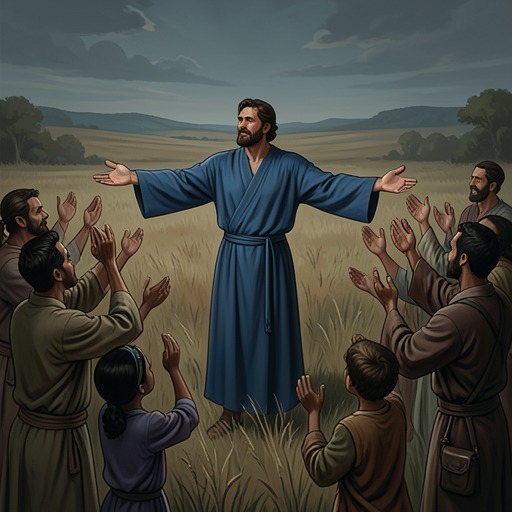
Where Is the Lord God of Elijah
Don't Leave God Alone: How to Get God's Attention, Remain in His Presence, and Even Change His Mind to Make a Difference in Your World“Where Is the Lord God of Elijah?” is the decisive cry of Elisha after the departure of his spiritual father, Elijah. Spoken over Elijah’s fallen mantle and the divided Jordan, it expresses grief, expectation, and a demand for visible continuity: Elisha must discover whether the power associated with his mentor will rest upon him. The narrative answers through action, as the river divides and Elisha crosses, showing that his persistent pursuit has led not merely to admiration of Elijah but to participation in the same divine power.
The Cry at the Jordan
Elijah’s ascension forms the immediate setting for the expression. As Elijah and Elisha walked and talked, a chariot and horses of fire came between them, and Elijah went up in a whirlwind to Heaven. Elisha watched until he could no longer see him, then tore his own robe in grief. The separation was both personal and vocational: the mentor who had shaped Elisha’s prophetic life was gone, and the disciple had to face the responsibility of continuing without him.
What remained was Elijah’s cloak, or mantle, the visible symbol of the anointing associated with his ministry. Elisha picked it up, returned to the bank of the Jordan, and struck the river with it. His cry, “Where is the LORD God of Elijah?” therefore arises at the threshold between loss and succession. It is not a detached inquiry about God’s location; it is Elisha’s urgent appeal for confirmation that the God who had worked through Elijah had not departed with Elijah.
Persistence Before the Succession
The expression is prepared by Elisha’s refusal to leave Elijah. When Elijah told him to remain at Gilgal while Elijah went to Bethel, Elisha answered, “As the LORD liveth, and as thy soul liveth, I will not leave thee.” The same pattern continued as they traveled through Bethel, Jericho, and toward the Jordan. Each place represented a test of Elisha’s heart and commitment, and each time he continued with Elijah rather than accept separation.
This persistence is presented as the condition through which Elisha received the power resting on his mentor. He did not leave Elijah alone until Elijah had gone, and he did not abandon the pursuit when Elijah attempted to discourage him. His steadfastness made him ready to step into what the book describes as “big shoes”: a powerful ministry inherited through spiritual sonship, commitment, and continued pursuit.
The four locations give the journey a staged structure. Gilgal, Bethel, Jericho, and Jordan are not merely points on a route; they function as successive tests of whether Elisha will continue until the manifestation of power appears. The path turns physical travel into a model of spiritual endurance, with the Jordan serving as the final boundary before the mantle and its authority are tested.
Mantle, Power, and Response
Elisha’s cry carries the emotional force of a son reaching toward a departing father. He had loved Elijah and desired the same anointing that had rested upon him. When Elijah was taken away, Elisha cried, “My father, my father!” before turning to the mantle. The garment thus becomes more than clothing: it is the remaining sign of Elijah’s calling and the instrument through which Elisha seeks evidence of God’s continued presence.
The narrative’s reversal comes when Elisha strikes the water and the Jordan divides. Before that moment, the mantle appears to be all that remains of Elijah. After it, the mantle becomes the means by which Elisha enters his own prophetic responsibility. The answer to the question is not supplied as an abstract explanation. It is revealed through the river’s response: the God of Elijah is present with Elisha, and the power once seen in Elijah’s ministry has been transferred to the pursuing disciple.
The book interprets this outcome as a consequence of Elisha’s refusal to leave his father alone. Elisha wanted God to rest upon him as God had rested upon Elijah, and his persistence positioned him to receive that power. The expression therefore joins longing to action. Elisha does not simply mourn the loss of his mentor or wish for a familiar religious experience; he takes up the mantle, speaks his challenge, and tests the promise at the Jordan.
A Pattern for Persistent Prayer
Applied beyond Elisha’s story, the expression becomes a model for refusing spiritual passivity. The book repeatedly teaches that God is within reach when a person presses toward Him, even when circumstances make Him seem distant. Jacob’s persistence at Peniel is used in the same argument: Jacob held on until he received the blessing, demonstrating that apparent delay does not prove divine absence.
The same logic appears in the teaching on importunity. Luke 11 is presented as a summons to ask, seek, and knock continually rather than stop when an answer seems delayed. Persistence is defined as shameless, bold, determined, pressing, entreating, and continual requesting. In that framework, “Where Is the Lord God of Elijah?” is a prayer of expectation: it refuses to accept silence or loss as the final word and presses for a response that can be recognized in changed circumstances.
The expression also belongs to a larger vocabulary of faith-filled speech. David confronts Goliath with a holy attitude of victory, while the angel declares before Zerubbabel, “Who art thou, O great mountain? before Zerubbabel thou shalt become a plain.” These declarations treat speech as an act that confronts obstacles rather than merely describes them. Elisha’s question works similarly. It names the apparent absence of power while simultaneously calling for that power to appear.
From Biblical Scene to Personal Call
The book extends the Jordan scene into a practical exhortation. Readers are urged not to abandon prayer after failure, embarrassment, or the sense that God is angry. Adam and Eve are presented as an opposing pattern: after sinning, they hid from God and covered themselves instead of returning to fellowship. Persistent pursuit means running toward God even after failure rather than leaving Him alone through shame and avoidance.
The same principle is connected with freedom and deliverance. Readers are told to use the Word of God and the name of Jesus, believe that the Lord wants them free, stand their ground, refuse to give up on deliverance, and remain in church with an anointed pastor who can help. The promised result is that enemies turn back and strongholds are broken. Elisha’s cry thus becomes part of a wider imperative to keep seeking divine power until bondage gives way to freedom.
The book finally turns the expression into an invitation to personal devotion. It urges readers to spend quality time with God every day, seek an intimate relationship with Jesus Christ, and adopt a life of continued pursuit. In the closing prayer, the petitioner commits to pursuing God like the figures described in the book and chooses not to leave Him alone until blessing comes. The phrase therefore ends not as a historical question but as a repeatable posture: grief may begin the cry, but persistence carries it toward encounter, power, and renewed life.