
The Drug Supply’s Evolution
DopesickThis thread traces how changes in opioid supply repeatedly altered the routes, costs, and risks facing dependent users.
increasing Bearing strength in each event
 decreasing
Bearing strength in each eventdecreasingPrescription Access

Prescription Access
A broad medical channel
OxyContin and other prescription opioids became available to patients with a range of pain conditions. Sales promotion and changing standards made opioids easier to obtain in places far from traditional urban drug markets.
Diversion follows supply
Unused pills, fraudulent prescriptions, and excess prescribing moved medications into illicit circulation. A person could become dependent through medical treatment and then rely on street supply once prescriptions ended.
The expansion of supply preceded the broad epidemic. This sequence challenges explanations that focus only on preexisting demand or individual misconduct.
Black-Market Pills
Black-Market Pills
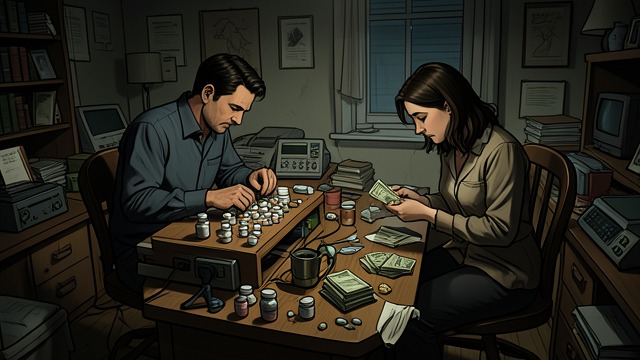
Pills gain exchange value
High-dose OxyContin tablets could be divided, sold, or used to avoid withdrawal. In communities with economic hardship, some people treated prescribed pills as income as well as medicine.
A costly dependence
As tolerance grew, users needed more medication to feel normal or avoid becoming sick. Rising cost and difficulty obtaining pills made illicit alternatives increasingly attractive.
The pill economy joined medical supply to household finances and criminal markets. It made addiction a daily problem of access, money, and survival.
Abuse Deterrence and Substitution
Abuse Deterrence and Substitution
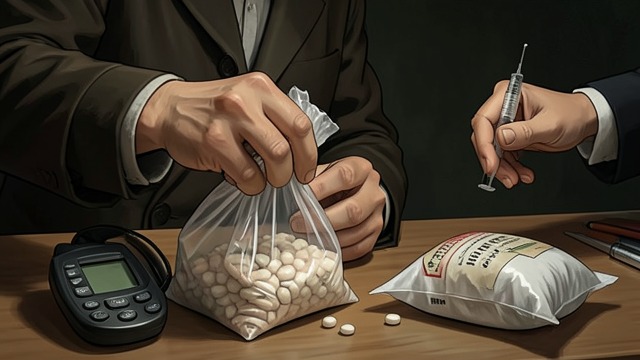
A barrier to crushing
The reformulated pill became harder to manipulate for a rapid high. Some users could no longer use it in the same way or afford it on the black market.
Heroin fills the gap
People with opioid dependence still needed a supply. Heroin, often cheaper and more potent, became an alternative for users moving from pills, while commuter-dealers brought it back from urban markets.
A product change altered the route without treating the dependence. The shift illustrates how interventions aimed at one formulation can redirect a market rather than end it.
Bulk Heroin and Local Markets

Bulk Heroin and Local Markets
A new scale of supply
Ronnie Jones brought large quantities of heroin to Woodstock, changing a market previously supplied by users traveling to cities. Subdealers made the product accessible to many people who had been struggling to obtain pills.
Exponential recruitment
Dependent users sold portions of their supply and recruited new customers. This structure increased the customer base while tying lower-level sellers to their own need to avoid withdrawal.
The network’s growth depended on both price and dependence. Supply made heroin easier to buy; addiction made the market unusually resilient after arrests.
Fentanyl’s Uncertain Potency

Fentanyl’s Uncertain Potency
The dose becomes unpredictable
Fentanyl and related compounds appeared in heroin and counterfeit pills, sometimes without users’ knowledge. Even experienced users could not reliably determine potency by appearance.
Overdose risk rises
Emergency responders encountered surges in fatal and nonfatal overdoses and needed multiple doses of naloxone in some cases. The market’s newest supply could produce a sudden local cluster of deaths.
The changing supply turned each purchase into a more dangerous gamble. The crisis had moved from dependence alone to a drug environment in which the next dose could be lethal.
1996–2001, as prescription opioids spread into ordinary practice
Early 2000s, as illicit pill markets grew in rural communities
2010–2014, after OxyContin’s reformulation
2012–2013, as large shipments reached Woodstock
2015–2017, as fentanyl entered heroin and counterfeit pills
