
Sarah’s Fall and the Life Afterward
Down Cemetery RoadThis subplot follows Sarah’s student-era drug use and rooftop fall as a buried trauma that returns under police pressure and shapes the imagery through which she understands danger and survival.
increasing Bearing strength in each event
 decreasing
Bearing strength in each eventdecreasingThe Other Sarah

An Imagined Rival
The Idealized Self
As a schoolgirl, Sarah imagines another version of herself: effortlessly successful, popular, attractive, and untroubled. The figure becomes both companion and opponent, embodying standards Sarah feels unable to meet in ordinary life.
When Sarah tells someone about the imagined girl, the story spreads through school as ridicule. The private device that once helped her manage insecurity becomes a public mark of strangeness, deepening the distance between her actual self and the person she thinks she should be.
A Habit of Comparison
The Other Sarah remains a measure against which the real Sarah is judged. She seems able to accomplish everything without effort, while Sarah experiences school and adolescence as a sequence of uncertain performances.
The imagined rival later reappears during moments when Sarah’s identity is under pressure. Her significance is not that she is a separate person, but that Sarah has learned to describe her own choices as failures beside an impossible ideal.
A First Step Outside the Rules
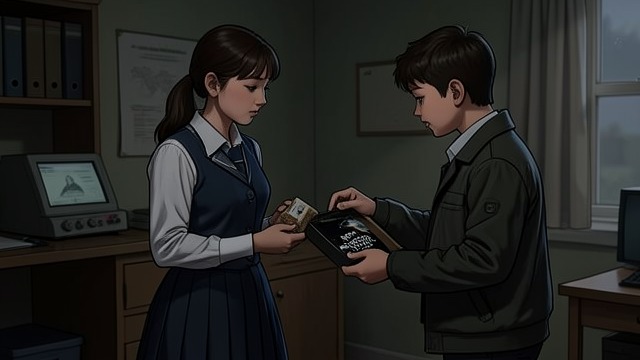
The Appeal of Being Someone Else
A Deliberate Transgression
At a sixth-form party, Sarah tries a roll-up containing a drug and experiences the decision as a break from the obedient, capable identity represented by the Other Sarah. For a few minutes, the act feels less like danger than liberation from a role she has been carrying.
She flirts with a boy and follows him to a bathroom, where the sexual encounter proves disappointing. The next day she is ill and fears she may be pregnant, but the first excitement of having crossed a boundary remains vivid in memory.
Temporary Freedom
The episode teaches Sarah that intoxication can feel like putting down a heavy burden, even when it offers no lasting solution. It marks the beginning of choices that promise spontaneity while leaving her more exposed to accident and harm.
Her later memory distinguishes the pleasure of escape from the consequences of relying on it. That distinction becomes important when police and others use the fact of her past drug use to explain events she did not cause.
The Rooftop and the Fall

A Night That Changes Her Life
The Trip Escalates
At a basement party in Birmingham, Sarah takes what she believes is LSD and gradually experiences the house and its stairs as a transformed landscape. Ordinary rooms become impossible terrain, and she climbs toward the roof while the people around her fail to persuade her to stop.
At the top, the world appears to be contained in a playpen, and the Other Sarah seems to take control of it. Sarah experiences the choice between them as cosmic and urgent, then rushes toward a vision of flight rather than safety.
The Fall’s Aftermath
Sarah falls from the roof and sustains multiple broken bones. She survives despite the severity of the accident, but the memory of city lights cartwheeling as she descends becomes a recurring image in later crises.
The event ends her belief that drugs can make her invulnerable. It also creates a physical and psychological history that she carries into adulthood, including a scar and a recurring sense of falling without reaching the ground.
A Hospital Interlude
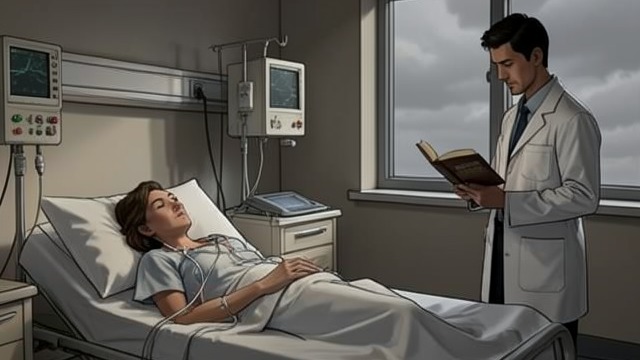
Recovery in Limbo
Survival Without Control
Sarah spends weeks in hospital, where her body is treated and monitored after the fall. Visitors come at first, many of them guilt-ridden, then disappear as the academic term ends and other demands take over.
Her parents visit and weep, leaving her unsure whether they are responding to her injuries or to the choices that preceded them. Recovery is not presented as a clean return to normal life; Sarah is suspended between the accident and whatever will follow discharge.
The First Meeting with Mark
Mark visits while Sarah is recovering, bringing books and working beside her bed. At first she finds him irritating, but he keeps returning, and their acquaintance begins in the uneventful persistence of shared space rather than a dramatic declaration.
The hospital period connects Sarah’s survival to the beginning of her marriage. It also establishes how readily other people can define what recovery should look like, a pattern that later becomes more troubling when medication is again used to manage her distress.
The Past Used Against Her
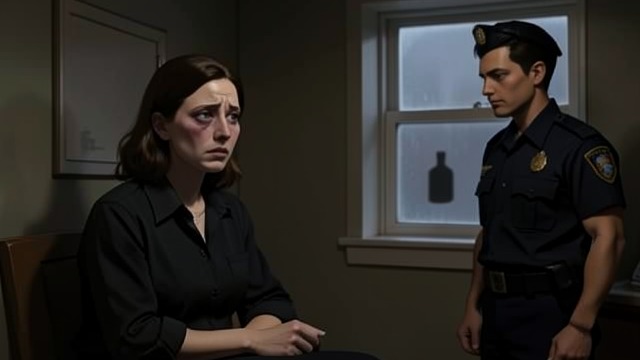
Old Evidence, New Suspicion
A History Recast
After cocaine is found in her bathroom, Inspector Ruskin brings Sarah’s student drug use into the investigation. Her rooftop fall and earlier experiences with drugs become a basis for treating her as a likely user rather than a witness whose account deserves scrutiny.
Sarah is already exhausted by Joe’s death and the police interview. Memories of the past return in fragments, and the accusation that she has returned to drugs makes her feel that her history is being used to swallow her present identity.
Survival as an Unfinished Task
Sarah does not accept the police explanation, even while she is too shaken to challenge it effectively. Her earlier survival of a fall and her present vulnerability are held together by the same recurring imagery of leaving the world and being forced back into it.
Later, when threats become immediate, the old accident no longer functions only as a source of shame. Its memory becomes part of Sarah’s understanding that surviving an event does not make her invulnerable, but it can leave her capable of continuing through the next one.
Sarah’s school years
At a sixth-form party
During Sarah’s student years in Birmingham
The weeks after Sarah’s fall
During the police investigation into Joe’s death
