
Michael Downey’s Return from the Dead
Down Cemetery RoadMichael Downey’s trajectory follows a presumed-dead soldier from captivity and concealed survival into a return for Thomas Singleton’s family, ending in rescue, exposure, and an unresolved struggle against illness.
increasing Bearing strength in each event
 decreasing
Bearing strength in each eventdecreasingA Survivor in Hiding
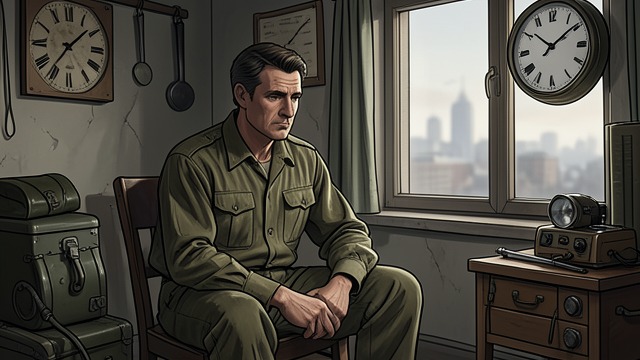
A Survivor in Hiding
Death as official cover
Michael Downey is reported dead in a military helicopter crash near Cyprus, though he has never been to Cyprus. The false report conceals his survival after a secret desert operation and makes him, in public records, a man who no longer exists.
The lie is not a personal choice so much as a decision imposed by the institution that has taken custody of him. Downey’s identity becomes one more thing controlled by the people who hold him.
Living outside ordinary time
After being treated as an experimental subject, Downey is moved with the other surviving soldiers to the Farm, where confinement continues under the fiction that they are being cared for. Days blur into repeated promises that they will soon be sent home.
His presumed death gives the state a way to keep him out of public view, but it does not erase the injuries or memories that remain. The hidden years leave him alive in body and cut off from any ordinary claim to a life.
The Desert’s Survivors
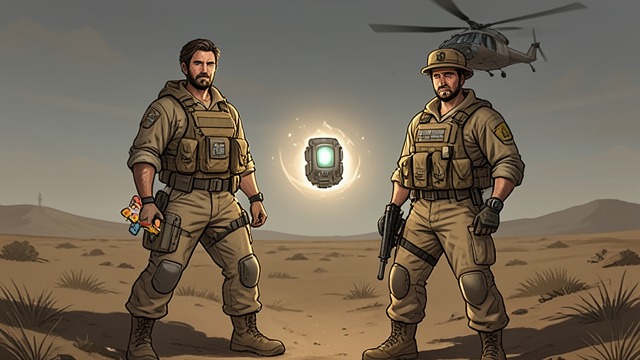
The Desert’s Survivors
The test disguised as an operation
In the desert, Downey and Thomas Singleton are ordered to capture Iraqi child soldiers and bring them back alive. The children are frightened conscripts, not the threatening enemy the mission’s framing implies, and the men discover that they have been sent into a test rather than a conventional engagement.
A helicopter attacks their truck, then releases a device that exposes them to a devastating agent. Downey remembers burning pain and the children melting in front of him, an image that becomes the defining wound of his memory.
Knowledge with a price
The operation’s protective coating does not keep the soldiers safe; it turns them into subjects in a covert experiment. Once they understand this, they know the danger is not limited to the battlefield: the people who ordered the test also control whether its survivors can speak.
Downey’s later silence and violence grow out of this history, though the novel does not present that history as absolution. His survival carries both the evidence of state crime and the burden of what he himself has done.
Escape with Tommy
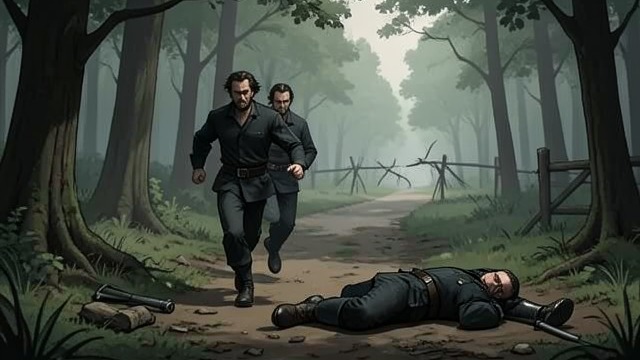
Escape with Tommy
The end of waiting
At the Farm, Downey and Thomas Singleton learn that the outside world believes them dead. The guards’ assurances that they will eventually go home lose their force once the men understand that no official return is planned.
Downey and Singleton escape together after killing guards and leaving the other prisoners behind. Downey describes the choice as a continuation of a war in which nobody has told them whose side they are on; their freedom begins with violence rather than release.
A life built around flight
The two men remain fugitives from the institution that concealed them. Downey’s identity is maintained through borrowed documents, and he lives without an ordinary home or public history.
His bond with Singleton persists through years of danger, but it also binds him to the family Singleton left behind. When the story reaches the present, Downey is not simply returning from hiding: he is returning to a past that had never been safely concluded.
The Return for Dinah
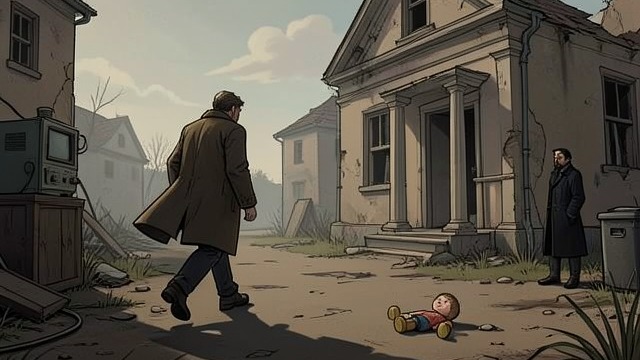
The Return for Dinah
Reappearing at the edge of the story
Downey returns to the area around the Singleton house after Thomas Singleton is again declared dead, this time in an explosion that kills Maddie Singleton. Sarah Trafford notices him at the ruined house and later encounters him at the hospital, where he asks about Dinah.
He has come looking for Singleton’s daughter, but refuses to explain himself to Sarah. His secrecy makes him appear threatening even as it signals the danger surrounding the child and the men who have hidden her.
Choosing pursuit over disappearance
Downey recognizes Axel’s presence around the wreckage and understands that the bombing is part of a trap meant to draw him out. He nevertheless continues toward Dinah, putting the child’s location ahead of his own safety.
His return also settles an old debt with Axel: when Axel tries to kill Sarah, Downey shoots him. The act saves Sarah, but it confirms that Downey’s response to danger is still shaped by the soldier who learned to survive through force.
A Rescue Without Resolution
A Rescue Without Resolution
Taking Dinah from the trap
Downey reaches the island where Dinah is being held and takes her from the Farm. The guards and other occupants are left dead or apparently dead, and the operation becomes another scene of violence created by a state that had intended the child to serve as bait.
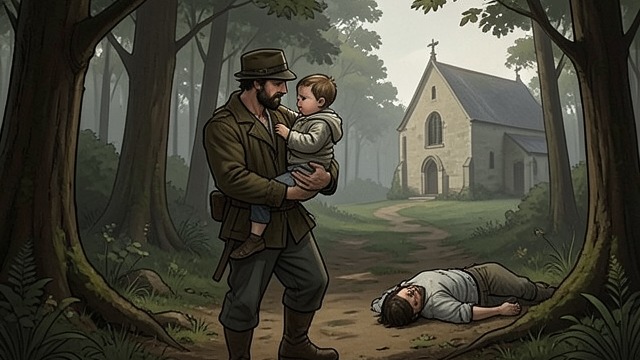
Downey carries Dinah to the chapel in the woods, where Sarah and Zoë Boehm find him. His claim that he did not kill anyone this time does not undo the bodies behind him; it reveals how urgently he needs the rescue to mean something different.
The illness still waiting
The rescue reunites Downey with Dinah, whom he believes may be his daughter, though the evidence ultimately identifies her as Thomas Singleton’s child. His attachment is real even where biological certainty is absent, and he holds her as someone entrusted to him rather than as a claim he can prove.
Downey is also gravely ill from the desert exposure, and Howard tells Sarah that the illness is fatal. The novel gives him a moment of reunion, not a cure or a settled future: survival has brought him back to Dinah, but has not freed him from the damage that followed him out of the desert.
Four years before the main action
During the North African desert operation, before the secret detention
After the soldiers are secretly detained at the Farm
After Thomas Singleton’s reported death and the bombing of his house
From the Farm massacre to the chapel reunion
