“Accidents happen” doctrine
Down Cemetery RoadThe “Accidents happen” doctrine is the covert logic by which the Department makes political violence appear accidental and presents concealment as necessary to democracy. Its central contradiction is laid bare in Amos Crane’s history: a system that claims to protect democratic government preserves it by withholding facts, destroying those who possess them, and disguising deliberate acts as chance.
The doctrine and its lesson
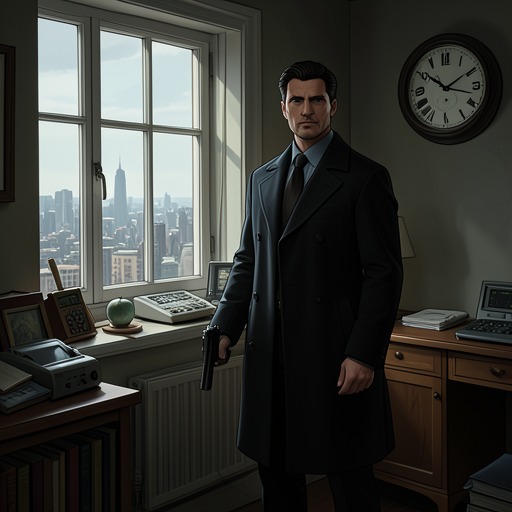
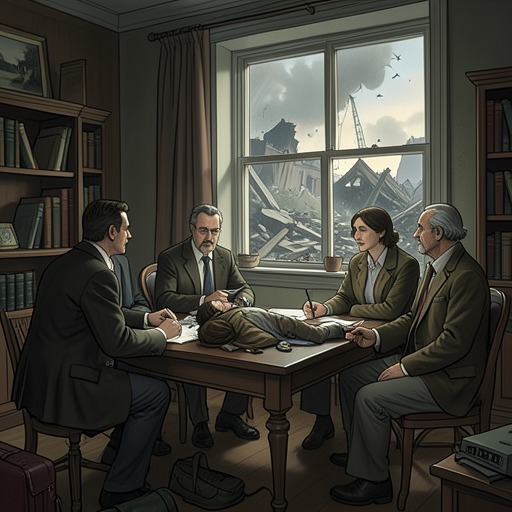
The novel introduces the doctrine through a recollection on a train: Amos Crane remembers being recruited to The Department at twenty-three and listening to an experienced operative lecture on “The Dark Heart That Beats In The Chest Of Government.” The lesson was that democracy’s hidden capacity for violence must remain hidden, rather than being used openly to produce terror and obedience. Political killings, the lecturer insisted, belonged to fascists; in a democracy, deaths could be made to look like accidents.
Crane’s secret was that he did not need to be taught this. He performed the expected role anyway, sitting, nodding, and appearing to absorb the lesson. That gap between outward assent and prior understanding establishes the doctrine not as a reluctant discovery but as a language of institutional initiation: the recruit learns how power explains its own methods, even when he already understands them.
Concealment as a method of government
The examples Crane recalls show how the doctrine treats public knowledge as the danger to be managed. A minor royal might be made to fall while getting out of a shower, the lecturer explains, rather than allowing the entire royal family to be dragged into scandal. The resulting obituary turns the dead figure into a national object of mourning; the country forgets, and the boat remains unrocked. The point is not simply to remove a problem but to shape what the public can know and how it will remember the death.
The same principle extends beyond public figures. A senior civil servant who accidentally opens a file revealing undisclosed weapons at American air bases in Britain may face an “accident” on an icy road, even if his loyalty is unquestioned. In this logic, innocence does not protect a person who possesses dangerous information. The preservation of secrecy, not proof of disloyalty or intent to expose it, is enough to make that person expendable. Crane assures his instructor that this presents no problem, confirming how readily he accepts the doctrine’s premise.
Crane’s later work makes the method more concrete. When a pimp obtains compromising photographs of the Foreign Secretary, Crane applies the ABC principle and kills the pimp and eight other hustlers within two days. The deaths generate editorials about a gangland war, which muffle serious investigation. Crane had initially suggested killing the minister instead, since that would eliminate the possibility of blackmail; his superior pretends to take the suggestion as a joke, and Crane pretends to have meant it as one. The exchange shows how euphemism and performance protect the operation even among its participants.
The doctrine in the present crisis
The conversations between C and Howard reveal that this inherited logic still governs decisions in the present. C rebukes Howard for overlooking the possibility of war and makes the stakes explicit: the country is prepared to take up arms to stop Michael Downey from speaking publicly. Howard is warned not even to mention that possibility if he expects to keep his career. The threat to suppress disclosure is therefore not confined to a lone operative or a conveniently staged death; it reaches the scale of national policy.
Later, C explains why Michael Downey’s testimony is dangerous. Downey is officially dead, while the evidence of his survival could expose the killing of Iraqi boy soldiers and the use of live targets for a chemical weapon. C frames the possible consequences in terms of the country’s allies, its claim to defend democracy, and the prospect of sanctions or missile attacks. The invocation of national peril turns the doctrine’s usual argument into an urgent political bargain: bury the truth, or risk the state’s standing and security. Howard counters that Downey would already have spoken if he intended to, but C notes that Downey previously had only Thomas Singleton beside him under combat conditions; the circumstances are now different.
Threats, consequences, and significance
The doctrine’s language survives as a direct instrument of intimidation. When Sarah challenges C over the fate of the boy soldiers, he argues that the public is happier not knowing what happens at democracy’s margins and defines disclosure and concealment as his job. He insists that the child is safe, but this assurance does not undo the fact that she was used. In the same exchange, he warns that if Sarah uses her gun against him, The Department will retaliate through a chain of staged “major accidents” affecting Michael Downey, the child, Sarah’s husband, Wigwam, and everyone else she may have contacted.
That warning brings the doctrine’s governing contradiction into the open. C describes its violence as the work of clearing up after events that cannot always be prevented, yet threatens to create new violence if anyone refuses the arrangement. Accidents are not merely a cover story for isolated crimes; they are the threatened consequence of exposing the system itself. The doctrine thus connects the novel’s secret histories to its immediate danger: a government that claims to preserve democracy by keeping its dark operations unseen can make secrecy both the justification for violence and the means by which that violence continues.